Is purple shamrock (purple-leaf oxalis) toxic? Non-toxic, with growing tips
The purple-leaf oxalis plant is compact, grows fast, and has a long flowering period; it is especially spectacular when in bloom, which is why it is so loved by flower enthusiasts, and many people keep it at home as an ornamental plant. So could it harm people's health? Is purple-leaf oxalis toxic? Is oxalis easy to grow? How do you grow oxalis? Below, the editor will give you the answers.
Is purple-leaf oxalis toxic?
1. Whole plant / non-toxic
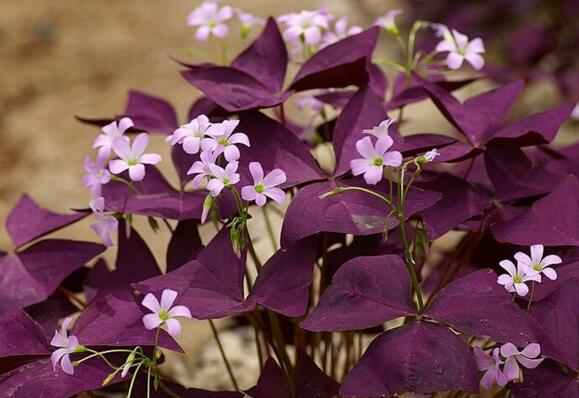
The stems, leaves, and roots of purple-leaf oxalis are all non-toxic, and the whole plant can be used as medicine; it can reduce fever and promote urination, and relieve swelling and disperse blood stasis. Its leaves also contain oxalic acid, which can be used to polish utensils to make them more lustrous, so it is both ornamental and medicinal.
Friendly reminder: Although the stems and leaves of purple-leaf oxalis can be used as medicinal material, they must not be taken in large amounts, otherwise they may cause physical discomfort, because scientific research has found that if cattle and sheep eat large amounts of oxalis it can be fatal, so flower enthusiasts who grow oxalis at home need to avoid taking excessive amounts.
2. Scent / non-toxic
Oxalis has a relatively long flowering period; the flowers it produces are brightly colored and give off a faint, delicate fragrance. As for its scent, is purple-leaf oxalis toxic? The answer is also non-toxic. Although its fragrance is not as strong as that of some flowers, it is only mildly irritating, and it is loved by many flower enthusiasts who enjoy light fragrances.
Is oxalis easy to grow?
Oxalis has strong drought resistance and tolerance for partial shade, so the method of growing oxalis is relatively simple. It can be said to be a very easy plant to grow: it not only grows fast, but also propagates easily, and as long as care and management are proper, it will produce beautiful flowers.
How do you grow oxalis?
1. Watering
Many flower enthusiasts like to spray water on the leaf surface when growing plants. This practice can increase air humidity and also lets excess water on the leaf surface flow into the soil to be absorbed; it is a very good method, and this method is also suitable for oxalis. When watering, spraying or drip irrigation is more appropriate; do not use flood irrigation that causes water to accumulate in the soil.
2. Pest and disease prevention
Pay attention to changes in air humidity, and be sure to avoid excessively high humidity that causes leaves to turn yellow. If the branches and leaves are relatively dense, some should be pruned to improve light penetration. Before temperatures begin to rise in May, some acaricide can be sprayed to prevent pests such as red spider mites.
3. Keep the environment clean and tidy
Keep the environment where oxalis is placed clean and tidy; for example, do not let weeds, fallen leaves, and so on appear in the soil. In addition, do not let it be in an environment with poor air quality and a lot of dust. Keeping the environment relatively well ventilated is very beneficial to the growth of oxalis.
Is purple-leaf oxalis toxic? Morphological characteristics of purple-leaf oxalis
Purple-leaf oxalis is a widely cultivated garden plant. Do you know about it? Is purple-leaf oxalis toxic? What are the morphological characteristics of purple-leaf oxalis? Let's learn about it together below.
Is purple-leaf oxalis toxic:
Purple-leaf oxalis, namely purple-leaf Yamamoto oxalis, of the Oxalidaceae family, is non-toxic. Oxalis is an important type of forage crop with broad cultivation significance, and is also an important green manure and soil-and-water conservation plant; the cultivated area is largest in Western Europe, North America, and Oceania.
In Soviet Russia, people like to drink tea made from oxalis leaves; the slight sourness not only makes it tasty, but it also has great effects on easing fever and regulating blood, so it can be said to be a flower like a health food.
Morphological characteristics of purple-leaf oxalis:
Perennial herbaceous plant with persistent roots; the root system is semi-transparent fleshy roots, branched, light brown, with a few fibrous roots at the lower part. At the top of the roots grow underground stems; the underground stems are composed of scale-like segments one by one, and the underground stems branch underground and are distributed in a coral-like form.
Leaves grow from the top of the stem, and each leaf blade is connected to each scale of the underground stem. The leaves are palmately trifoliolate compound leaves, clustered, born at the top of the petiole; the leaflets have extremely short petiolules and are isosceles-triangular in shape, borne on the common petiole, and the common petiole is 15-31 cm long. The upper surface of the leaf is rose red, with an irregular light rose-red marking in the middle in a "person" shape, extending toward both edges of the leaf. The underside of the leaf is deep red and glossy. Generally it unfolds during the day, and droops under strong light and in the evening, with the three leaflets pressed tightly together, resembling dancing butterflies. When planted under sparse woods, the leaves unfold all day and the leaf color is quite glossy. The flowers are umbellate inflorescences, light pink, with 5 petals, and 5-8 flowers clustered at the top of the flowering stem. The flowering stem is slender, 14-20 cm, swaying in the wind, graceful and charming. One to several flowers form axillary umbellate inflorescences. Sepals are oblong, acute at the apex, with soft hairs;
Petals are obovate, slightly rolled outward; the bases of the filaments are united into a tube. The capsule is nearly cylindrical, 5-angled, with short soft hairs, and when mature and dehiscent it expels the seeds. Seeds are small, flat-ovate, red-brown, with transverse grooves. Flowering and fruiting period is March-August.
How to grow purple-leaf oxalis: cultivation methods for triangular purple-leaf oxalis
Triangular purple-leaf oxalis is also called red-leaf oxalis, purple-leaf oxalis, and is a perennial herbaceous plant with persistent roots. Purple-leaf oxalis plants are neat, with purple-red leaf color; the purple-red leaves are beautiful and alluring, and the pink flowers are charming and lovely. Potted plants are used to arrange flower beds and embellish scenic spots, and it is an excellent potted plant and groundcover plant. Below, let's talk about how to grow purple-leaf oxalis and learn about the cultivation methods for purple-leaf oxalis.
Growth habits of purple-leaf oxalis
Purple-leaf oxalis is suitable for loose soil with good drainage; it likes light and tolerates partial shade; the flowering period lasts as long as 8 months. It has no pest or disease damage; during periods of high temperature and high humidity, old leaves are prone to gray mold, but this does not affect new leaves. It is relatively cold-tolerant; above -5°C it stays evergreen in winter, and below -5°C the aboveground leaves wither, but the underground parts do not die, and new leaves can sprout again in March of the following year. It has no obvious dormant period, and cultivation and management are extensive.
How to grow purple-leaf oxalis
Purple-leaf oxalis likes a moist, partially shaded, and well-ventilated environment, and is relatively drought-tolerant. It is suitable for growing in sandy soil rich in humus and with good drainage. In midsummer, purple-leaf oxalis grows slowly or enters a dormant period; sunlight can cause leaf scorch, resulting in curled and scorched leaves. In summer it must be properly shaded; after entering the semi-dormant period, all forms of fertilizing should be stopped and watering controlled, preferring dry over wet, to prevent root or bulb rot.
Cultivation methods for purple-leaf oxalis
1. Propagation: Use division and sowing (planting) for propagation. Division is mostly carried out during the growing season, but the high-temperature period in summer should be avoided, with spring being the most ideal. When dividing, first dig up the plant and separate the corms for planting; the corms can also be cut into small pieces, each retaining more than 3 buds, and placed in a sand bed to cultivate. After rooting and leaf development, transplant and cultivate, and water thoroughly after planting.
2. Management: It likes a warm, humid environment with sufficient sunlight, tolerates partial shade, and is slightly cold-tolerant. The optimum growth temperature is 24-30°C. At home it is mostly grown as a potted ornamental; the potting soil should use neutral or slightly acidic sandy soil rich in humus, loose and fertile, with somewhat good drainage.
3. Light: During the growing period, place it in a bright place for care. During high summer temperatures the plant is in a semi-dormant state, so it can be properly shaded and ventilation strengthened. Because its leaves have strong phototropism, the pot should be rotated frequently during cultivation so that the plant shape is symmetrical and attractive.
4. Watering: Follow the rule of "do not water if not dry, and water thoroughly when watering." When the air is dry, spray water on the plant and around it to increase air humidity, so that its leaves are thick and glossy.
5. Fertilizing: Apply a decomposed dilute liquid fertilizer or compound fertilizer about once every 20 days. The fertilizer solution should contain comprehensive nitrogen, phosphorus, and potassium nutrition; in particular, the nitrogen content should not be too high, so as to avoid causing leggy growth and fading of the purple-red color on the leaf surface, which affects ornamental value.
6. Winter care: In winter, move it indoors to a bright place, restrain watering, and stop fertilizing; above 5°C it can overwinter safely. After heavy frost in winter, its aboveground leaves wither, and it overwinters in the soil as a root-like corm, sprouting new leaves in March of the following year.
Is purple-leaf oxalis toxic?
Purple-leaf oxalis, namely purple-leaf Yamamoto oxalis, of the Oxalidaceae family, is non-toxic. Oxalis is an important type of forage crop with broad cultivation significance, and is also an important green manure and soil-and-water conservation plant; the cultivated area is largest in Western Europe, North America, and Oceania.
In Soviet Russia, people like to drink tea made from oxalis leaves; the slight sourness not only makes it tasty, but it also has great effects on easing fever and regulating blood, so it can be said to be a flower like a health food.
Flower language of purple-leaf oxalis
The flower language represented by purple-leaf oxalis is: patriotism, luck, Easter.
Easter: In Southern Europe, oxalis is called "Hallelujah." Perhaps because it happens to bloom around Easter, its flower language is - Easter. People born under the blessing of this flower are lively, talkative, and often smile, and get along very harmoniously with others.
One saying is that the national flower of Ireland is white-flowered oxalis. The oxalis, which belongs to the Fabaceae family, is the flower used to honor Ireland's patron saint - Saint Patrick, and is now the national flower of Ireland. In order to fight for independence, Ireland once waged a long bloody war against Britain. Therefore, its flower language is - patriotism.
Ordinary oxalis has only three leaflets, but occasionally a mutant individual with four leaflets appears, called a "lucky clover." Legend says that if you have a four-leaf lucky clover, you can make a wish and have it come true.
The above is the relevant introduction to the cultivation methods of purple-leaf oxalis and the flower language of purple-leaf oxalis. I believe everyone should have a deeper understanding of purple-leaf oxalis now. I hope the above content is helpful to everyone.