Introduction to Common Corn Poppy Varieties and Analysis of Their Characteristics
The corn poppy has varieties such as bicolour, parti-colour, double and semi-double. Closely related species in the same genus include the Iceland poppy (p. nudicaule) and the Oriental poppy (p. orientale). The Iceland poppy is a perennial herb, growing in clumps and nearly stemless. The leaves are basal, pinnately lobed or half-lobed. The flowers are borne singly on leafless scapes, deep yellow or white. It is native to the polar regions. Varieties include near-red or orange forms. In North China there is a wild variety, the mountain poppy, also known as "chicken egg yolk", with orange-yellow flowers that are very showy. The Oriental poppy is a perennial upright herb, 60-90 cm tall, covered all over with white hairs. The leaves are pinnately parted, the flowers are scarlet with a purple-black blotch at the base, 7-10 cm across. It is native to Iran and the Mediterranean region. The varieties come in a great many flower colours, from white, pink, orange-red to purple-red, with the flower diameter increasing to 15 cm. It can be propagated by root cuttings. The main strains of cultivars include the begonia and buttercup types, and semi-double and double varieties.
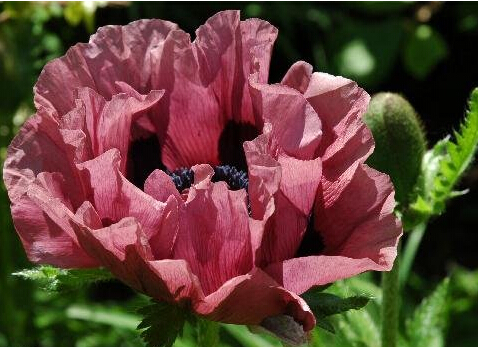
Oriental poppy
Introduction to the Corn Poppy
Corn poppy, scientific name: Papaver rhoeas, category: flowering ornamental, alias: lady's flower. It belongs to the Papaveraceae family and is an annual or biennial herbaceous flower. It mostly grows in clumps, about 80 cm tall, with hairs on both stems and leaves, and milky sap in the stems. The leaves are alternate and pinnately divided. The flowers are borne singly at the tip of the scape, with 4 petals or double, papery yet lustrous, in colours such as crimson, purple, pink and white, as well as bicolour, edged and spotted forms, extremely delicate and beautiful. The flowering period is April to May. It is native to Europe and the Asian continent and is widely cultivated in China, most of all in the Jiangsu and Zhejiang regions. It likes warmth and tolerates cold.The corn poppy is delicate and charming, and its petals are as thin as silk and as smooth and glossy as satin, making it an excellent ornamental flower variety, often used for flower beds, potted flowers or cut flowers.
Corn Poppy Pictures and Introduction
(2011-08-05 15:08:33)Tags: corn poppy pictures
Introduction
Category: beautiful scenery
Corn Poppy Pictures and Introduction
Corn poppy aliases: lady's flower, rival to the peony, small opium poppy flower, corn poppy, butterflies filling the garden in spring, field poppy
Scientific name / Latin name: Papaver rhoeas L.
English name: poppy
Family and genus: Papaveraceae, genus Papaver
[Brief introduction]
Also called field poppy or Flanders poppy.
Scientific name Papaver rhoeas. An annual (rarely biennial) plant of the family Papaveraceae, native to Europe, North Africa and Asia, and introduced to Australia, New Zealand and North America.
The flowers are borne atop stems 25-90 cm (10-35 in) tall, about 7-10 cm in diameter. There are 4 petals, usually bright red, sometimes with a black blotch at the base. The corn poppy was formerly a widespread weed in cultivated fields, with seeds lying dormant in the soil for years and germinating only when the soil was turned. During and after World War I, the battle-torn land was covered with blooming corn poppies, and so the corn poppy became a symbol of that war.
The Shirley poppy is one of the most commonly cultivated garden poppies, developed from the corn poppy. The corn poppy can also yield a red dye used as a colouring agent in certain wines and medicines.[Origin]
The temperate continental regions of Europe and Asia; cultivated in many parts of the world, and Belgium has made it its national flower. Today the corn poppy is widely cultivated in China, most of all in the Jiangsu and Zhejiang regions. It is a fine herbaceous flower for beautifying flower beds, flower borders and courtyards in spring, and can also be potted or used as a cut flower.
[Flower language] Consolation, forgetfulness, rest
Red / vanity
White / sleep
Light red / consolation
Deep red / fervour, dreams[Ecological habits]
An annual herbaceous plant. The corn poppy grows 40-60 cm tall, with slender weak branches covered in short stiff hairs. The whole plant is covered in spreading coarse hairs and has milky sap. The leaves are pinnately parted or fully divided, with lance-shaped lobes and irregularly serrated margins. The flowers are solitary with long stalks, drooping before opening, with 2 elliptical sepals covered with coarse hairs on the outside. The corolla has 4 petals, nearly round, with a dark blotch. The stamens are numerous and free. The ovary is obovate, the style is extremely short, and the stigma usually has 10 or 16 radiating branches. The flower diameter is about 5-6 cm, and the flower colours are rich. The capsule is cup-shaped, dehiscing by pores at the top when ripe, with numerous kidney-shaped seeds, thousand-seed weight 0.33 grams, viability 3-5 years.
The corn poppy is cold-tolerant but afraid of summer heat, prefers a sunny environment, and likes well-drained, fertile sandy loam. It does not transplant well and can self-sow. The flowering period is May to August.
The corn poppy has varieties such as bicolour, parti-colour, double and semi-double. Closely related species in the same genus include the Iceland poppy (P. nudicaule) and the Oriental poppy (P. orientale). The Iceland poppy is a perennial herb, growing in clumps. The leaves are basal, pinnately lobed or half-lobed. The flowers are borne singly on leafless scapes, deep yellow or white. It is native to the polar regions. The Oriental poppy is a perennial herb, 60-90 cm tall, covered all over with white hairs. The leaves are pinnately parted, the flowers are scarlet with a purple-black blotch at the base. It is native to Iran and the Mediterranean.
Before the corn poppy flower opens, the egg-shaped bud, wrapped in two green sepals with white edges, hangs alone on the slender upright flower stalk, looking very much like a young girl bowing her head in thought. When the corn poppy bud bursts open and the sepals fall away, the corn poppy stands out: the bent body straightens up, and on the upward-facing flower the 4 thin petals are as thin as silk and as smooth and glossy as satin; the light corolla is like cluster after cluster of red clouds and piece after piece of coloured silk; even without wind it seems to sway on its own, and when the wind blows it looks even more as if about to float away. The once curved and delicate flower stem now actually straightens up and holds the flower aloft. It is hard to imagine that such a delicate and plain corn poppy plant could produce such richly coloured and magnificent flowers.
The corn poppy has a lush and elegant posture, graceful and charming, dancing in the wind like a coloured butterfly spreading its wings, stirring much reverie. The corn poppy combines both plain elegance and rich, magnificent beauty, the two harmoniously united in one body. Its appearance and bearing greatly resemble the charm of a beauty in classical Chinese art, and it can be called a finest of flowers and plants.
[Cultivation techniques]
Propagation: by seed. Sow in September-October in a seedbed prepared in advance; the optimum germination temperature is 20°C. Because the seeds are very small, the seedbed soil must be worked fine; after sowing do not cover with soil, cover with straw to keep moist, and remove the cover after the seedlings emerge.
Management: after the seedlings emerge, thin them out, with a planting spacing of about 30 cm between plants and rows. When they have grown 5-6 leaves, choose a cloudy day, water thoroughly first, and then transplant; take care not to damage the roots when transplanting, and keep soil around the roots, pressing the soil firm when planting. Do not water too much at ordinary times; keeping it regularly moist is enough. During the growing period, apply once every 2-3 weeks with decomposed urine diluted 5 times with water. For plants not kept for seed, promptly cut off withered flowers during the flowering period so that the remaining flowers bloom better. The capsules do not ripen uniformly and must be harvested in batches for seed.
[Uses]
The corn poppy has a beautiful flower form and bright colours, and is an excellent material for flower beds and flower borders; it can also be potted or used as a cut flower. For use as a cut flower, it must be cut when the bud is half open and immediately immersed in warm water to prevent too much milky sap from flowing out, otherwise the stem will quickly shrivel and the flower will not open fully. The whole plant can be used as medicine.
[Caution]
The whole corn poppy plant is toxic, containing toxic alkaloids, especially in the seeds. Accidental ingestion causes poisoning by inhibiting the central nervous system, and in severe cases can endanger life.
The main differences between the corn poppy and the opium poppy
The corn poppy and the opium poppy belong to the same family, and in appearance the two are very similar. The opium poppy can be refined into the drug heroin and is strictly prohibited from cultivation, while the corn poppy is a common ornamental flower widely planted. Therefore people often mistake the corn poppy for the opium poppy and then report it to the relevant authorities. Everyone's enthusiasm for fighting drugs is very much to be applauded, but a scientific spirit is also needed. Therefore, the differences between the two are set out below, with pictures and explanations.
1. Scientific names: corn poppy Papaver rhoeas; opium poppy Papaver somniferum
2. The whole corn poppy plant is covered in obvious rough hairs, with many slender branches, relatively thin leaves, and an overall delicate appearance. The whole opium poppy plant is smooth and covered with a white powder, including stems, leaves and capsules; the stem is thick and sturdy, the stalk has few branches, and the leaves are thick and substantial.
3. The corn poppy's flower diameter is relatively small, generally about 5 cm to 6 cm; the petals are extremely thin and delicate in texture. The opium poppy's flowers are larger, with a flower diameter of up to 10 cm; the petals are thicker and very glossy.
4. The corn poppy's fruit is relatively small, about 0.6 cm to 1.0 cm in diameter. The opium poppy's capsule can reach 3 cm to 5 cm in diameter and, when fresh, contains a relatively large amount of white milky sap (which becomes raw opium when dried in the sun).