How to Grow and Care for the Lotus-Leaf Peperomia (also known as Peperomia Jade)
Lotus-Leaf Peperomia, also known as Round-Leaf Peperomia, Peperomia Jade, or simply Peperomia. With its bright, colorful leaves and strong ornamental appeal, it is an excellent foliage plant. It has no main stem, and potted specimens can be used to decorate studies, bedrooms, balconies, windowsills, and other spots. The Lotus-Leaf Peperomia is native to Brazil.
Of course, the Lotus-Leaf Peperomia has many other interesting names in different regions, such as: Rock Bean Petal, One Stick of Incense, Bean Petal Grass, Nail Grass, Everlasting Bean Petal, and so on.
The appearance of the Lotus-Leaf Peperomia:
The Lotus-Leaf Peperomia is a perennial evergreen herbaceous plant, growing about 15-30 cm tall. The fleshy parts of the leaves have a reddish blush, and the leaves grow in clusters. The leaf blades are obovate with an acute or abruptly pointed tip, entire margins, leathery texture, and a glossy surface. The spike inflorescence is grayish-white. Common cultivated varieties include the spotted-leaf type, the variegated-leaf type, the glossy-leaf type, and the wrinkled-leaf type. The spotted-leaf type has fleshy leaves with a reddish blush; the variegated-leaf type has green centers with golden-yellow margins; the glossy-leaf type has leaves with a metallic sheen and is the most ornamental variety; and the wrinkled-leaf type has deeply sunken veins that form a "crumpled" looking leaf, which is quite interesting.
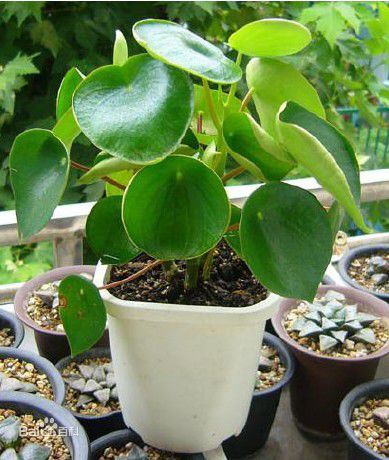
Planting and care of the Lotus-Leaf Peperomia:
The Lotus-Leaf Peperomia is native to tropical and subtropical regions and has been introduced and cultivated in southern China. It likes ample diffused light and a high-temperature, high-humidity environment. It dislikes direct strong sunlight, is not drought-tolerant, and is not cold-tolerant. Its optimal growing temperature is 20-28°C. If the temperature drops below 10°C, it will stop growing, and below 5°C it will suffer cold damage. The Lotus-Leaf Peperomia has high soil requirements, with fertile, well-draining sandy loam being best. For potting soil, a mix of leaf mold and river sand is commonly used, or a mix of peat moss and perlite. During the growing season, keep the soil moist and water once a day. In dry weather, spray the leaves with water to increase the surrounding air humidity and keep the foliage a vivid green. The Lotus-Leaf Peperomia has low fertilizer requirements; fertilizing once or twice a month is enough, mainly with nitrogen fertilizer, supplemented with phosphorus and potassium. When cultivating, it should be placed in a semi-shaded environment, and it must never be grown under strong light, to prevent sunburn on the leaves.
1. In winter (especially in northern regions), be sure to keep it warm for overwintering; the indoor temperature must not be lower than 10°C;
Lotus-Leaf Peperomia: Benefits, Uses, and Cautions - How to Grow and Care for the Lotus-Leaf Peperomia
The Lotus-Leaf Peperomia is a foliage plant. Generally speaking, anyone who has experience growing the Lotus-Leaf Peperomia will have noticed that they have never seen it bloom; of course, the Lotus-Leaf Peperomia does not flower. However, the Lotus-Leaf Peperomia's other benefits are enough to make up for its lack of flowers.
Benefits and uses of the Lotus-Leaf Peperomia
1. The foliage value of the Lotus-Leaf Peperomia
The potted Lotus-Leaf Peperomia has ornamental value, but only as foliage; the Lotus-Leaf Peperomia itself does not flower, so it has no flower-viewing value. As a foliage houseplant, combined with some of its own characteristics, it has high value for indoor foliage use.
2. The ornamental role of the Lotus-Leaf Peperomia
The Lotus-Leaf Peperomia, also known by the alias Peperomia Jade, has obovate leaves that cluster together. The leaves are nearly fleshy, somewhat thick, grayish-green with dark green veins, and very cute. The vivid green, lovely leaves, the small and delicate plant, and that touch of green that does not easily fade make it endearing. Grow the Lotus-Leaf Peperomia as a cute potted plant; it is also shade-tolerant, making it an excellent and highly decorative indoor foliage plant.
3. The medicinal value of the Lotus-Leaf Peperomia
The main value of the Lotus-Leaf Peperomia is ornamental, but it also has some medicinal value. The Lotus-Leaf Peperomia can relieve cough and phlegm, dispel wind and dampness, and promote blood circulation and relieve pain. It can be used to treat rheumatic muscle and bone pain, pulmonary tuberculosis with asthma, whooping cough, and so on, as well as injuries from falls, fractures, and similar conditions.
Cautions for using the Lotus-Leaf Peperomia
When using it, you must strictly follow a doctor's advice.
How to grow and care for the Lotus-Leaf Peperomia
1. Light and temperature
The Lotus-Leaf Peperomia requires ample diffused light, and during the growing period it is best to avoid direct strong sunlight. It is also strongly shade-tolerant, so shading is needed in summer when the sun is intense. As for temperature, the optimal growing temperature for the Lotus-Leaf Peperomia should be kept between 20°C and 30°C. It is not cold-tolerant, so in winter it needs good insulation, and it is best not to let it drop below 5°C, otherwise cold damage will occur. In summer, the temperature should also not exceed 35°C; provide appropriate shading and enhance ventilation to lower the temperature.
2. Soil
The Lotus-Leaf Peperomia has high soil requirements, needing fertile soil with good drainage. Generally, when planting the Lotus-Leaf Peperomia, sandy soil can be used. For potting, a mix of several media can be used, such as peat moss, leaf mold, and perlite, mixed in a certain ratio.
3. Watering and fertilizing
The Lotus-Leaf Peperomia does not have high humidity requirements, but moist conditions are best. During its growing season, keep the potting soil moist and water once a day; in dry weather, spray water on the leaves. However, be careful not to let the soil become too wet, to avoid root rot. Fertilize once or twice a month; to make the leaves green and attractive, you can apply more nitrogen fertilizer.
The growing habits of the Lotus-Leaf Peperomia
The Lotus-Leaf Peperomia likes a warm, humid growing environment and requires an optimal growing temperature between 20°C and 30°C. When the temperature is below 5°C, the Lotus-Leaf Peperomia will suffer cold damage. It likes bright diffused light, is shade-tolerant, and dislikes overly bright direct light. Fertile humus soil is best for cultivation.
The Lotus-Leaf Peperomia is a plant with medicinal value. Generally speaking, we can combine it with other herbaceous plants to treat related illnesses. However, knowing that the Lotus-Leaf Peperomia can treat illness does not mean we can make our own usage plans; it requires a doctor's diagnosis and combination.
Lotus-Leaf Peperomia Photo Gallery - When Does the Lotus-Leaf Peperomia Bloom?
The Lotus-Leaf Peperomia itself belongs to the group of Peperomia; there is actually relatively little information about it online. However, because its leaves closely resemble lotus leaves and it has certain ornamental and medicinal value, as more people grow it in the future, people will come to know more about the Lotus-Leaf Peperomia.
When does the Lotus-Leaf Peperomia bloom?
The Lotus-Leaf Peperomia is itself a non-flowering plant; it belongs to the foliage plants.
How to grow and care for the Lotus-Leaf Peperomia
1. Light and temperature
The Lotus-Leaf Peperomia requires ample diffused light, and during the growing period it is best to avoid direct strong sunlight. It is also strongly shade-tolerant, so shading is needed in summer when the sun is intense. As for temperature, the optimal growing temperature for the Lotus-Leaf Peperomia should be kept between 20°C and 30°C. It is not cold-tolerant, so in winter it needs good insulation, and it is best not to let it drop below 5°C, otherwise cold damage will occur. In summer, the temperature should also not exceed 35°C; provide appropriate shading and enhance ventilation to lower the temperature.
2. Soil
The Lotus-Leaf Peperomia has high soil requirements, needing fertile soil with good drainage. Generally, when planting the Lotus-Leaf Peperomia, sandy soil can be used. For potting, a mix of several media can be used, such as peat moss, leaf mold, and perlite, mixed in a certain ratio.
3. Watering and fertilizing
The Lotus-Leaf Peperomia does not have high humidity requirements, but moist conditions are best. During its growing season, keep the potting soil moist and water once a day; in dry weather, spray water on the leaves. However, be careful not to let the soil become too wet, to avoid root rot. Fertilize once or twice a month; to make the leaves green and attractive, you can apply more nitrogen fertilizer.
The value of the Lotus-Leaf Peperomia
1. The ornamental role of the Lotus-Leaf Peperomia
The Lotus-Leaf Peperomia, also known by the alias Peperomia Jade, has obovate leaves that cluster together. The leaves are nearly fleshy, somewhat thick, grayish-green with dark green veins, and very cute. The vivid green, lovely leaves, the small and delicate plant, and that touch of green that does not easily fade make it endearing. Grow the Lotus-Leaf Peperomia as a cute potted plant; it is also shade-tolerant, making it an excellent and highly decorative indoor foliage plant.
2. The medicinal value of the Lotus-Leaf Peperomia
The main value of the Lotus-Leaf Peperomia is ornamental, but it also has some medicinal value. The Lotus-Leaf Peperomia can relieve cough and phlegm, dispel wind and dampness, and promote blood circulation and relieve pain. It can be used to treat rheumatic muscle and bone pain, pulmonary tuberculosis with asthma, whooping cough, and so on, as well as injuries from falls, fractures, and similar conditions.
3. The potted ornamental appeal of the Lotus-Leaf Peperomia
The small potted plant has a fresh, green feel that is truly refreshing. This is the charm of plants: the Lotus-Leaf Peperomia does not need the adornment of fresh flowers; just a little bit of green is enough to capture the heart.
The growing environment of the Lotus-Leaf Peperomia
The Lotus-Leaf Peperomia likes warm, humid, and semi-shaded environments. Its optimal growing temperature is 20-30°C; below 10°C it will stop growing, and below 5°C it will suffer cold damage. It likes bright diffused light and also has fairly strong shade tolerance; too-strong direct sunlight is very harmful to the plant's growth. It does not have high air humidity requirements and can tolerate the dry environment of a home. Fertile humus soil is best for the growing medium. Drainage must be good, with 50-70% sunlight; avoid direct strong sunlight. Fertilize once a month, with more nitrogen fertilizer, for more attractive leaf color. Aged plants should be pruned. It likes high temperatures and high humidity; the growing room temperature should be 20-28°C, and below 10°C it needs protection from cold damage.
As for the Lotus-Leaf Peperomia, what we can currently learn is only some basic growing methods, its significance and uses, the environments it is suited to, and its living habits, and so on. Other related content still needs to be continually supplemented by more people who love the Lotus-Leaf Peperomia.