Is rain lily toxic, and is it suitable to put in the bedroom? / Many benefits of keeping it indoors
As a beautiful flower, the rain lily has excellent qualities. First, it looks lovely and is a delight to the eye; second, it purifies the air and beautifies the home, giving us a healthy living environment. Such a plant naturally attracts people's affection, but some say it is toxic! So, is the rain lily toxic? Is the rain lily suitable to put in the bedroom? Here, let us clear up the confusion for you.
1. Is the rain lily toxic? Yes, it is toxic
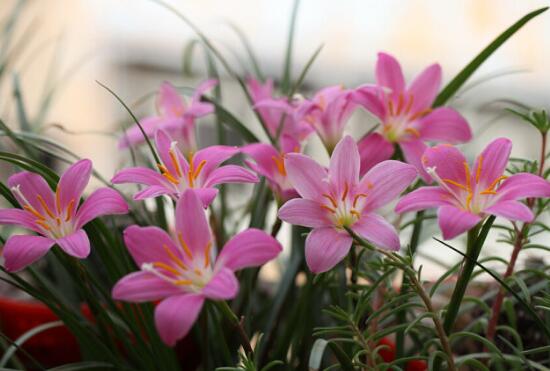
On this question, we can look at the types of rain lily. It is understood that rain lilies fall into two kinds: one is the broad-leaved Zephyranthes carinata, and the other is the slender Zephyranthes candida. Whether it is Zephyranthes carinata or Zephyranthes candida, both belong to the Amaryllidaceae family, and both are toxic!
Poisoning symptoms: If you accidentally eat the bulbs of the rain lily, it will cause symptoms such as vomiting and diarrhea. Once too much is mistakenly eaten, it can also cause skin allergies, chest tightness, and dizziness. Especially in summer, the skin is even more prone to problems.
Is the rain lily toxic when in bloom? No, it is not toxic
After the rain lily blooms, it gives off a captivating fragrance. But because the rain lily is toxic, many flower lovers worry that its fragrance is also toxic. So, is the rain lily toxic when in bloom? According to our research, the rain lily is not toxic when in bloom, but people who are very sensitive to smells should smell it less. So when growing rain lilies indoors, it is best to place them in a ventilated spot.
2. Is the rain lily suitable to put in the bedroom? No, it is not suitable
Because the rain lily is very beautiful, when growing it indoors, many flower lovers like to place it in the bedroom, since they think the rain lily flowers are beautiful and its fragrance is pleasant! But the bedroom is a place for people to rest, and plants cannot be placed there casually. So, is the rain lily suitable to put in the bedroom? Our advice is not to place it there, for two reasons:
(1) The rain lily is toxic. Although we would not be so silly as to eat it, toxic is toxic, and for our own safety we should take preventive measures.
(2) Like ordinary plants, the rain lily performs respiration at night, absorbing oxygen and releasing carbon dioxide. Bedrooms are generally small and enclosed, which creates a situation of competing with people for oxygen, thus affecting people's sleep. So, is the rain lily suitable to put in the bedroom? Clearly it is not suitable.
3. What are the benefits of growing rain lilies indoors
1. Highly ornamental
Although the bedroom is not suitable for growing rain lilies, growing them indoors has many benefits. First of all, they look beautiful and are highly ornamental. As shown in the picture above, the flowers of the rain lily are delightful at first glance. Its rich flower colors and lily-like flower shape both give a pleasing sense of beauty. Such a flower, grown as a potted plant at home, can be said to be very pleasing to the eye.
2. Beautifying the home
Because the rain lily is very beautiful, placing it indoors and waiting for it to bloom has the effect of beautifying the home. Do you find an unchanging indoor environment monotonous? Then you might as well place a few pots of rain lilies, which can make the indoor environment fresher and more elegant. After a busy day, opening the door and looking at the beautiful rain lily flowers, one's fatigue seems to drift away.
3. Purifying the air
Besides looking good, the benefits of growing rain lilies are the same as other indoor potted plants: they also purify the air. If the indoor odor is strong or the room has been unused for a long time, then you might as well place two pots of rain lilies, and before long the indoor air will become fresh. Living in a comfortable environment, one's health and mood can both be assured.
4. Cultivating character
Growing rain lilies indoors, besides purifying the air and beautifying the home, can also cultivate our character and elevate our temperament. Not only that, growing rain lilies for a long time can also regulate mood, relieve stress, and increase vitality. It can be said that growing rain lilies can prevent the environment from being too dull, which helps prolong the life of the grower.
Summary: If the bedroom is large or well ventilated, growing a pot of rain lilies is very good, but if the bedroom is not large, we suggest you not grow them. That is all for our introduction on whether the rain lily is toxic. Friends who are tempted might as well grow a pot and try. Those who do not know how to grow them can also look at the cultivation methods for rain lilies. Finally, may everyone's rain lilies bloom into beautiful flowers.
Cultivation methods for Daphne odora 'Aureomarginata'
Daphne odora 'Aureomarginata' (scientific name: VC.Aureomariginatn) is a traditional famous flower of China and also a famous flower of the world. In modern horticultural history, together with the Changchun monk's Clivia and the Japanese five-needle pine, it was praised as one of the three treasures of horticulture. Daphne odora 'Aureomarginata' is a traditional famous flower of China and also a renowned flower of the world. It is famous throughout the world for its four excellences of "color, fragrance, posture, and charm," and once left behind the eternal masterpiece: "The peony is the national beauty and heavenly fragrance, but the golden-edged daphne is the finest."The flower language and symbolic meaning of Daphne odora 'Aureomarginata': auspiciousness, good fortune.
Daphne odora 'Aureomarginata' is a variety of daphne, an evergreen small shrub of the genus Daphne in the family Thymelaeaceae. It has a fleshy root system. The leaves are densely whorled, elliptical, about 5-6 cm long and 2-3 cm wide, with a smooth, thick, leathery surface, hairless on both sides, dark green on the upper surface, light green on the underside, golden yellow at the leaf margins, and short thick petioles. It bears terminal head-shaped inflorescences, with a tubular perianth split into four at the upper end, about 1.5 cm in diameter. Each flower is composed of dozens of small flowers, opening from the outside inward. Daphne odora 'Aureomarginata' usually blooms around the Spring Festival, and the flowering period can reach more than 60 days. Its posture is graceful and free, bending and stretching naturally; its leaves are neat and lush, yellow as gold, green as jade, and it remains luxuriant all year round. Especially since its flowering period coincides exactly with the time of celebrating the New Spring Festival, and its fragrance accompanies the aroma of wine. When it blooms, the branches are full of clusters and bunches, a profusion of flowers, with bright purplish-red colors and a rich fragrance. It adds many auspicious signs to the New Spring Festival, so for many years it has continued to be loved by people.Cultivation methods for Daphne odora 'Aureomarginata'
1. Soil: For potted Daphne odora 'Aureomarginata', the potting soil should be fertile, loose, humus-rich, acidic leaf mold, mixed with an appropriate amount of river sand and decomposed cake fertilizer. Daphne likes loose, fertile, well-drained acidic soil (pH 6 to 6.5) and avoids alkaline soil. You can use mountain soil or garden soil mixed with 40% peat soil, leaf mold, pine needle soil, and an appropriate amount of coal cinder ash, rice husk ash, urban garbage, etc. as the growing medium.
2. Watering: The roots of Daphne odora 'Aureomarginata' are fleshy, so special attention must be paid to controlling watering during routine care. If watered too much and the potting soil remains too wet for a long time, it easily causes root rot. After rain, the accumulated water in the pot must be poured out promptly. After Frost's Descent, the soil moisture content in the pot should be controlled at about 45% for safe overwintering.
3. Sunlight: Although Daphne odora 'Aureomarginata' likes partial shade and avoids scorching sun exposure, in winter and spring it should be placed in an environment with sunlight. During the growing period, if there is sufficient light and appropriate fertilizer, it can make the branches plump and the leaves dark, with brilliant flowers and strong fragrance. In summer it should be placed in a well-ventilated, shady spot, and water should be sprayed to lower the temperature during hot weather. Daphne bonsai should be placed in a warm, humid, semi-shaded, semi-sunny location. In summer it should avoid direct sun exposure, and in winter it should be placed under a south-facing window with light and air circulation.
4. Temperature: Daphne odora 'Aureomarginata' fears high temperatures and heat. Growth stops when the temperature exceeds 25°C, and water should be sprayed to lower the temperature in summer. It is not cold-resistant, so after Frost's Descent it must be moved indoors and placed in a sunny spot, and the room temperature should be kept above 5°C for overwintering.
5. Fertilizing: In winter, apply sufficient base fertilizer. In spring, apply decomposed cake fertilizer water 2-3 times; the fertilizer water should not be too concentrated. During the dog days of summer, stop fertilizing to avoid burning the root system. After the beginning of autumn, apply thin fertilizer frequently until the flower buds open. In spring, apply fertilizer water mainly based on nitrogen and potassium; after autumn, fertilizing should mainly be based on phosphorus. After the flower buds form, you can spray the branches and leaves with monopotassium phosphate at a concentration of 0.1-0.2% for foliar feeding, but the fertilizer water must be sprayed on the back of the leaves to improve fertilizer efficiency and promote abundant flowers and lush leaves. Daphne avoids the use of human excrement and urine fertilizer. Daphne odora 'Aureomarginata' prefers fertilizer, and during the growing season a thin liquid fertilizer should be applied about once every 10 days. Before and after flowering, a thin cake fertilizer water should be applied once each as a supplementary feeding.
6. Pests and diseases: The main pests harming Daphne odora 'Aureomarginata' are aphids and scale insects, which mostly appear in dry, hot climates and should be prevented and controlled early. The main disease is mosaic disease caused by a virus. Infected plants show colored spots and deformities on the leaf surface, poor flowering, and stunted growth. Once discovered, they should be dug out by the roots and burned with fire.
7. Pruning: The branches of Daphne odora 'Aureomarginata' grow in clusters and have strong sprouting ability. Daphne is relatively tolerant of pruning. Generally, before sprouting, densely growing small branches can be pruned away, leaving a certain amount of space to facilitate ventilation and light penetration. Daphne should be shaped and pruned after flowering, cutting short the branches that have already bloomed, and removing leggy branches, overlapping branches, overly dense branches, crossing branches, and other branches that affect the beauty of the tree shape, so as to maintain a graceful form.Yellowing leaves of Daphne odora 'Aureomarginata'
1. Soil on the alkaline side: Potted Daphne odora 'Aureomarginata' should use fertile, loose, humus-rich, acidic leaf mold. If the selected soil is strongly alkaline, it will cause the leaves of Daphne odora 'Aureomarginata' to turn yellow and drop. Solution: Replace the potting soil or apply ferrous sulfate solution to ensure the soil is acidic.
2. Excessive sunlight: Daphne odora 'Aureomarginata' fears the high temperatures and scorching sun of midsummer. In summer it should be placed on a cool, ventilated flower rack, or in a place without direct sunlight. Excessive sunlight can cause the leaves to turn yellow. Solution: Place Daphne odora 'Aureomarginata' in a spot with plenty of diffused light for growing.
3. Temperature too low: Daphne odora 'Aureomarginata' has poor cold resistance. If the temperature is too low, the leaves will turn yellow and drop, and the plant will also suffer freeze damage. Solution: Potted Daphne odora 'Aureomarginata' should be moved indoors before Frost's Descent, and the room temperature should be kept no lower than 5°C.Is Daphne odora 'Aureomarginata' toxic?
Daphne is very fragrant and not toxic. If you can stand the smell, you can put it in the bedroom, but this is also hard to say. Of course it has its disadvantages as well as its benefits; smelling it too much is not good for the human body. Isn't there an old saying in China? When things reach an extreme, they reverse. When something goes too far, the good can become bad, and the bad may also become good.The effects of Daphne odora 'Aureomarginata'
1. Ornamental: Daphne odora 'Aureomarginata' has high ornamental value. Its tree posture is graceful, its branches are vigorous and naturally curved, its leaves are neat and glossy, fresh and deep green, its flowers are richly fragrant, and its flowering period is relatively long. It is a precious flower excellent in posture, color, fragrance, and charm, and is deeply favored by the vast number of flower lovers.
2. Medicinal: Besides ornamental value, Daphne odora 'Aureomarginata' also has relatively high medicinal value. Daphne odora 'Aureomarginata' contains daphnin. Its roots, stems, leaves, and flowers can all be used as medicine. It is sweet in nature and non-toxic, and has the effects of clearing heat and detoxifying, reducing inflammation and relieving pain, promoting blood circulation and removing blood stasis, and dissipating nodules. It has been included in the compilation of the "Dictionary of Traditional Chinese Medicine."
3. Gifting: Daphne odora 'Aureomarginata' is famous throughout the world for its four excellences of "color, fragrance, posture, and charm." It blooms around the Spring Festival, with branches full of clusters and bunches, a profusion of flowers, and a rich, clear fragrance, adding auspicious signs to the New Spring. Thus it has become an item for adding auspiciousness and good fortune to people's homes during the Spring Festival, and is also one of the choices for many people when giving gifts among relatives and friends.Daphne, called Lujia in ancient times, also known as woolly daphne, Qianlixiang, and mountain dream flower, etc., is an evergreen small shrub plant of the genus Daphne in the family Thymelaeaceae. Daphne originates in China and is a traditional famous flower of China. Daphne blooms in early spring and has a rich fragrance. Its variety Daphne odora 'Aureomarginata' is the finest among daphnes, hence the saying, "The peony is the national beauty and heavenly fragrance, but the golden-edged daphne is the finest."
Introduction
Daphne, also known as sleeping fragrance and romantic tree, and also called Penglai flower, is an evergreen shrub of the genus Daphne in the family Thymelaeaceae, reaching a height of 1.5-2 m. It grows in clusters, with smooth stems; the leaves are alternate, mostly gathered at the top, entire and glossy; it blooms from March to May, with flowers 1.5 cm long, yellow-white to purplish-red, densely clustered, and especially strongly fragrant.
Daphne originates in China and is distributed in the mountain forests of East China, Central China, and South China.
Artificial cultivation began in the Song Dynasty. The main cultivated varieties include three kinds: woolly daphne, rose daphne, and Daphne odora 'Aureomarginata'.
Daphne odora 'Aureomarginata' is the outstanding one among daphnes. The Song Dynasty poet Zeng Shu said of it, "Through wind and rain its branches and leaves grow sparse, yet pitifully it never diminishes its clear fragrance."
Daphne likes shade, avoids direct sunlight, and prefers fertile, moist, well-drained, slightly acidic loam.
Daphne has strong sprouting ability, tolerates pruning, and has very few pests and diseases, so cultivation and propagation are relatively easy.
Place of origin and distribution
Daphne originates in China and Japan, and is a traditional famous flower of China. It is distributed in the provinces and regions south of the Yangtze River basin, and now it is also distributed in Japan. Ganzhou City, Jiangxi Province, lists it as its "city flower." It is also one of the city flowers of Nanchang City.
Morphological characteristics
The daphne plant is 1.5-2 m tall, with slender, smooth, hairless branches. The leaves are simple and alternate, long elliptical, 5-8 cm long, dark green, thick, and glossy. The flowers are clustered at the tips of the branches. The head-shaped inflorescence has a common peduncle, the perianth is tubular and split into four at the upper end, and the flower diameter is 1.5 cm. They are white, or purple or yellow, with a strong fragrance, and have the names "flower fragrance stealer" and "flower thief." If placed together with other flowers, the other flowers feel as if they have lost their fragrance. The flowering period of daphne is from February to March, lasting about 40 days.
Growth habits
It likes semi-shade and ventilated environments, fears exposure to the sun, and is not tolerant of drought or waterlogging.
Variety classification
White-flowered daphne, with pure white flowers;
Red-flowered daphne, with red flowers;
Purple-flowered daphne, with purple flowers;
Yellow-flowered daphne, with yellow flowers;
Daphne odora 'Aureomarginata', with golden yellow leaf margins, red flower buds that turn white after opening; woolly daphne, with white flowers, the outside of the perianth densely covered with grayish-yellow silky soft hairs; Daphne odora 'Aureomarginata' is the finest among daphnes, hence the saying, "The peony is the national beauty and heavenly fragrance, but the golden-edged daphne is the finest"
Rose daphne, with petals white inside and light red outside;
Concave-leaved daphne, with leaf margins rolled back and the apex blunt with a small concave notch.
Landscape uses
It is most suitable for planting in forest clearings, along forest-edge roadsides, on hillside terraces, and on the shady side of rockeries. If scattered among rocks, it adds even more charm. Japanese gardens also greatly favor daphne, often pruning it into a spherical shape and planting it in front of pines and cypresses for embellishment.
Daphne has high ornamental value. Although its flowers are small, they cluster into masses, and the fragrance is fresh, elegant, and refined. The root of daphne is sweet and salty, non-toxic, and mainly treats acute throat wind; the stem bark fiber is a good raw material for papermaking.
Medicinal value
[Nature, flavor, and meridian entry]: Pungent, sweet, warm.
[Functions and indications]: Dispels wind and removes dampness, promotes blood circulation and relieves pain. Used for rheumatoid arthritis, sciatica, pharyngitis, toothache, early-stage breast cancer, and traumatic injuries.
[Usage and dosage]: 2-4 qian.
Common medicinal prescriptions
Besides being ornamental, daphne also has high medicinal value. The root, bark, and flowers of daphne can all be used as medicine. Sweet and salty in nature and flavor, it can promote blood circulation and remove blood stasis, relieve spasms, stop pain, dispel wind and remove dampness, and treat acute throat wind, numbness of hands and feet, chilblains, and burns.
[Rheumatic pain]: 6 grams of flowers, 9 grams of cassia twig, decocted in water; and use 4 to 8 liang of bark and leaves, decocted in water to wash the affected area externally.
[Sciatica]: 9 grams of bark decocted in water and taken. Twice daily, taken for several consecutive days.
[Sore, swollen throat]: 12 grams of flowers or roots, mashed, taken with boiled water.
[Toothache]: 6 grams of flowers or roots, 2 eggs, decocted together, eat the eggs and drink the soup. Externally use several flowers, mashed, and hold at the painful tooth area.
[Traumatic injuries]: 50 grams of bark, soaked in child's urine for 24 hours, sun-dried, together with 3 grams of raw Aconitum kusnezoffii and 3 grams of pyrite, ground into fine powder, taken twice daily, 3 grams each time, with boiled water.
[Vaginal bleeding during pregnancy, postpartum dizziness]: 12 grams of stems and leaves, 50 grams of saxifrage, decocted in water.
[Stomach duct pain]: 250 grams of roots, 50 grams of flowers, ground into powder, 3 grams each time, taken with boiled water, once daily.
[Venomous snake bite]: Grind the roots with strong liquor into a thick juice, apply to the area around the wound and the swollen part. Apply again when the medicine dries.
Flower appreciation
Daphne has a graceful tree posture, a round crown, soft branches and thick leaves, dancing branches, abundant and fragrant flowers, and implies auspiciousness. For appreciation, the flowering period in early spring in February is the best. If you need it to bloom earlier, increase the temperature of the watering water 1 month before flowering, and it can bloom half a month earlier; withholding water during the peak flowering period can extend the flowering period.
Daphne is a traditional famous flower of China. In ancient poetry there are many words of praise. The Song Dynasty poet Wang Shipeng wrote in his poem "Daphne Flower": "Truly it is the auspicious one among flowers; only in this dynasty did its name first become known."
Therefore the daphne flower symbolizes auspiciousness.Reasons why daphne drops its leaves:
1. Metabolism
After daphne sprouts branches and leaves, as a large number of new leaves grow, old leaves will also continuously fall off. Solution: This is normal metabolism, and no special treatment is needed; just let it grow naturally.
2. Too much sunlight
Daphne likes a semi-shaded environment. When exposed to the sun, the leaves can become scorched and whitish, and leaf drop occurs. Solution: Provide shading in summer and autumn.
3. Damage from heavy rain
In midsummer, the weather is not only hot, but there are also many heavy rains, rainstorms, and thunderstorms. Thunderstorms especially come suddenly and with relatively high intensity, causing the temperature to drop sharply, which very easily damages the capillary roots of daphne and causes leaves to fall off. Solution: In summer when there is heavy rain, be careful to shield the daphne to reduce the damage caused by heavy rain.
4. Overwatering
The roots of daphne are fleshy, so it tolerates dryness and dislikes wetness. When the potting soil is too wet, it can cause root rot and lead to leaf drop. Especially in summer after rain clears, when water accumulates in the pot and the plant is in an environment of being baked above and steamed below, root respiration is hindered, which easily causes root rot and brings about leaf drop. Solution: Be careful to maintain a state of "alternating dry and wet" watering for daphne. Especially during the high-temperature period in summer, avoid overwatering or sudden exposure to rain.
5. Too little watering
Although daphne likes dryness, when the potting soil is too dry, because the plant cannot get a supply of water, the leaves will curl, shrivel, and fall off. Solution: When watering daphne, pay attention to its habits; you should neither water too much nor fail to provide enough water for its growth.
6. Improper fertilizing
Daphne avoids concentrated fertilizer and raw fertilizer. Applying concentrated fertilizer or raw fertilizer will cause leaf drop. Especially when watering with concentrated fertilizer, if it stains the leaves, it will cause the leaves to fall off rapidly. Solution: Fertilizing daphne should use thin fertilizer, and after applying fertilizer, rinse the leaf surface with clean water, while avoiding the use of human excrement and urine. After severe leaf drop occurs, watering should be controlled and fertilizing stopped, and only after normal growth resumes can routine care and management be carried out.
Daphne is a very common plant for us. Growing it in pots to beautify home spaces such as the living room and study is quite good, but attention must be paid to care. Daphne dropping leaves is often caused by improper care.