What are the control methods for leaf spot disease in Amaryllis?
If Amaryllis is not properly cared for, leaf spot disease is likely to occur in late autumn and early winter, affecting the leaf tips, leaf surfaces and leaf margins. In the early stage of the disease, small purplish-brown spots appear on the leaves. If not controlled in time, they expand into brown, irregular lesions, then turn mottled and yellow, and finally grayish-white, scattered with black dot-like pycnidia of the pathogen. The control methods are:
1. Remove diseased leaves. At the end of winter, diseased leaves must be thoroughly removed to reduce the source of infection the following year.
2. Spray with chemicals. During the disease period, promptly spray 800-fold carbendazim solution several times in succession.
3. Pay attention to care. Usually pay attention to ventilation and care so that the plants grow robustly and increase their ability to resist disease.
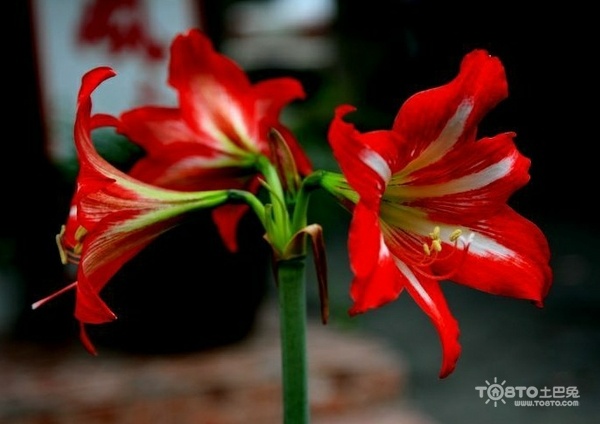
Amaryllis pest and disease control methods:
1. Red spider mite
Red spider mites mainly harm the leaves of Amaryllis, sucking the sap, causing the leaves to show grayish-yellow spots or patches, and the leaves to turn orange-yellow and fall off. Solution: spray with 1000-fold 40% dicofol emulsifiable concentrate.
2. Nematodes
They mainly invade through the stomata on the leaves and flower stems. After invasion, they cause disease in the leaves and stems and flowers, and gradually spread toward the bulb. Solution: soak the bulbs in 43°C warm water with 0.5% formalin for 3-4 hours to achieve control.
3. Chrysanthemum longhorn beetle
The chrysanthemum longhorn beetle mainly bites and injures the stems when the adults lay eggs; the stem tips above the wound wither, and the larvae bore into and feed on the stems and roots, causing the whole plant to die.
Solution: promptly prune off the withered and drooping tender tips, eliminate the eggs and larvae within them, and spray 500-800-fold trichlorfon or fenitrothion solution, 2500-fold 20% fenvalerate solution, or 200-fold 25% Yuanke No. 3 solution.
4. Chaff scale
It is mainly the adults that pierce and suck the sap of Amaryllis. In severe cases, it causes premature leaf drop and withered branch tips, affecting flowering. Solution: when many insects are found, scrape them off and spray 1000-fold 90% trichlorfon solution or 1500-fold 50% fenitrothion solution, once every 15 days, spraying 2-3 times in succession.
5. Viral disease
It mainly harms the roots and leaves of Amaryllis, causing the roots and leaves to rot. Solution: for affected plants, spray 700-fold 75% chlorothalonil wettable powder.
6. Leaf spot disease
After infection by leaf spot disease, small purplish-brown spots form on the leaf tips, leaf margins and leaf surfaces, gradually expanding into brownish-red oval or irregular lesions. Solution: during the disease period, spray 600-800-fold carbendazim solution, controlling 3-4 times in succession.
Amaryllis has large, beautiful flowers and great ornamental value. Placing it in the home makes a fine accent, but attention must be paid to Amaryllis pest and disease control, which is something you must understand to grow Amaryllis well.