How to prevent and control lilac leaf blight?
Symptoms and pathological changes: Brown spots mainly form on the leaves. The spots are round, nearly round or irregular, with dark brown edges and light brown centers. In severe cases, the leaves are covered with brown spots and fall early, leaving only a few leaves on the whole plant. The pathogen is a fungus, Cercospora lilacis. The stroma is spherical, dark brown. The conidiophores are bundled, upright. The conidia are thread-like or slender club-shaped, colorless or nearly colorless, with multiple septa; the basal cell is obconical, bluntly rounded or nearly flat. The pathogen overwinters in fallen diseased leaves as stroma or mycelium, and infects in May to June of the second year. Under rainy and humid conditions, the pathogen spreads and infects repeatedly, so the disease is severe in years with more rain. When there is more rain in autumn, the disease is severe.
Prevention and control methods: 1. Remove diseased leaves in autumn and winter, prune and shape in time during the growing season, and control branch and leaf density to facilitate ventilation and light transmission. In daily management, apply water and fertilizer reasonably and drain promptly. 2. Chemical control: after leaf expansion, spray 50% carbendazim 1000-fold solution or 75% chlorothalonil wettable powder 500-fold solution, 80% zineb wettable powder 500-fold solution, etc., once every 15 days, continuously 2 to 3 times, which can control this disease.
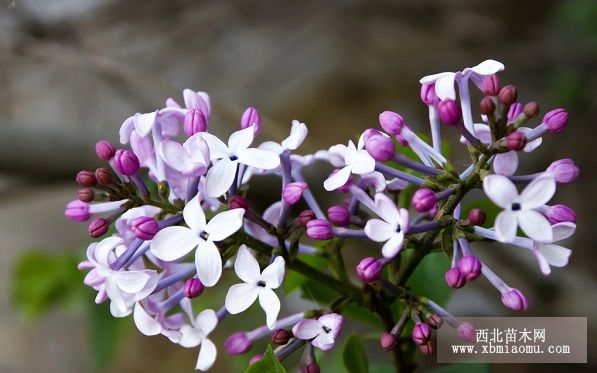
Height 1.5-4 m, bark grayish brown, branchlets yellowish brown, initially pubescent. Later gradually shedding. Young leaves clustered, later opposite, ovate, obovate or lanceolate, panicles, flowers pale purple, purplish red or blue, corolla tube 6-8 mm long. Flowering period May to June.
Lilac black spot diseaseSymptoms: At the initial stage of the disease, there are chlorotic spots on the leaves, gradually expanding into round or nearly round lesions, 3-10 mm in diameter, brown or dark brown, with indistinct concentric rings. In the later stage, the lesions turn grayish brown and are densely covered with black moldy spots, which are the conidia and conidiophores of the pathogen. The lesions connect with each other, causing a large part of the leaf to become brown and dead, and to shrink or even fragment.
Pathogen and disease characteristics: The pathogen is a fungus in the genus Alternaria. Conidiophores are scattered or gathered in several, brown; conidia brown. The disease overwinters on fallen diseased leaves as mycelium or conidia and spreads with rain splashes.
Lilac brown spot disease
Symptoms: The lesions on lilac leaves are polygonal, irregular, or round to nearly round, brown, 5-10 mm in diameter. In the later stage, the central tissue of the lesion becomes grayish brown, and the edge is dark brown. On the lower epidermis of the lesion, a dark gray mold layer grows, namely the conidia and conidiophores of the pathogen. When the disease is severe, a small amount of mold also appears on the upper surface of the lesion. The lesions connect with each other into large patches, showing grayish brown spotting and withering.
Pathogen and disease characteristics: The pathogen is Cercospora lilacis of the genus Syringa. The pathogen overwinters on fallen leaves as sporodochia or mycelium, and the conidia are spread by wind and rain. More rain, heavy dew, high planting density and poor ventilation easily lead to the occurrence of the disease.
Lilac leaf spot and wilt disease
Symptoms: At the initial stage of the disease, nearly round, polygonal or irregular lesions are scattered on both sides of the leaves. The edge of the lesion is darker, and the central tissue is lighter, grayish brown. In the later stage, a small number of black dots grow in the center of the lesion, namely the pycnidia of the pathogen.
Pathogen and disease characteristics: The pathogen is Septoria syringae. The pathogen overwinters on fallen diseased leaves as pycnidia, and the conidia are spread by wind and rain.
Prevention and control measures
Reduce the source of infection. Remove diseased residues; carry out moderate pruning and cut off diseased dead tips.
When the disease occurs, spray 1% Bordeaux mixture of equal amounts; 70% thiophanate-methyl wettable powder 1000-fold solution; spray once every 10-15 days, continuously 3-4 times for better effect.
How to prevent and control lilac brown spot disease?
Syringa oblata Lindl. (scientific name: Syringa oblata Lindl.) is a deciduous shrub or small tree. Also known as lilac, North China lilac, baijie, qingke, longsaozi. Syringa oblata is native to North China and has been cultivated in China for more than 1000 years. It is a precious flower of China.
Height 1.5-4 m, bark grayish brown, branchlets yellowish brown, initially pubescent. Later gradually shedding. Young leaves clustered, later opposite, ovate, obovate or lanceolate, panicles, flowers pale purple, purplish red or blue, corolla tube 6-8 mm long. Flowering period May to June.
Brown lesions often appear on lilac leaves, called lilac brown spot disease. The lesions are round, nearly round or irregular and have concentric rings, with dark brown edges and light brown centers, 5-10 mm in diameter, with black moldy material growing on them. When the disease is severe, the leaves are covered with lesions and fall early. The pathogen of lilac brown spot disease is a fungus of the genus Cercospora. The pathogen overwinters in diseased fallen leaves and spreads by wind and rain in May to June of the second year. Under rainy and humid conditions, the pathogen spreads and infects repeatedly, so the disease is severe in years with more rain.Measures to prevent and control lilac brown spot disease: First, promptly remove dead branches and fallen leaves and burn them in a centralized manner to eliminate the overwintering source of disease. Second, when planting lilacs, the plants should not be too dense. In daily management, apply water and fertilizer reasonably and drain promptly. Third, chemical control: after leaf expansion, spray 50% carbendazim wettable powder 1000-fold solution or 75% chlorothalonil wettable powder 500-fold solution, 80% zineb wettable powder 500-fold solution, etc., once every half month, continuously 2 to 3 times.