Identification and Control Methods of Hydrangea Leaf Spot
Symptoms and pathological changes: Hydrangea leaf spot is mainly distributed in Sichuan, Henan, Guangdong, Taiwan, China, Jilin, Shanghai, Zhejiang, Hunan and other places. The disease mainly occurs on leaves. The leaf spots are initially light yellowish-brown water-soaked small spots, which later expand into circular or nearly circular spots, 2-5 mm in diameter, reaching about 15 mm at the largest. Later the center becomes light brown, the edge dark brown, slightly raised, with indistinct concentric rings. Black small dots, namely the fungus's pycnidia, are produced in the diseased areas. On severely infected leaves, the spots merge together, causing the leaves to turn brown and withered yellow, until the plant dies. The pathogen is a fungus belonging to the Deuteromycetes, Cercospora genus, Coelomycetes, Sphaeropsidales.
The pathogen overwinters on diseased leaves and plant debris in the soil. In the second year, when environmental conditions are suitable, conidia are produced from the pycnidia, and the conidia spread by wind and rain. Large numbers of conidia are produced on new spots and spread by airflow, causing multiple reinfections. High humidity and abundant rain favor the occurrence and spread of the disease. The disease generally occurs from August to September, gradually decreases in October, and old leaves are prone to infection.
Control methods for hydrangea leaf spot: 1. Hydrangea prefers fertile sandy loam and is not tolerant of waterlogging. Planting in sandy loam is advisable to facilitate drainage; at the end of autumn, diseased leaves and diseased plants should be collected and destroyed to reduce sources of infection for the coming year. 2. Collect seeds from disease-free, healthy plants, and disinfect with potassium permanganate or zineb before sowing. 3. Chemical control: Before the disease occurs, spray 0.5% Bordeaux mixture for prevention, and promptly remove diseased leaves as soon as they are found. Spray fungicides at the early stage of the disease or when the disease is severe. Options include 50% carbendazim 500 times dilution, or 75% chlorothalonil 700 times dilution, or 25% carbendazim wettable powder 300-600 times dilution, or 50% thiophanate-methyl 1000 times dilution, or 50% zineb 800-1000 times dilution.
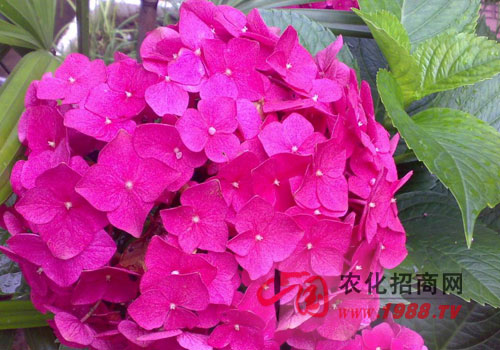
During its growth, hydrangea can be attacked by diseases, such as hydrangea leaf spot. Hydrangea leaf spot causes the leaves of hydrangea to gradually turn brown and progressively appear withered and yellow, and may even cause the hydrangea plant to die. Hydrangea leaf spot mainly occurs on the leaves of hydrangea. The leaf spots initially appear as light yellowish-brown water-soaked small spots, then gradually expand into circular shapes. The center of the hydrangea spot is light brown, the edge dark brown, slightly raised, with indistinct concentric rings. Black small granules, namely the fungus's pycnidia, are produced in the diseased areas of hydrangea leaf spot. In severe cases of hydrangea leaf spot, on the infected hydrangea leaves, the spots merge together until the plant dies. It is understood that yellowing from hydrangea leaf spot generally occurs most severely from August to September. The pathogen of hydrangea leaf spot overwinters safely on diseased leaves and plant debris in the soil. In the coming year, when environmental conditions are suitable, conidia are produced from the pycnidia, and the conidia spread by wind and rain. Large numbers of conidia are produced on new spots and spread by airflow, causing multiple reinfections of hydrangea leaf spot. High humidity and abundant rain favor the occurrence and spread of hydrangea leaf spot.
In order to timely control hydrangea leaf spot, effective measures should be taken for prevention and control. Growers should strengthen the management of hydrangea plants. Since hydrangea prefers a moist and semi-shaded growing environment, the optimal temperature for hydrangea growth is 18-28°C, which is more favorable for the growth and development of hydrangea. To timely control hydrangea leaf spot, 0.5% Bordeaux mixture should be sprayed for prevention before the disease occurs in hydrangea. Growers should promptly remove diseased hydrangea leaves after finding them. At the early stage of hydrangea leaf spot, fungicides can be sprayed: 50% carbendazim 500 times dilution, or 75% chlorothalonil 700 times dilution, or 25% carbendazim wettable powder 300-600 times dilution, or 50% thiophanate-methyl 1000 times dilution, or 50% zineb 800-**** times dilution, or 50% wanmeiling 600 times dilution. Alternatively, spray 40% carbendazim-sulfur suspension concentrate 500-600 times dilution, 50% hunshaliu suspension concentrate 500 times dilution, 1:1:200 Bordeaux mixture, 77% kesha wettable powder 500 times dilution, 50% copper diammonium diacetate (DT) wettable powder 400-500 times dilution, once every 10 days or so, for 2-3 applications, which can promptly control hydrangea leaf spot.