A Complete Guide to the Cultivation and Growing Methods of Dianthus
Propagation is mainly by seed. The optimum temperature for seed germination is 21-22 degrees, and sprouts emerge in about 5 days. During the seedling stage, the growing temperature should be slightly lower, which makes the seedlings sturdy. Depending on the temperature during the seedling-raising period, it takes about 9-10 weeks from sowing to finished seedling. For home cultivation, seeds are mostly sown directly in late autumn in a sunny, wind-sheltered spot in the courtyard; after winter sets in, cover them for cold protection; after the weather warms in the following spring, thin and transplant the seedlings, and they bloom in May.
Sowing is also possible in spring, but growth and flowering are not as good as with autumn sowing. In warm regions, propagation by cuttings can be used. From late September to early March of the following year, healthy, slightly firm branches can be cut into 6 cm long cuttings, inserted 3 cm into sand, and placed at a temperature of 20-24 degrees. Keep them moist and provide appropriate shade; roots will form in 2-3 weeks.
Cultivation and Growing Methods of Dianthus
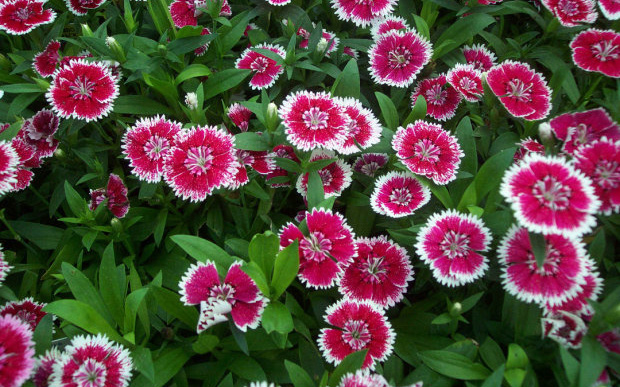
The stems of Dianthus are slender like bamboo, forming lush green clumps; the flowers come in pale red, red, and white, with petals richly edged in a fringed, velvet-like trim, their texture like silk velvet and their colors like rosy clouds, rich and varied; many varieties also have a delicate, elegant fragrance. The famous Tang dynasty poets Li Bai and Du Fu both wrote lines about "Dianthus embroidered on silk robes" and "sleeping among Dianthus with musk incense," praising the beauty of Dianthus. Dianthus is native to eastern Asia and is a perennial herbaceous flowering plant with persistent roots. It is distributed across the mountainous regions of every province in both northern and southern China, is cold-hardy, and prefers fertile, moist sandy soil or loose leaf mold. The cultivation site should be chosen in a sunny, well-ventilated location, and it is most intolerant of waterlogging. The flowering period is from May to September. Dianthus is mainly used for courtyard flower beds and flower borders, and is also a beautiful potted plant and cut flower.Propagation is mainly by seed. The optimum temperature for seed germination is 21-22 degrees, and sprouts emerge in about 5 days. During the seedling stage, the growing temperature should be slightly lower, which makes the seedlings sturdy. Depending on the temperature during the seedling-raising period, it takes about 9-10 weeks from sowing to finished seedling. For home cultivation, seeds are mostly sown directly in late autumn in a sunny, wind-sheltered spot in the courtyard; after winter sets in, cover them for cold protection; after the weather warms in the following spring, thin and transplant the seedlings, and they bloom in May.
Sowing is also possible in spring, but growth and flowering are not as good as with autumn sowing. In warm regions, propagation by cuttings can be used. From late September to early March of the following year, healthy, slightly firm branches can be cut into 6 cm long cuttings, inserted 3 cm into sand, and placed at a temperature of 20-24 degrees. Keep them moist and provide appropriate shade; roots will form in 2-3 weeks.
For Dianthus grown in the courtyard, the management method is extremely simple. For potted Dianthus, the growing medium is best prepared from 7 parts garden soil and 3 parts sand; when the seedlings have four or five leaves, move them into small flower pots with a 6-7 cm diameter, and as the seedlings grow, gradually transfer them into pots about 15 cm in diameter, after which no further repotting is needed; place the potted seedlings in a sunny spot. During the growing period, apply liquid fertilizer once every 10 days, and the flowers will be abundant and lush. In autumn, the plants can be divided and replanted, and the new plants will grow vigorously the following year. In winter, potted seedlings must be placed in a cool (8-10 degrees) and sunny environment to overwinter.
In hot summer regions, the plants mostly wither, greatly reducing their ornamental value, so they are often grown as biennial flowers. In regions with warm winters and cool summers, by adjusting the sowing and seedling-raising period, flowers can be had year-round. Because varieties readily cross naturally, seed propagation produces offspring that vary greatly; in cultivation, to maintain the superior traits of a variety, care should be taken to keep appropriate spacing between different varieties to prevent the mixing of variety-specific traits, and when collecting seed, strictly "select the superior and discard the inferior," and "select the pure and discard the mixed."
How to Cultivate Dianthus: Cultivation and Management Methods for Dianthus
Dianthus flowers are cute and adorable, with brilliantly colored blooms, yet they are a rather ordinary-looking ornamental flower; though understated, they are also much loved by people, perhaps because people admire the spirit of Dianthus. Still, some small problems can arise in the process of growing Dianthus. So how do you cultivate Dianthus flowers? Below, we introduce the cultivation and management methods for Dianthus flowers.
How to Cultivate Dianthus Flowers
Dianthus is a perennial herbaceous flower with weak persistent-root characteristics, and is mostly grown as an annual or biennial plant. Potted Dianthus requires sufficient base fertilizer, with 2-3 plants per pot. When the seedlings grow to 15 cm tall, remove the terminal buds to encourage branching; afterward, take care to appropriately remove the axillary buds, otherwise too many branches will disperse the nutrients and result in small flowers; appropriately removing axillary buds concentrates the nutrients and can promote large, brightly colored flowers. During the growing period, it should be placed in a sunny, well-ventilated spot for care, keep the potting soil moist, and apply a thin, well-rotted liquid fertilizer about once every 10 days. In summer, when there is too much rain, pay attention to drainage and loosening the soil. Dianthus crosses easily, so those saving seed need to plant them in isolation. Before flowering, promptly remove some of the flower buds in the leaf axils, mainly to ensure the terminal flower buds bloom. In winter, water less; if the temperature is kept at 5-8 degrees, it will bloom continuously through winter and spring.
Cultivation and Management Methods for Dianthus Flowers
1. Planting: In August, apply sufficient base fertilizer, plow deep and harrow fine, and level the beds. When the sown seedlings grow 1-2 true leaves, thin them; when they grow 3-4 true leaves, transplant them. Plant spacing 15 cm, row spacing 20 cm. Water after transplanting, and spray with New High Lipid Film to increase the survival rate.
2. Light and Temperature: The suitable growing temperature is 15-20°C. In winter, they should be placed in a greenhouse, with the temperature kept above 12°C. During the growing period, they require ample light, so place them in a sunny spot; in summer, diffused light is preferable, avoiding harsh sun exposure. When temperatures are high, provide shade and cooling.
3. Watering and Fertilizing: Watering should follow the principle of not watering until dry. When the plants reach 10 cm tall, transplant them once more. For Dianthus sown in autumn, water with antifreeze water in November-December, and with greening water in the spring of the 2nd year. Throughout the growing period, apply topdressing 2-3 times with well-rotted human manure or cake fertilizer. To get more flowers, pinch the tips to make it branch more, and the axillary buds must be promptly removed to reduce nutrient consumption. After pruning, Dianthus flowers can bloom again.