How to grow and cultivate Agapanthus (also known as African lily)
Agapanthus gets its name because it has many flowers and many seeds, and its leaves resemble those of an orchid; because its form is close to that of a clivia, but its flowers are purple-blue, it is also called purple clivia; in Jiangnan areas such as Shanghai and Hangzhou, it is also called baizilian. It is a perennial evergreen herb with rhizomes, with strap-shaped leaves about 80 cm long, basal, arranged in two rows
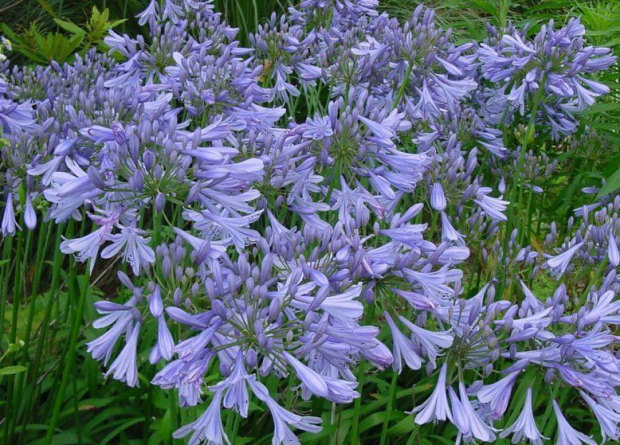
It is a perennial evergreen herb with rhizomes, with strap-shaped leaves about 80 cm long, basal, arranged in two rows; in June it sends up a scape about 60 cm tall, with the tip curved and drooping, blooming in compound summer, with 2060 flowers per inflorescence, and the flowering period lasts as long as 1 month. In cultivation there are varieties such as double-flowered, white-flowered, purple-flowered, and golden-edged leaf and silver-edged leaf.
Native to South Africa, it prefers a warm, humid climate and a semi-shaded environment, and avoids exposure to the scorching sun; in summer it should be placed in a shaded, ventilated spot; it is not demanding about soil, but grows poorly in heavy clay soil and poor sandy soil, and grows best in fertile, humus-rich, well-drained soil.
For home cultivation, division propagation is the most convenient. In South China it can be planted in the open ground, while in the Yangtze River basin and areas to the north it is mostly grown in pots and overwintered indoors, with room temperature required to be above 5i in winter. In spring, divide it along with repotting; cut the rhizome together with the plant and plant it into a new pot. After planting, once the roughly half-month recovery period has passed, water and fertilizer should be supplied generously; generally it will bloom one year after division. In the vigorous summer growing season, water once a week with dilute liquid fertilizer or fertilizer tablet water; when fertilizing, phosphorus and potassium should be the main nutrients, and nitrogen fertilizer must not be excessive, otherwise it easily causes leggy growth, with large leaves but few flowers.
After entering October, the weather gradually turns cooler, and the plant enters a semi-dormant state until April of the following year; during this period watering should be controlled and fertilizing stopped, so as to avoid sprouting and growth that would affect flowering. In the south the semi-dormant period is somewhat shorter, but attention should still be paid; in spring, before new leaves sprout, part of the old leaves should be cut off to keep the plant's shape neat.
How to grow and cultivate Agapanthus
Agapanthus is also called purple clivia by some; it is a perennial herbaceous plant of the Amaryllidaceae family, with broad lanceolate leaves in two rows, dark green, and short thick fleshy roots underground, a scape 60-90 cm tall, terminal corymbose inflorescence, bearing about 15-30 flowers, blue flowers, flowering period 6-8 months, very beautiful. When not in flower, the foliage is also attractive, so flower growers mostly like to grow it in pots for appreciation. Agapanthus is native to South Africa; it likes warmth and humidity, is not very cold-tolerant, likes sunlight but fears the scorching sun, is slightly shade-tolerant, likes fertilizer, and is suitable for growing in sandy loam rich in humus and well drained.This flower is mainly propagated by division, which can be done in spring or autumn, generally autumn is better, because if divided in spring, it mostly cannot bloom that year. Potted plants should be divided about once every 3 years; if not divided for a long time, it will affect growth and flowering. When dividing, each new plant should carry 2-3 buds; after division, first place it in a shady spot for a one-week transition before moving it into the sun. If the sowing method is used, it takes more than 5 years to bloom, so this method is used less often.
For Agapanthus cultivation, it is suitable to mix 3 parts garden soil with 1 part rice husk ash and 1 part compost. For care, it should be placed in a semi-shaded, humid spot; from June to September, care should be taken not to let the scorching sun shine directly on it, so as not to scorch the leaves; watering should be done to the degree of keeping it moist, alternating dry and wet; in summer especially, care should be taken to ensure sufficient water, and the plant and surrounding environment should often be sprayed with water to increase humidity and lower temperature. On the day before fertilizing, watering should be paused once so that the potting soil absorbs the water; after fertilizing, the leaves should be sprayed with clean water; it is best to alternate manure fertilizer, cake fertilizer and chemical compound fertilizer, once every 10-15 days. For divided seedlings, sufficient fertilizer and water should be given even more, so that they can bloom early. After flowering, the flowers should be removed and fertilizer applied promptly. After October, stop fertilizing, and when the temperature drops to 1-2°C, move it indoors to a humid spot; keeping it above 0°C is enough for overwintering. At this stage, care should be taken to control watering; keeping the potting soil slightly moist is enough, and it must not be watered too much.
How to grow Agapanthus
Agapanthus is also called purple clivia by some; it is a perennial herbaceous plant of the Amaryllidaceae family, with broad lanceolate leaves in two rows, dark green, and short thick fleshy roots underground, a scape 60-90 cm tall, terminal corymbose inflorescence, bearing about 15-30 flowers, blue flowers, flowering period 6-8 months, very beautiful; when not in flower, the foliage is also attractive, so flower growers mostly like to grow it in pots for appreciation.Agapanthus is native to South Africa; it likes warmth and humidity, is not very cold-tolerant, likes sunlight but fears the scorching sun, is slightly shade-tolerant, likes fertilizer, and is suitable for growing in sandy loam rich in humus and well drained. This flower is mainly propagated by division, which can be done in spring or autumn, generally autumn is better, because if divided in spring, it mostly cannot bloom that year. Potted plants should be divided about once every 3 years; if not divided for a long time, it will affect growth and flowering. When dividing, each new plant should carry 2-3 buds; after division, first place it in a shady spot for a one-week transition before moving it into the sun. If the sowing method is used, it takes more than 5 years to bloom, so this method is used less often.
For Agapanthus cultivation, it is suitable to mix 3 parts garden soil with 1 part rice husk ash and 1 part compost. For care, it should be placed in a semi-shaded, humid spot; from June to September, care should be taken not to let the scorching sun shine directly on it, so as not to scorch the leaves; watering should be done to the degree of keeping it moist, alternating dry and wet; in summer especially, care should be taken to ensure sufficient water, and the plant and surrounding environment should often be sprayed with water to increase humidity and lower temperature. On the day before fertilizing, watering should be paused once so that the potting soil absorbs the water; after fertilizing, the leaves should be sprayed with clean water; it is best to alternate manure fertilizer, cake fertilizer and chemical compound fertilizer, once every 10-15 days.
For divided seedlings, sufficient fertilizer and water should be given even more, so that they can bloom early. After flowering, the flowers should be removed and fertilizer applied promptly. After October, stop fertilizing, and when the temperature drops to 1-2°C, move it indoors to a humid spot; keeping it above 0°C is enough for overwintering. At this stage, care should be taken to control watering; keeping the potting soil slightly moist is enough, and it must not be watered too much.