Gladiolus Cultivation and Management Methods and Technical Key Points
Sword-shaped leaves resembling those of the sweet flag (Acorus), long stems emerging, covered with seed pods, funnel-shaped flowers of various colors opening in succession; people like to cut the flower stems and place them in vases -- even away from the roots, the flowers still stand upright to the top. This is a portrayal of the basic characteristics of gladiolus. Its other names include: Changlan, Jianlan, Shiyangjin, Shisan Taibao, Bianzhulian, etc.
The gladiolus inflorescence is elegant and long, upright and straight; a single spike can contain as many as over 20 flowers and can continue blooming for more than 1 week. The flowers are large, the color varieties are bright and colorful, the flower shapes are varied and graceful, and the ornamental value is extremely high. Cultivation and propagation are simple, making it the most popular cut flower among home gardening enthusiasts, and also the most important cut flower in the world's flower production.
Gladiolus is a cormous flower of the Iridaceae family. It originated in South Africa, with a few species from the Mediterranean coast of southern Europe and western Asia; there are about 250 wild species, mainly distributed in the Cape of Good Hope area of South Africa.
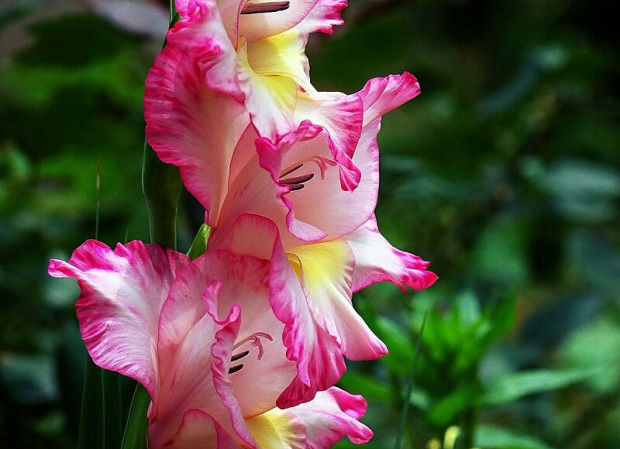
Around 1740, gladiolus was introduced from South Africa to Europe and cross-breeding work began. The cultivars grown today are all derived from hybridization, elimination and selection between different species, and the number of cultivars reaches more than eight thousand. They can basically be divided into two major categories: spring-flowering types and summer-flowering types. Spring-flowering types are planted in autumn in warm regions and bloom the following spring; summer-flowering types are planted in spring and bloom in summer. Summer-flowering types can further be divided by growth period length into: early-flowering, blooming in 50 to 70 days; mid-flowering, blooming in 70 to 90 days; and late-flowering, blooming in 90 to 120 days. Those cultivated in North China are all summer-flowering types, with a flowering period from June to October.
Cultivation and Management Methods of Gladiolus
"Sword-shaped leaves resembling those of the sweet flag (Acorus), long stems emerging, covered with seed pods, funnel-shaped flowers of various colors opening in succession; people like to cut the flower stems and place them in vases -- even away from the roots, the flowers still stand upright to the top." This is a portrayal of the basic characteristics of gladiolus. Its other names include: Changlan, Jianlan, Shiyangjin, Shisan Taibao, Bianzhulian, etc. The underground part of the gladiolus is a flattened round corm; each corm has one central main bud and two lateral secondary buds. A robust corm, during each growing season, can sometimes even send up 1-2 lateral flower stems in addition to the main flower stem.The gladiolus inflorescence is elegant and long, upright and straight; a single spike can contain as many as over 20 flowers and can continue blooming for more than 1 week. The flowers are large, the color varieties are bright and colorful, the flower shapes are varied and graceful, and the ornamental value is extremely high. Cultivation and propagation are simple, making it the most popular cut flower among home gardening enthusiasts, and also the most important cut flower in the world's flower production.
Gladiolus is a cormous flower of the Iridaceae family. It originated in South Africa, with a few species from the Mediterranean coast of southern Europe and western Asia; there are about 250 wild species, mainly distributed in the Cape of Good Hope area of South Africa.
Gladiolus corms can sprout at 4-5 degrees, grow best at 20-25 degrees, and require sufficient sunlight, long-day conditions, and a well-ventilated environment, avoiding stuffy heat and cold, wet soil. Therefore, summer cultivation in Northeast and North China grows better than in Central China, East China and other places; it is intolerant of freezing cold and waterlogging. Each year new corms form above the mother corm; as the new corm grows, the mother corm gradually declines. Conditions with large day-night temperature differences favor the maturation of the new corm. Usually it can be harvested one month after flowering.
Propagation is mainly by division of corms. For courtyard cultivation in North China, planting can be done in batches in early April, with the latest no later than late July, so that flowers continue to bloom throughout summer and autumn; corms planted in early to mid-July will bloom exactly around National Day. In addition to planting large corms separately, small corms can also bloom within two years; propagation can also be done by cutting the corms into pieces, each piece must carry one strong bud, and the cut surface should be coated with plant ash to prevent rot and provide a certain fertilizing effect. When breeding new varieties, seed propagation is used; with proper sowing and seedling management, they can bloom within two years.
The planting depth of corms depends on the nature of the soil and the size of the corm, about 5-10 cm; larger corms deeper, smaller corms shallower; sandy soil should be deeper, clay soil shallower. Plant spacing and row spacing vary from about 15-25 cm.
For courtyard cultivation of gladiolus, choose a sunny position with good drainage. Ordinary garden soil can be used for planting, but fertile sandy loam containing humus is most suitable. It can also grow and bloom in clay soil, but the development of replacement corms is poor, and the number of small corms formed beneath the old corm is also fewer. Before planting, sufficient base fertilizer should be applied to the soil; base fertilizers rich in phosphorus and potassium are suitable.
After planting, water promptly and keep the soil moist and loose. For carefully managed plants, three topdressings should also be applied, but nitrogen fertilizer should not be excessive, otherwise the plants grow poorly and flowering is delayed. As for the timing of topdressing: the first is applied after the first two leaves unfold, to promote stem and leaf growth; the second when the stems and leaves elongate and flower buds are developing, to promote flower development and opening; the third after flowering, to promote the development of replacement corms.
For the purpose of cutting flowers, it is best to cut when the first flower at the base of the inflorescence just begins to open. When cutting the flower stem, retain as many leaves on the plant as possible, so that sufficient leaves provide adequate nutrients for the replacement corm. It is best to insert slender scissors into the center of the leaves and cut the flower stem, damaging the leaves as little as possible. For simplicity, at least cut the flower stem above four leaves.
The best time for cutting flowers is early each morning. The flower branches placed in the vase open progressively upward day by day, and the first-opened flowers also wither in sequence. Every morning, remove the withered flowers, appropriately shorten the pedicel so that the length of the inflorescence and pedicel maintains a proper proportion with the vase, and change the clean vase water; then from beginning to end it will not lose its beautiful ornamental value. Generally speaking, a bunch of cut flowers can maintain an ornamental period of about one week, about 5 days in summer, and 10-12 days in winter. If the purpose is to harvest corms, then remove the flower buds when they show color but leave the flower stem, so as to avoid nutrient consumption from flowering that would be unfavorable to corm growth.
For courtyard planting for ornamental viewing, after flowering is finished, cut off the pedicel below the first flower to avoid seed formation and nutrient consumption. In September and October, when temperatures drop and plant growth slows, watering should be moderated; between October and November, when the replacement corm develops fully and the leaves turn yellow, cut off the stems and leaves at about 5 cm above the ground, dig out the corms, dry them in the shade, or sun-dry them; on rainy days and at night, protect them from rain and dew.
After harvest, in humid and rainy areas, it is best to have air-drying equipment, with the temperature maintained at 30 degrees, to dry the corm surface as quickly as possible to avoid disease infection. When digging corms, choose a sunny day, be careful not to damage the small corms, promptly remove the residual base of the old corm at the base of the new corm, remove old roots, and clean the corm skin, but do not peel it. Eliminate corms with pests and diseases, and handle large and small corms separately. Large corms can be placed in flat-bottomed perforated sieves; small quantities can be put in gauze bags, and stored under well-ventilated conditions at 4-11 degrees, with 2-3 degrees being most ideal.
During cultivation, gladiolus pests and diseases are relatively serious. Common ones include corm rot, dry rot and scab, mostly caused during storage by high temperature or high humidity. In addition, aphid damage causes mosaic virus disease, making the plants wither.
During cultivation, practice crop rotation; this can reduce the occurrence of diseases, prevent diseased corms from being planted, and reduce the spread of disease. When conditions permit, before planting corms, soak the seed corms in 1/1000 carbendazim plus 1.8/1000 captan or thiram at a water temperature of 46 degrees for 15 minutes, then soak and rinse with clean water for 10 minutes, spread them out, and they are ready for planting.
Gladiolus is very sensitive to the toxic gas hydrogen fluoride and can serve as an indicator plant for monitoring hydrogen fluoride in the air; its corms can be used as medicine, externally applied to treat parotitis, carbuncles and other conditions.
Cultivation and Management of Gladiolus
Gladiolus is the king of cut flowers in the world, and its cultivation and management should pay attention to the following points.1. Propagation Methods
Mainly use corm division propagation. Remove the naturally divided corms and cormels from the mother corm and plant them separately in the field. Larger cormels can bloom in one year; small corms (diameter less than 1 cm) need 1-2 years of cultivation before they can bloom. When there are few seed corms, to accelerate propagation, corm cutting propagation can be carried out. Because two-year-old gladiolus corms usually have 4-6 bud eyes, generally arranged in a straight line, the seed corm can be cut longitudinally into several parts; each part must carry more than 1 bud and part of the basal plate, otherwise it cannot sprout or take root. To prevent rot, the cut surface needs to be coated with plant ash, and planting is done after the cut surface dries.
2. Management Measures
The planting site should use warm, moist, sunny, well-ventilated, well-drained sandy soil (pH 5.5-6.5). When planting in late March (soil temperature above 5 degrees C), apply sufficient fully decomposed organic fertilizer and phosphorus-potassium fertilizer. This is because applying phosphorus fertilizer can improve flower quality, while potassium fertilizer promotes improving corm quality and increasing the number of cormels. Before planting, the seed corms need disinfection; they can be soaked in 50% carbendazim 500 times solution for 20 minutes, dried, and then planted. When planting, plant separately according to the size of the seed corms; the planting depth is 2-3 times the corm. After planting, water once thoroughly.
Gladiolus corms can bloom only after a certain period of dormancy following harvest. In order to extend the ornamental period and supply cut flowers year-round, planting can be done in batches according to growth period length (mostly 80-90 days): for example, if planted in a greenhouse in January-February, flowers can be supplied for "May Day"; if transplanted from a plastic tunnel to open ground in March, flowers can be supplied for "June 1"; if flowers are to be supplied for National Day, then in early July select medium-sized corms for shaded open-ground planting, water in the morning and evening two weeks later, and expose to light when half have sprouted; if planted in a plastic tunnel in September, flowers can be supplied around New Year's Day, but from mid-October they need 4 hours of light every day; if planted in a plastic tunnel in January with large corms, flowers can be supplied around Spring Festival, but the corms need full cold storage, and heating and supplementary lighting should begin around November. Because gladiolus is a typical long-day flower, flower bud differentiation can occur only when the light period reaches 14 hours. Therefore, controlling the flowering period of gladiolus needs to be carried out in an environment where light and temperature can be controlled, and during the flowering period a 0.2% potassium dihydrogen phosphate solution should be sprayed once every 10 days. When cutting gladiolus flowers, on the premise of meeting the cut flower length, each plant should retain at least 4-5 leaves to promote continued growth of the underground corm. When 1/3 of the leaves turn yellow, the seed corms can be dug and harvested; after drying for 1 week, store them in a cool, ventilated indoor area. Corms to be planted later the following year should be stored under low temperature (2-3 degrees C) conditions to prevent the seed corms from sprouting and deteriorating.
3. Pest and Disease Control
Common pests and diseases of gladiolus mainly include damping-off, mosaic disease, brown spot, corm rot and nematode disease. Damping-off mainly occurs due to excessive watering, excessively high temperature and poor ventilation; it can be controlled by pouring 50% amobam aqueous solution 300-500 times around the roots. Mosaic disease and brown spot can be sprayed with 65% zineb 600 times solution. Corm rot mostly occurs during storage due to high temperature or high humidity; maintaining a dry, cool environment can prevent infection. For nematode disease, spray-kill with 40% dimethoate emulsion 1000-1500 times solution.
Latest Information
Marigold Cultivation Techniques and Applications: Several Measures for Dwarf Cultivation of Flowers
Hydroponic Flowers Cater to Consumer Fashion Medicinal and Health Benefits of Aloe