What are the cultivation and growing methods for Chinese roses and roses?
Chinese rose is also known as Changchun flower, and also called four-season rose, because it blooms all year round and is a close relative of the rose. Our country has a very long history of cultivating Chinese roses. In ancient times, there was a poetic line, "People only say flowers are red for ten days, but this flower has spring breeze every day," praising the Chinese rose's characteristic of blooming in all four seasons. But this refers to the Chinese rose, namely Yueyuehong or Tiebanhong, while the history of modern Chinese roses is not long, only about 200 years. In the 18th century in France, Chinese roses were crossed with European roses to breed the first batch of large-flowered Chinese roses; later, breeders crossed China's fragrant Chinese roses and other types of roses with them, selecting and breeding different flower colors.
Varieties with different flower shapes and other forms are widely cultivated around the world. It is estimated that there are already more than 10,000 varieties worldwide, and enthusiasts are still continuously selecting and breeding new varieties; the Chinese rose is the national flower of the United Kingdom. In China, Tianjin, Changzhou and other cities have also designated it as their city flower, and Beijing, Tianjin, Changzhou and other places have specially established Chinese rose associations, while the UK and the US both have national association organizations.
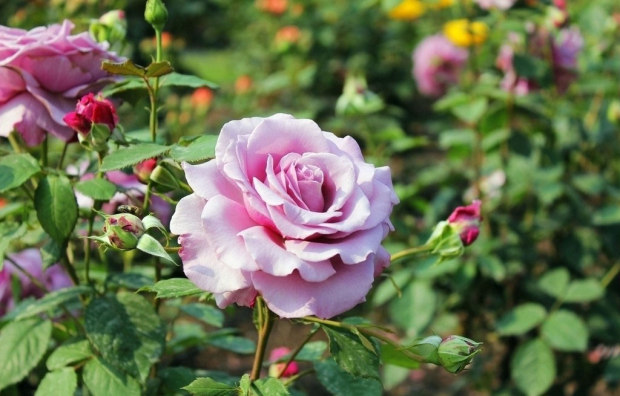
There are many varieties of Chinese roses, but by plant form they can be divided into climbing type, with creeping and trailing branches that need support to grow, with main varieties including Jinguang, Fen Jingang, Huang Heping and others; upright type, with upright branches that mostly bloom at the top of the stems, with main varieties including Jinbei Dahong, French White, Peace, Mohong, Laolaihong, Lan Lulu, Guifei Zuijiu and others; dwarf type, with short plants and branches that divide into many small twigs, with main varieties including Xiao Jiemei, Mantianxing and others; in addition, they can also be divided by flower color into white flowers, yellow flowers, red flowers, purple, green and variegated sprinkled-gold types.
Rose cultivation and growing methods
Rose flowers are brightly colored, pleasantly fragrant, and covered with thorns, so the rose is also called thorn rose. It is a famous raw material for essence, and also a fragrance-blending raw material for scenting tea, making wine and food. Its essential oil is very valuable, and on the international market it is often more expensive than gold. It is an upright, thorny shrub. Rose and Chinese rose are both sisters in the Rosaceae family and look just like twins, except that the rose's leaves are wrinkled on top and whitish on the underside with small prickles, while the Chinese rose's leaves are flat. The original species has single flowers, and the round red fruit formed after flowering is also very beautiful and contains very high vitamin C, making it an important natural vitamin raw material. The ornamental rose widely cultivated now is a double-flowered variety. Both fruiting and ornamental types are widely cultivated, almost throughout Asia, Europe and North America.Roses originated in the dry regions of Asia and Europe. In China they are distributed in the mountainous areas of North China, Northwest China and Southwest China, and they are also distributed in Japan and Korea. They like dry air, fertile and well-drained places, and do not bloom easily in shaded areas. In China, Miaofeng Mountain in Beijing, Kushui Township in Yongdeng, Gansu, and Pingyin County in Shandong all have large-scale plantings specifically for producing rose flowers. They are often cultivated in gardens and homes in various places.
For rose propagation, single-flowered types can be sown from seed, preferably sown immediately after collection in autumn, otherwise they are not easy to germinate the next year and need another year before seedlings emerge. Double-flowered varieties, because their stamens have all become petals, have no fruit and cannot be propagated by sowing. In the past, division or layering was mostly used. In the south, where spring air humidity is high, cuttings also root easily; in the north, softwood cuttings can only be done in summer in glass-frame beds, and the survival rate is hard to guarantee. Large-scale softwood cuttings can be carried out under plastic film covers, but the relative humidity inside the film must be kept above 80% and the temperature around 25°C.
Chinese rose growing methods Chinese rose cultivation methods
Chinese rose growing methods Chinese rose cultivation methods
Flower introduction: Chinese rose, also known as Yueyuehong, Douxuehong, Shouke, Changchun flower, is an evergreen or deciduous shrub of the genus Rosa in the Rosaceae family.
Chinese rose flower meaning: waiting for hopeful hope, happiness, glory, beauty ever new.
Growing place: Chinese rose originated in China and is distributed in the mountainous areas of Hubei, Sichuan, Gansu and other provinces; it is now planted throughout the world except in tropical and frigid zones.
Benefits of growing flowers: unique in shape, noble and elegant, with high ornamental value; the flowers can be used to extract fragrance; the roots, leaves and flowers can all be used as medicine, with effects of promoting blood circulation and reducing swelling, and reducing inflammation and detoxifying; Chinese rose can absorb harmful gases such as hydrogen chloride, hydrogen sulfide, ether and phenol.
Flower and leaf appearance: pinnate compound leaves, broadly ovate or ovate-oblong, with serrated leaf margins and smooth on both sides; flowers clustered, mostly double-flowered, in umbel-like inflorescences, with flower colors including red, yellow, purple, pink, orange, rose pink, deep red, rose purple, pale green and others, and it is known as the "queen of flowers."
Variety selection: varieties such as Ying'er Heihong, Yi Li Zhu, Ying'er Wucai Binfen, Yu Linglong and Huatan have small plants that do not grow tall and are suitable for pot cultivation; giant Chinese roses such as Elizabeth and Golden Giant are not suitable for pot cultivation; varieties such as Liberty Bell and Golden Phoenix have sparse, tall branches and are not easy to shape, so they are not suitable for pot cultivation.
Plant selection: choose plants with thick, strong branches, large, deep green and glossy leaves, large flower stems, brightly colored flowers and fragrance.
Flower pot selection: for cultivating Chinese roses, clay pots are best, and purple clay pots are also relatively good. For cultivating small seedlings, a small pot with a diameter of about 20 cm is sufficient.
Preparation of growing soil: Chinese roses like soil that holds water well, is aerated, holds fertilizer well, is loose and is weakly acidic or neutral. Chinese rose growing soil can be prepared with a variety of materials. For example, nutrient soil made by composting organic matter with soil, garden soil, and rice husk ash can be used.
Preparation method 1: mix garden soil, composted soil from leguminous plant straw, and rice husk ash in a 2:4:4 ratio, and after drying it can be set aside for use.
Preparation method 2: mix humus soil (peat, rotted leaves, etc.), organic fertilizer (manure-soaked compost, dried manure powder, etc.), field sandy loam soil, and bone meal (or oil residue, plant ash, etc.) uniformly in a 3:2:4:1 ratio.
Preparation method 3: mix garden soil, coal cinder and compost in a 3:2:2 ratio, then add 50-100 grams of decomposed cake fertilizer as base fertilizer.
Flower cultivation: potting can be done in spring, autumn and winter, and in spring and autumn potting is generally done on cloudy days or in the evening.
Before potting, prepare the pot, nutrient soil and seedlings. Clean the pot thoroughly, lay a layer of broken tiles on the bottom of the pot, then put in a layer of coarse sand, then put in part of the nutrient soil, place the seedling roots spread out on the nutrient soil, then fill in nutrient soil, patting the side of the pot lightly while adding soil, and finally press the soil down gently. The soil used for potting should be kept moist. That is, it forms a clump when grasped and breaks apart when rubbed. After potting, water thoroughly, place in a semi-shaded place, and after a week of recovering, enter normal management.
Fertilizing: Chinese roses like fertilizer, so fertilize frequently and promptly, but apply a small amount each time and use dilute fertilizer.
If you find that the Chinese rose plant's leaves are thin, small and tender green, and the new shoots from axillary buds are weak in growth, it means it lacks fertilizer and needs quick fertilizing; if you find that the plant's leaves are large and thick, dark green and glossy, it indicates sufficient fertilizer, so you can apply less or temporarily not fertilize. Applying too much, too concentrated or too hasty fertilizer will cause waste of fertilizer and easily damage the roots.
For fertilizer, oil residue, cake fertilizer, plant ash and chemical fertilizers are best; when burying fertilizer, do not let the fertilizer directly touch the roots.
In March, before Chinese roses begin to sprout and unfold leaves, a small amount of dilute liquid fertilizer can be applied to make the branches strong and the leaves lush.
From April to June and September to October, when Chinese roses grow vigorously, apply a topdressing once every 10 days, using decomposed and fermented fishy liquid or vegetable-leaf liquid, mixed and applied in a ratio of 3 parts fertilizer to 7 parts water.
From July to August, when the weather is hot, especially when the temperature reaches above 30°C, Chinese roses approach a semi-dormant state and their metabolism slows, so it is not suitable to fertilize or to fertilize little.
In late autumn, fertilizing should be stopped to avoid stimulating autumn shoots and causing frost damage in winter.
In winter, apply one dose of relatively concentrated cake fertilizer, or use decomposed barnyard manure, compost, etc.; throughout the winter dormant period, no further topdressing is needed.
Warm reminder: note that when Chinese rose buds sprout and leaves unfold, it is not suitable to fertilize. At this time its roots are growing new roots, and if they encounter concentrated fertilizer, it can easily cause the new roots to shrink, and the leaves on new branches will then scorch, wrinkle or become stunted, seriously affecting normal growth and even causing the whole plant to wither.
The degree of light application here is generally controlled at 7 parts water and 3 parts fertilizer.
Chinese roses should be given more organic fertilizer, and it must be fully decomposed before use.
Fertilizing time should be chosen on sunny days, and finally before fertilizing, loosen the soil first, then do it in the evening when the potting soil is slightly dry, so the absorption effect is good.
The day after fertilizing, water once to prevent fertilizer damage.
When fertilizing, be careful not to let the fertilizer liquid touch the stems and leaves; it can be poured along the edge of the pot.
Watering: the watering principle for potted Chinese roses is "water when dry, stop when wet"; when the soil looks whitish, water promptly, as Chinese roses fear water cutoff most.
The general watering pattern is that in spring and autumn, on clear days, water once every morning; in summer, water once in the morning and once in the evening; in winter, water once every few days at noon.
Of course, the amount of watering should be adjusted according to the needs of different growth and development stages. When it is sprouting and unfolding leaves and growing branches, gradually increase the amount of watering. During its flowering period, water appropriately less to prevent the flowers from fading. After the flowers fade, the original watering amount can be restored. When the plant enters dormancy, water less.
Of course, the amount of watering should be adjusted according to the needs of different growth and development stages. When it is sprouting and unfolding leaves and growing branches, gradually increase the amount of watering. During its flowering period, water appropriately less to prevent the flowers from fading. After the flowers fade, the original watering amount can be restored. When the plant enters dormancy, water less.
Warm reminder: if Chinese rose leaves turn yellow, people think it is lack of water, but actually not necessarily; only when the lower leaves gradually dry, turn yellow and fall upward while the new leaves and growing tips remain normal does it indicate that the plant lacks water.
Pruning: Chinese roses should be pruned year-round; the purpose of pruning is to improve their light conditions and ventilation conditions. Pruning should be done flexibly according to the plant's age, season and specific growth conditions.
Generally, for Chinese roses that sprout in early spring, bud thinning should be carried out to ensure concentrated nutrients, a well-proportioned plant shape and abundant flowering. First remove weak inner buds and overlapping buds from the base, and when the remaining buds grow to about 7 cm, remove buds again; according to the size and shape of the plant, leave an appropriate number of healthy buds as appropriate, so that they develop into branches and bloom.
After the first batch of flowering ends, moderate pruning should be carried out, grasping the principles of pruning strong branches later and pruning short and weak branches first and high. For branches that are short with few leaf nodes, only remove the first single leaf or compound leaf below the flower. Long branches should be pruned more as appropriate, but not more than 2/5 of the whole branch; terminal branches that did not bloom in the first batch should also be pruned. After pruning, buds should also be thinned; generally leave two buds on strong branches and one bud on weak branches. After pruning, water appropriately, and after the new buds send out branches and unfold leaves, then water and apply topdressing.
When the second batch of flowers, that is, continued full blooming, occurs, it is in the hot summer, and most varieties are in a semi-dormant state. During this period, heavy pruning is not suitable; you can prune crossing and overlapping branches and buds and crowded, miscellaneous branches, and if necessary remove flower buds.
Autumn pruning is mainly based on the branches that continue to grow after the first batch of flowers, cutting from the lower 1/3 of them.
According to the different growth stages of the plant, pruning can also be done as follows:
For pruning young seedlings, some seedlings form buds when the branches are still very short, but the flowers are not well formed. To prevent them from consuming too many nutrients, remove the young buds together with the first leaf; when non-budding new branches grow to 7-8 leaves, pinch them to promote sturdy new branch growth. For the second section of branches continuing from the top, remove the remaining side buds at any time. In summer and autumn, heavy pruning should not be done, to avoid insufficiently solid growth; wait until winter to prune heavily, so that vigorous growth can occur the following spring.
For pruning Chinese roses that have already grown for two years, shaping and pruning are generally carried out after winter begins when the temperature drops below the [threshold]. The targets of pruning are dead branches, diseased branches, crossing branches, thin and weak branches, old and residual main branches, and soil-borne branches that grew in late autumn.
For normally growing, robust and flourishing Chinese roses and miniature Chinese roses, light pruning should be carried out, cutting off about 1/3 of the whole plant; for this type of Chinese rose, more branches should also be retained appropriately, which helps the plant show a flourishing appearance with abundant flowers and lush leaves.
Light and temperature management: Chinese roses like light, and sunshine must be long; sufficient light is very beneficial to the growth and flowering of Chinese roses, so Chinese roses should be placed where they can receive more than half a day of sunlight.
In spring and autumn, the plant needs 8 hours of light per day so that stems and leaves grow robustly and the flowers bloom brilliantly.
If light is insufficient, the branches will grow thin and weak, the leaves will be tender yellow, the flowers will become smaller, and the flower color will be dull and lusterless.
However, during the flowering period, Chinese roses should not be exposed to strong sunlight, otherwise the flower buds will develop poorly, the petals will easily scorch, and the ornamental flowering period will be shortened. They should be appropriately shaded to protect the flowers and leaves and keep them fresh.
Chinese roses are by nature averse to heat; the optimum temperature for most varieties is between 15°C and 26°C during the day and between 10°C and 15°C at night. When the temperature is between 20°C and 25°C, the plant grows best; above 30°C, growth becomes difficult.
Chinese roses are relatively cold-tolerant; when the winter temperature is below 5°C, they enter dormancy, and general varieties can tolerate low temperatures of -15°C.
Flowering and fruiting period management: the natural flowering period of Chinese roses is from May to November, during which flowering is continuous. If pre-flowering management is strengthened, with more watering and frequent fertilizing, the Chinese rose flower buds can grow robustly, and some dilute superphosphate liquid can be applied as topdressing. But when the flower buds show color, stop fertilizing. During flowering, water more promptly. After the flowers fade, promptly prune the residual flowers and leaves, and apply topdressing.
Some flower-growing enthusiasts want the flowers to bloom at a specific time, so they must control the flowering period well.
To control the flowering period, pruning methods can be used. The buds on Chinese rose flowering branches are of two types. At the 1st-5th leaf below the flower, the upper buds on the branch are pointed, and the flowering branches they send out are shorter, with about 6-9 leaves, budding early, usually in 15-18 days, and the flowers are small.
For the middle buds on the branch, that is, at the 6th-9th leaf below the flower, the buds are round; the flowering branches sent out by round buds are long, with about 13-16 leaves, and the budding time is longer, usually about 25 days, and the flowers are large.
The buds at the base of the branch have flat growing points, low activity, slow branching, and easily become leggy branches; the budding time of the flowering branch is even longer, usually more than 30 days. Based on these, we can prune reasonably and control the flowering time well.
Under normal circumstances, it takes about 45 days from new bud sprouting to flowering for Chinese roses. Therefore, potted Chinese roses and cut-flower Chinese roses can be given a comprehensive branch pruning about 45 days before the desired flowering time.
After the plant is pruned, when the new generation of buds does not sprout, 0.2% urea can be sprayed on the leaves once every 5-6 days to promote sprouting; if the plant grows too fast and new branches grow rapidly beyond the planned range, growth can be inhibited by controlling water supply. Water control should be kept within limits; when branches and leaves are found wilting, spray water immediately. If new branches are found to bud later than planned, 0.2% monopotassium phosphate can be sprayed on the leaves once every 5-6 days, and the flower buds will then grow rapidly.
Some flower-growing enthusiasts hope it will bloom during the Spring Festival. Generally, only strong 1-2 year old plants of varieties with strong growth vigor are suitable, such as Sudan Gold and others.
To make it bloom in winter, heavy pruning should be carried out in mid-October to concentrate nutrients. When the lowest temperature drops to -8°C in late November, move it indoors. Then place it in a low-temperature place to thaw slowly, then repot or change the pot, and finally water thoroughly once.
Move the pot to a place at around 10°C, and after the plant sprouts, move it to a place indoors with sufficient sunlight, with at least more than 4 hours of direct light each day, preferably at a temperature of around 20°C, keeping the air fresh and humid. After it buds, promote flowering or inhibit growth as appropriate, so that it can bloom on schedule.
Warm reminder: when growing Chinese roses in winter, high temperature and darkness are most taboo, as this can easily cause branches and leaves to grow tender and weak, becoming leggy and failing to bloom.
Repotting: potted Chinese roses generally, after one or two years of growth, have grown taller, and the roots may grow close against the pot wall; the nutrients in the potting soil can no longer meet the plant's growth needs, so at this time they should be repotted. The time for repotting is usually winter each year. When repotting, lift the Chinese rose out of the pot with the soil, then cut off the plant's old roots and diseased roots.
Then first support the pot hole with a tile and lay a drainage layer, cover with a layer of growing soil, then according to the depth and size of the pot add 30-50 grams of hoof pieces, spread evenly as base fertilizer; decomposed miscellaneous bones, fur scraps and other organic fertilizers can also be used as base fertilizer, then cover with another layer of soil. Then slightly spread out and straighten the plant's fibrous roots, then press firm, water thoroughly once, and place in a semi-shaded place.
Propagation: there are many propagation methods for Chinese roses, and the commonly used ones include cuttings, grafting, division, layering, sowing and tissue culture propagation.
Cutting propagation. Cutting propagation can be carried out all year round. Spring is generally from late April to early May. Summer cuttings are generally from mid-June to early July, autumn cuttings are generally from late August to early October, and winter cuttings are carried out after November.
For cuttings, choose robust growing branches, generally cutting 8-10 cm. Before inserting, dip them briefly in a 0.5%-1% indolebutyric acid solution to promote rooting. The substrate can be river sand, rice husk ash, vermiculite and other materials.
Generally, when cuttings are taken in spring and summer, they can root in about 15 days; autumn cuttings take 30 days to root. During cutting, ensure the room temperature is 20°C-25°C, and mist appropriately to maintain humidity.
Water propagation can also be used. In early summer and autumn, under conditions of 20°C-25°C, immerse 1/3 of the cuttings in water, and they can generally root after about 20 days.
Grafting propagation. Grafting propagation can be carried out all year round. Grafting includes bud grafting and soft-tip grafting, and the rootstock is usually selected from multiflora rose and pink cluster rose.
For bud grafting, the bud selected is usually a vigorous, just-sprouting axillary bud after flowering, peeled off together with the bark. Use a knife to make a horizontal cut on the rootstock, 1 cm long, then make a vertical cut so that it forms a T shape with the horizontal cut, with a length of 1.5 cm. Use a grafting knife to pry open the bark, insert the peeled bud into the cut and press it firm, then wrap the cut with 1 cm wide plastic film, exposing the petiole and bud point. Generally, after 15 days it can be untied, and after 30 days it can sprout and survive.
The method of branch grafting is to cut vertically into the rootstock to a depth of 2 cm, select a tender tip that has not yet unfolded leaves as the scion, and the scion is best similar in thickness to the rootstock, then tie it tightly with plastic film, and it can heal in about 10 days.
Division propagation. When Chinese roses grow in a clustered state, the surrounding soil can be dug open, and the plant cut apart with scissors and potted separately. At the same time, prune the aboveground part to reduce the plant's water evaporation and improve the survival rate of transplanting.
Layering propagation. For some climbing or semi-climbing Chinese roses, this propagation method can be used. Bend the branch and press it into a soil pit, and use a sharp knife to score the branch in the pit, press it firm, then cover with soil and keep the soil moist. After 25-30 days, new roots will grow at the scored place, and after about 40 days it can be cut away from the mother plant and become an independent seedling.
Sowing propagation. Generally, Chinese rose seeds mature and can be collected in October-November. The seeds can be stored in wet sand and sown indoors from December to February of the following year. A temperature of 22°C-25°C is most suitable for plant germination, and seedlings generally emerge after about 30 days.
Tissue culture propagation is often used with terminal buds or tender stems as explants, then disinfected, and then inoculated on MS medium supplemented with 2 mg/L 6-benzylaminopurine and 0.1 mg/L naphthaleneacetic acid. After 5 weeks, 25% of terminal buds develop into new shoots, then they are transferred to 1/2 MS medium with 1-3 mg/L naphthaleneacetic acid, and after about 3 weeks, 68% of the new shoots root.
Overwintering: potted Chinese roses are generally relatively cold-tolerant, and can be moved indoors in late November when the temperature reaches -8°C. Generally, low-temperature cold storage is used to make them dormant, so that they grow vigorously in the coming spring. The indoor temperature is most suitable at around [value]; the temperature should not be too high, otherwise they cannot enter normal dormancy.
After the Beginning of Winter when frost appears, the branches of potted Chinese roses can be cut short, watered thoroughly, and then placed in a pit dug in the ground and covered well with soil; they can also be placed in a shaded place on the balcony and covered with plastic film, leaving a ventilation opening for storage.
Basically no management is needed throughout winter; only when the potting soil is relatively dry, water appropriately to prevent the branches from drying out. Pest and disease control: Chinese roses are often attacked by gray mold, black spot, mosaic disease, leaf curl disease, powdery mildew, aphids,
scale insects and other pests.
Gray mold. After Chinese roses are infected, water-soaked light brown spots appear on the leaf margins and leaf tips, smooth and slightly sunken; afterward, the rotting area gradually expands. When flowers are infected, the petals turn brown, shrink and rot. This disease occurs most easily in warm and humid environments.
To control this disease, promptly remove the diseased parts, cut off the source of infection, keep indoor ventilation, and maintain constant temperature and dryness
conditions.
In the early stage of the disease, spray 1:1:100 Bordeaux mixture once every two weeks. Or spray with 50% procymidone wettable powder 2000 times solution, or 50% iprodione wettable powder 1000-1500 times solution, or 50% thiophanate-methyl wettable powder 500 times solution, or 50% carbendazim 500 times solution, once every 7-10 days, for 2-3 consecutive times.
Black spot. After Chinese roses are infected, the spots on the leaves are initially purple-brown or brown small dots, then expand into small round spots, black or dark brown, with fringed edges. The disease is generally severe in the plum rain season and typhoon season, and spreads slowly in the hot, dry summer season. Plants are susceptible when weakened.
To prevent this disease, promptly sweep up fallen leaves and remove diseased leaves. Potted plants should not be placed too densely, nor directly on the ground, to prevent the flower pots from becoming too wet when water accumulates on the ground. Do not water at night, so that the water cannot dry quickly and give pathogens an opportunity.
In summer when new leaves have just grown, spray with pesticides such as chlorothalonil, carbendazim, zineb and thiophanate-methyl for control.
Powdery mildew. In the early stage of infection, chlorotic yellow spots appear on the leaves, then gradually expand, and a layer of white powdery substance forms; in severe cases the whole leaf is covered with a white powdery layer. May-June and September-October are the peak periods of the disease.
To effectively control this disease, prune and destroy infected shoot tips promptly to reduce the source of infection. Ventilate the plant appropriately and reduce humidity. Avoid excessive [fertilizer], and appropriately increase phosphorus and potassium fertilizer.
In the early stage of the disease, spray 15% triadimefon wettable powder 1500 times solution, or 20% triadimefon emulsifiable concentrate 2000 times solution, generally once every 7-10 days, for 2-3 consecutive sprays.
Flower rot. In the early stage of infection, the spots are on the inner side of the base of the outer petals, appearing as fuzzy brown small spots; after expansion, the flower is covered by brown spots, finally drying out yellow-brown and producing black granular matter. The disease occurs easily when the plant grows weakly and environmental humidity is high.
To control this disease, pay attention to maintaining ventilation and light transmission for the plant, and also spray lime-sulfur mixture, anilazine, carbendazim and other pesticides for control.
Citrus spiny whitefly. May-October is the peak occurrence period, causing leaf yellowing, and it lives on the underside of leaves.
It can be controlled with pesticides such as crystalline trichlorfon, omethoate, dichlorvos and fenitrothion.
Aphids and scale insects. Aphids mostly begin to cause damage in mid-March each year, and damage is most serious in April and May. Poor ventilation and light transmission in plants easily induces scale insects.
To control this pest, promptly prune off branches with eggs, and yellow sticky boards can also be used to trap and stick winged aphids. When eggs are found, pesticides such as imidacloprid and deltamethrin can be used for control.
Nettle caterpillars. Nettle caterpillars chew and feed on leaves, causing leaf gaps and affecting ornamental value. Damage is heavier in July-August each year.
To control this pest, light trapping, manual removal of cocoons, or pesticides such as chlorbenzuron, diflubenzuron and deltamethrin can be used.
Sawflies. Sawflies gnaw and damage leaves, affecting the plant's photosynthesis and ornamental value. Spraying 1000 times 90% trichlorfon solution or 3000 times deltamethrin solution can be used for control.
Best placement: it can be used as a bonsai, or as cut flowers, flower baskets, bouquets, etc., placed in the living room, corridor or on cabinets in the home.