A Detailed Guide to the Cultivation Methods and Growing Techniques of Oleander
The oleander gets its Chinese name "jiazhutao" (lit. "bamboo-leaved peach") because its leaves resemble bamboo and its flowers resemble peach blossoms; some say its leaves resemble willow and its flowers resemble peach, which is why it is also called "liuyetao" (willow-leaf peach). The oleander is an evergreen shrub or small tree in the dogbane family (Apocynaceae), with a height of up to 3 m. The old branches are gray and smooth, and the leaves are simple and dark green. The inflorescence is terminal, and the corolla is funnel-shaped, creamy white or pink, with a slight fragrance. The oleander plant has a graceful, unrestrained habit and brilliant flowers, combining the best of both peach and bamboo; it begins blooming in early summer and continues until autumn. It is an excellent flower for embellishing courtyards.
Native to India and Iran. It likes a cool, sunny position, and in China's Yangtze River basin it can be grown in the open ground; the soil should be a fertile loam with strong water retention. Propagation is mainly by layering: in the rainy season, cut the bark of a branch near the ground surface, wound it, and bury it in the soil; after about two months it roots and can be separated from the parent plant. It can also be propagated by cuttings: in May, cut off branches and soak them in a glass of water kept at a temperature of 20 degrees; after about a month they begin to root, then take them out and insert them in coarse sand, place them in a shady spot, and they will survive.
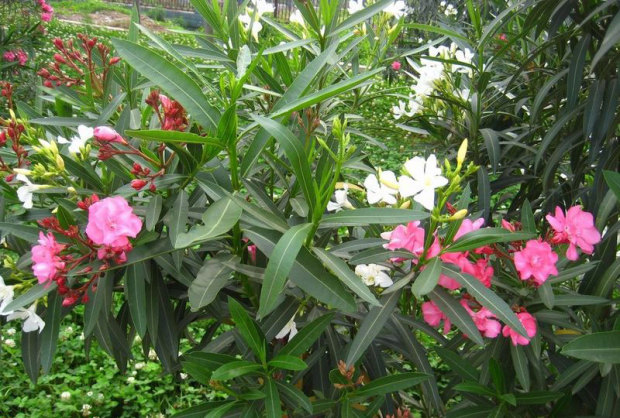
Cultivation is relatively simple; in the Jiangsu-Zhejiang area it is a common flowering shrub in courtyards. In various parts of North China it is not tolerant of severe cold and can only be grown in pots; if planted in the ground in a courtyard, it must be dug up at the end of autumn, potted, and moved indoors to overwinter. For potted plants, move them outdoors in mid-to-late April of early spring for repotting and application of base fertilizer. In summer, water appropriately more, and every 10-15 days water with a dilute, well-rotted fertilizer solution to promote vigorous growth.
Every evening, spray and wash the branches and leaves with clear water to keep the air moist and the branches and leaves fresh. After 2-3 years of flowering, the old branches have weakened, so a heavy pruning should be carried out to promote the regrowth of thick branches and abundant flowering. When pruning, generally keep 3 main branches on each plant's trunk, and keep 3 branchlets on each of these, so that in the future a crown of "three forks and nine tips" is formed. In order to promote rapid and robust growth, after pruning the plant can be grown in the ground and given sufficient water and fertilizer; in early autumn, transplant it into a pot and move it indoors to overwinter. In winter, the indoor temperature only needs to be kept no lower than 0 degrees: if the temperature is too high during the overwintering dormant period, much nutrition will be consumed, affecting the next year's growth and flowering.
The stems and leaves of the oleander are toxic, and people and livestock must not eat them by mistake; in medicine they can be used to extract cardiac stimulant drugs.
Monthly Calendar for Oleander Cultivation and Care
January
Do a good job of cold protection; the branches should be tied up and supported to prevent snow from pressing and breaking them, and after snow, the accumulated snow should be cleared away promptly.
February
Transplanting is best done in spring; apply base fertilizer in the planting hole, and water thoroughly the first time after planting. Transplanting in other seasons requires a soil ball, and in summer the leaves should also be appropriately thinned to reduce leaf evaporation. For frozen parts, before sprouting, short pruning should be carried out, along with bud removal, etc., to help the tree recover its vigor. For shaping and pruning, generally keep 3 main branches on each plant's trunk, and keep 3 branchlets on each of these, so that in the future a crown of "three branches and nine tips" is formed.
March
For cutting propagation, cut branches 15-20 cm long, tie every 20 into a bundle, immerse them in clear water at 20°C, with 1/3 of the length in the water, and change the water frequently; after 7-10 days, when the submerged part of the branches turns white and the tips begin to become sticky, take them out and insert them in a seedling bed. They can also be soaked in water for 30-40 days, then taken out after rooting and inserted in a sand bed, where they can root in about 1 month. Apply liquid fertilizer once to promote growth and flowering.
April
The plants begin to bloom and continue until October; pay attention to intertillage and weeding, and to pest and disease control.
May
Promptly cut off spent flowers to avoid consuming nutrients.
June
Layering propagation is carried out in the rainy season. Select a plant more than 1 year old with many branches as the mother plant, choose a current-year branch with a diameter of more than 0.8 cm, remove the leaves 33 cm from the tip, twist and injure the bark, bend it into a figure "8", and press it into the soil to a depth of about 10 cm, then cover with soil and press firm to prevent the branch from popping out of the soil after watering; water once after pressing, then water whenever it dries, and after about 60 days it can root and be separated.
July
After rain, prevent waterlogging, and promptly weed and remove spent flowers. The oleander has a strong sprouting ability, and during the growing period it will send up many suckers from the base; in order to reduce nutrient consumption and maintain a good appearance, these should be promptly removed or cut off.
August
Same management as the previous month.
September
Same management as the previous month.
October
Same management as the previous month.
November
After flowering, apply phosphorus and potassium fertilizer once to promote robust growth.
December
Do a good job of earthing up and cold protection; small seedlings should be wrapped in straw to prevent freezing, and carry out one pruning of suckers and overly dense branches. Control water, keeping it on the drier side.
Cultivation Techniques for Oleander
Oleander scientific name: Nerium indicum. Aliases: liuyetao. Family and genus: Apocynaceae, genus Nerium. Native to India and Iran. It has been introduced to China for a long time and is cultivated in all regions. Evergreen shrub or small tree. Leaves leathery, narrowly long, in whorls of 3, also opposite in 4s and 2s, leaf surface glossy, lateral veins pinnately parallel and densely arranged, margins revolute. Cyme terminal, corolla red or white, single or double, fragrant. Fruit long-horned. Flowering period June-September, fruiting period December-the following January. Common varieties in cultivation include: white oleander var. leucanthum, flowers pure white. Double oleander var. plenum, flowers red, double. Among plants of the same genus commonly cultivated for ornament is also the European oleander N. oleander, flowers clustered at the branch tips, peach-red, native to the Mediterranean region. The oleander has green leaves like willow and bamboo, and clusters of red flowers bright like peach; from summer to autumn they open in succession. It is suitable for group planting in parks, green spaces, roadsides, lawn edges, and traffic islands, and can clothe the flower-scarce summer in the spring garb of "red peach and green willow", reflecting a landscape of myriad purples and reds; it is also suitable as a pollution-resistant tree species in industrial and mining areas; potted ornament is also very appropriate, with brilliant flowers and a long flowering period; it can also be cut as cut-flower material. The whole plant is highly toxic, and it is dangerous if people or livestock eat it by mistake, so planting near wells and drinking water pools should be avoided. Cultivation Techniques for Oleander. The oleander likes sunlight and can also adapt to relatively shady environments. It likes a warm, humid climate, is not cold-tolerant, and fears waterlogging. It is not strict about soil, but well-drained, fertile neutral soil is most suitable; slightly acidic and mildly alkaline soil can also be tolerated. The tree is vigorous and has strong resistance to and absorption capacity for toxic gases such as sulfur dioxide and chlorine. The plant base and branches have strong sprouting ability and tolerate pruning. Propagation is mainly by cuttings, and it can also be propagated by division, layering, or sowing. Cuttings can be taken in spring and summer; before cutting, if the base of the cuttings is soaked in clear water for 7-10 days and the soaking water is kept fresh, they can root earlier after insertion and the survival rate is also high; they can also be rooted entirely in water at a water temperature of 20°C, changing the water frequently, and after rooting they are transplanted to a seedling bed for care, which also works well. Transplanting is best in spring; when lifting seedlings, medium and small seedlings need to retain more of the original soil, and large seedlings need a soil ball. When transplanting in summer, branches and leaves should also be thinned to reduce leaf water transpiration. In cold regions it can also be potted, and the minimum overwintering temperature needs to be above 5°C.