A Detailed Guide to the Cultivation and Growing Methods of Rosa xanthina
It mostly grows on sunny slopes at an altitude of 600-1200 m. It likes sunny, dry conditions, is cold-hardy and drought-tolerant, tolerates poor soil, and dislikes waterlogging. The wild species bears fruit after flowering, spherical and purplish-red. The cultivated double-flowered form rarely sets fruit.
For propagation, the cultivated species mostly uses division. When dividing, first cut the branches back hard, leaving only 30-50 cm, then dig up the whole plant with the roots and split the roots with a sharp knife or axe. When splitting the roots, note that each divided clump should have 3-5 branches, and all branches should have good roots beneath them. Layering can also be used for propagation; in recent years a method for rooting cuttings has also been worked out, mainly requiring bottom heat in the cutting bed and maintaining relatively high humidity, with good roots forming in about a month. When growing Rosa xanthina, choose a sunny, dry spot; in shady places it often grows thin and weak from insufficient light, with fewer and smaller flowers and fewer petals.
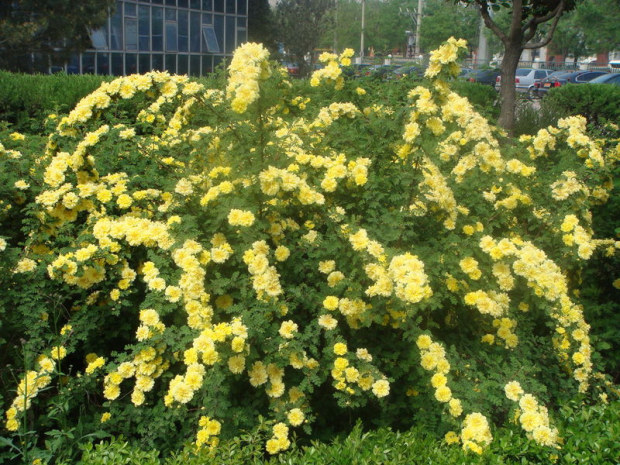
When newly planted, apply some organic fertilizer appropriately. For plants that have been hard-pruned and divided, if water and fertilizer are managed well after planting, they will flower well the following year. After the flowers fade, it is best to cut off the spent flowers together with some branches, which keeps the clump tidy and encourages new branching. Over-old branches should also be hard-pruned appropriately for renewal.
[Rosa xanthina] Cultivation Techniques and Prices for Rosa xanthina
Basic Introduction
First we need to know what Rosa xanthina is. It belongs to the deciduous shrub category, its flowering period is between May and June, and its fruit is red-yellow. It is also the city flower of Fuxin City, Liaoning Province. In southern Shanxi it is commonly known as “Maruzi”. So today let us seriously learn about knowledge related to Rosa xanthina.
Growth Habits
Rosa xanthina likes sunlight and can also tolerate slight shade, and its cold hardiness is very strong. However, it is not strict about soil, can tolerate drought and poor soil, and can even grow in saline-alkaline soil, though planting in loose, fertile soil is best. It does not tolerate waterlogging. It belongs to the deciduous shrub category. It also has few pests and diseases.
Growing Methods
The main propagation method we use for Rosa xanthina is still division. Because Rosa xanthina has very strong tillering ability, and the double-flowered form generally does not set fruit, division propagation is the simplest, fastest method with a high survival rate. For the single-flowered form, sowing can also be used. Cuttings and layering can also be used for propagation. Because Rosa xanthina is mostly cultivated and used in the north, where the average temperature in spring is relatively low, we can mostly use softwood cuttings, and in the north in early to mid-June we can select semi-lignified current-year branches for cuttings, using the same method as spring cuttings of roses. For division, carry it out in early spring before buds sprout and after the ground thaws. When dividing, first cut the branches back hard, dig up the whole plant with the roots, split the roots with a sharp knife, and then plant out; after planting, strengthen fertilizer and water management.
Management
Rosa xanthina is generally planted from late March to early April. It should be planted with a soil ball. When planting, apply 1-2 shovel-loads of decomposed compost in the hole as a base fertilizer, cut back hard after planting, water thoroughly after planting, and water once more after about 3 days, and it will survive. After surviving, it generally does not need further fertilizing, but to make it flourish, a topdressing can be applied once after flowering every other year. In daily management, water promptly according to drought conditions, to avoid wilting or even death caused by excessive drought and lack of water. In the rainy season, pay attention to drainage and waterlogging prevention, and before frost, water once with anti-freezing water. After flowering, prune to remove spent flowers and dead branches to reduce nutrient consumption. After leaf fall or before bud break, prune together with division, cutting out old branches, dead branches and overly dense, thin, weak branches to make it grow vigorously. For 1-2 year old branches, cut back as little as possible to avoid reducing the number of flowers. Rosa xanthina is easy to grow, requires extensive management, and has few pests and diseases.
Price
The most recent price for Rosa xanthina is around 5 yuan, varying from 4-5 yuan.
Growing and Management Methods for Rosa xanthina
Rosa xanthina, Latin scientific name: Rosa xanthina Lindl, deciduous shrub. Branchlets brown or brownish-red, with thorns. Odd-pinnate compound leaves, leaflets usually 7-13, nearly round or elliptical, with serrated edges; stipules small, lower part joined to the petiole, apex divided into lanceolate lobes, edges glandular, nearly entire. Flowers yellow, single or semi-double, without bracts. Flowering period May-June. Fruit spherical, red-yellow. Fruiting period July-August. City flower of Fuxin City, Liaoning Province. Commonly known in southern Shanxi as “Maruzi”. Growing methods: Rosa xanthina is mainly grown by division. Because Rosa xanthina has strong tillering ability, and the double-flowered form generally does not set fruit, division growing is simple, fast, and has a high survival rate. For the single-flowered form, sowing can also be used. Cuttings and layering can also be used for growing.Division growing: generally carried out in late March before buds sprout. Dig out the entire clump, divide it into several portions, each portion retaining at least 1-2 branches and part of the root system, then replant them separately and water thoroughly after planting.
Grafting. Use easily rooted wild Rosa species as rootstock, and current-year branches of Rosa xanthina as scion, grafting from December to early January of the following year. The rootstock length is about 15 cm; take a Rosa xanthina bud with a little xylem, cut the upper end of the rootstock with wood, then press the Rosa xanthina bud against it and bind tightly with plastic film, tie in bundles of 50 plants, dip in mud slurry and store in damp sand to promote healing and rooting. After mid-March, plant out separately for seedling raising, with a spacing of 20 cm×40 cm, and the survival rate is about 40%.
Cuttings. In the rainy season, cut current-year lignified branches, with cuttings 10-15 cm long, retaining 2-3 leaves, insert 1-2 cm into sand, with a spacing of 5 cm×7 cm. Division is carried out in early spring when buds sprout. For layering, in July press the young branches into the soil.
Cultivation management: sun-loving, slightly shade-tolerant, strongly cold-hardy. Not strict about soil, tolerates drought and poor soil, and can also grow in saline-alkaline soil. Does not tolerate waterlogging. It is a deciduous shrub.
Rosa xanthina is generally planted from late March to early April. It should be planted with a soil ball. When planting, apply 1-2 shovel-loads of decomposed compost in the hole as a base fertilizer, cut back hard after planting, water thoroughly after planting, and water once more after about 3 days, and it will survive. After surviving, it generally does not need further fertilizing, but to make it flourish, a topdressing can be applied once after flowering every other year. In daily management, water promptly according to drought conditions, to avoid wilting or even death caused by excessive drought and lack of water. In the rainy season, pay attention to drainage and waterlogging prevention, and before frost, water once with anti-freezing water. After flowering, prune to remove spent flowers and dead branches to reduce nutrient consumption. After leaf fall or before bud break, prune together with division, cutting out old branches, dead branches and overly dense, thin, weak branches to make it grow vigorously. For 1-2 year old branches, cut back as little as possible to avoid reducing the number of flowers. Rosa xanthina is easy to grow, requires extensive management, and has few pests and diseases.