How to grow purple shamrock so it flourishes into a full pot? Six tips to make it beautiful and vigorous
Among the plants in the genus Oxalis, the purple shamrock (Oxalis triangularis), native to South America, is known for its brilliantly colored flowers. It is not only easy to grow but also grows very fast. However, to make it both beautiful and vigorous, some tips are still needed. So how do you get purple shamrock to flourish into a full pot? Below, the editor will teach you six tips.
How to get purple shamrock to flourish into a full pot
1. Light should be moderate
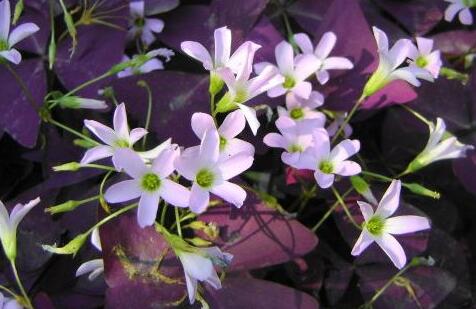
When planting, it is best to place it in a semi-lit environment, such as under the eaves, indoors near a window, on a balcony, and so on. Do not let purple shamrock be exposed to direct sunlight, and at the same time avoid an environment with too little light, otherwise the leaf color will become dull and the plant shape may become leggy.
2. Water should not be excessive
In the care methods for purple shamrock, it is best to use spray irrigation when watering. The method is to spray water onto the plant with a spray bottle. Besides rinsing the leaves, the excess water will naturally flow into the soil and be absorbed by the roots. However, be careful not to water too often. Wait until the soil is slightly dry before watering again, and never let water accumulate.
3. Pruning should be timely
Many flower enthusiasts water reasonably well, but still do not find that it grows very fast, so how do you get purple shamrock to flourish into a full pot? At this point, pruning also needs to be done well. Some branches and leaves intertwine because they grow quickly, which not only hinders light penetration but also affects the sprouting of new buds. Therefore, pay attention to observation during daily care, and when you find a large number of dense branches and leaves, thin them out.
4. Change the pot and soil regularly
The soil used for growing purple shamrock should be replaced every 1 or 2 years to avoid the soil becoming dry and hard, poorly aerated, and poorly drained, and also to reduce the possibility of pests lurking in the soil. The replacement soil is best disinfected to ensure a good soil environment, which is conducive to getting it to flourish into a full pot.
5. Temperature should be suitable
In summer, try to keep the environment around purple shamrock below 30°C. If the outdoor temperature is high, it can be moved to a cooler place. In winter, ensure the temperature stays above 5°C so that it can enter dormancy smoothly without being frostbitten. Only with proper dormancy can it grow more vigorously the following year.
6. Prevent pests and diseases
The more common pests of purple shamrock include purple wood sorrel mite, tobacco thrips, North China mole cricket, wild slug, and so on, while its common diseases include leaf spot, root rot, and so on. They are extremely harmful to Oxalis, but we can reduce the occurrence of pests and diseases by strengthening care management, and the method is to keep the environment suitable.
Seven flowers that bloom better the more rain they get, easy to grow and very fresh and beautiful!
Recently, all parts of the country have been washed by heavy rain. Many people say that their outdoor-grown flowers have been battered, with withered branches and fallen leaves everywhere, a miserable sight. But some flowers bloom better the more rain they get; when wind and rain come together, that is the day they hold their heads high and bloom in full glory. Today, the editor will introduce which flowers these are!
1. Rain lily
Rain lily often blooms suddenly after heavy rain. Its leaves are like orchid grass, so it is called rain lily, and because its flower shape resembles a lily, it is also called rain lily. Rain lily is especially easy to grow; usually just rough care is enough, without meticulous attention.
Care points
1. Soil: Rain lily has low soil requirements. When planted in the ground, it can grow however you care for it. For potted soil, sandy soil can be mixed with leaf mold and garden soil.
2. Watering: There is no need to water at a fixed frequency; judge by the weather conditions and whether the pot soil is dry or wet. In summer, water in the morning and evening, keeping the pot soil moist.
3. Light: It is best to place rain lily in a sunny environment. As long as it is not exposed to strong sunlight, it can safely pass the summer.
4. Fertilizing: Fertilize less in summer; applying a thin compound fertilizer once every 2 months is enough.
5. Pruning: Generally, rain lily can bloom until September. After the flowers fade, cut short the spent flower stems and thin branches to prevent leggy growth.
2. Purple shamrock
Purple shamrock likes a humid environment and always grows impressively during the plum rain season. Proper rain exposure helps the growth and development of flowers and leaves. As long as accumulated water is drained in time, the flowering period can last as long as 8 months.
Care points
1. Temperature: When the summer temperature exceeds 35°C, purple shamrock will slowly enter a semi-dormant period, showing signs such as curled and dried leaves. At this time, ventilation must be strengthened and water sprayed to lower the temperature.
2. Watering: After semi-dormancy, reduce watering and frequently spray the leaves, keeping the pot soil slightly moist. After rain, drain accumulated water to avoid root rot.
3. Light: Purple shamrock leaves have strong phototropism. During growth, frequently turn the flower pot so the plant shape is more attractive, but when the light is too strong, provide shade to avoid sunscald.
4. Pruning: When the plant grows too vigorously and the leaves are too dense, be sure to prune or directly cut back the top. This can improve ventilation, reduce the occurrence of pests and diseases, and also allow new leaves to grow, making the plant shape more attractive.
3. Cyrtanthus
The delicate and compact cyrtanthus especially likes a humid environment. Some flower enthusiasts exposed cyrtanthus to rain for 2 months during the plum rain season, and it was not damaged. Instead, after a period of time, it bloomed another round of flowers!
Care points
1. Soil: Fertile, loose, well-drained sandy soil, peat soil, or leaf mold are all suitable.
2. Watering: Cyrtanthus does not like overly dry soil. Except in winter, water diligently at other times to keep the soil moist.
3. Light: Cyrtanthus likes light. It needs full sun in the morning and afternoon, with appropriate shading at noon.
4. Lotus
Lotus, as an aquatic plant, will not have its growth or flowering affected by proper rain exposure. After rain, the lotus is bright and beautiful, clear and elegant, just as the saying goes, "a lotus fresh from clear water."
Care points
1. Soil: Lotus likes slightly acidic soil. Fertile river mud, pond mud, and paddy field mud are all natural slightly acidic soils, suitable for lotus growth!
2. Light: Lotus is extremely intolerant of shade and needs full-sun management. With insufficient light, it is prone to disease, and the flowers will gradually close.
3. Watering: Summer is the vigorous growth period for lotus. Potted lotus must not lack water; when you see wilting, water immediately. Note: let tap water sit for one or two days before use.
4. Fertilizing: Lotus likes fertilizer. In summer, during vigorous growth and the flowering period, apply once a week a topdressing of decomposed cake fertilizer water or diluted liquid compound fertilizer. If the soil itself is fertile enough, no fertilizing is needed all year.
5. Pennywort
Pennywort is robust by nature and amphibious, and it best withstands wind, sun, and rain. In summer, grow it in a water vat, and within no more than two days it will fill the pot, round and lush green, just looking at it lifts your mood.
Care points
1. Soil: Pennywort has low soil requirements; loose, breathable, well-drained soil is enough.
2. Watering: Summer temperatures are high, and pennywort has many leaves, so water is easily lost. Water once each morning and evening, and also spray frequently to maintain moisture and lower the temperature.
3. Light: Pennywort likes light, and each day it should receive 4-6 hours of light.
4. Fertilizing: During the vigorous growth period, apply a thin liquid nitrogen fertilizer once every 2-3 weeks, applying thin fertilizer frequently.
6. Maidenhair fern
Maidenhair fern was originally a wild fern, mostly growing in dark, damp environments. After rain, its growth speed increases, and it is especially suitable for rooms with poor lighting.
Care points
1. Soil: Calcareous soil or leaf mold mixed with river sand is more suitable for the growth of maidenhair fern.
2. Watering: Maidenhair fern likes water and should be watered 1-2 times a day. If it lacks water, the leaves will shrivel.
3. Light: Maidenhair fern is suited to a semi-shaded environment. In summer, it is best placed on a north-facing windowsill, and outdoors it needs shading.
4. Fertilizing: Apply a thin liquid fertilizer 2-3 times a month. When fertilizing, do not let it soil the leaf surface, to avoid causing leaf rot. You can also add crushed eggshells to the pot soil to supplement the calcium needed for plant growth.
7. Mint
Mint has very strong vitality. Because it likes light and moisture, it is very tolerant of sun and rain. In summer, place it on a south-facing balcony, give it plenty of water, and it will flourish into a full pot.
Care points
1. Soil: Ordinary garden soil, humus soil, and sandy loam are all fine.
2. Watering: In summer, be sure to water enough, once each morning and evening, keeping the pot soil moist. Be careful not to let water accumulate, to avoid root rot.
3. Light: Mint is a long-day plant. Even direct light will not scorch it. On the contrary, with insufficient light, the leaves will become dull and wither.
4. Pinching: Mint grows vigorously in summer, and it must be pinched frequently to flourish into a full pot.
These are the seven flowers above. Which one do you like best? The editor's favorite is pennywort. Its round little leaves are very cute, and a pot of lush green is especially refreshing to look at. If you want to grow outdoor flowers that are not afraid of heavy rain, you can choose it.
A Practical Guide to Home Flower Growing (Part Two)
61.Where to place small and medium-sized foliage plants indoors?Generally, plants under 1 m are called small and medium-sized foliage plants. The small and medium-sized ones mentioned here do not include hanging foliage plants.
Compared with large plants, small and medium-sized foliage plants are much richer in both variety and color. They mainly include: various ferns, baby rubber plant, copperleaf, poinsettia, clivia, wax begonia, coleus, aluminum plant, dieffenbachia, anthurium, caladium, umbrella plant, cast iron plant, asparagus fern, echeveria, jade plant, purple velvet plant, sedum, aloe, arrowhead plant, asparagus, bromeliads, maranta, snake plant, and so on.
For these plants, according to their ecological conditions and the size and shape of the plants, place them on windowsills, flower stands, coffee tables, writing desks, and so on. Do not place too many, otherwise it gives a dizzying feeling. In young people's rooms, more brightly colored plants can be placed, such as coleus, caladium, and purple velvet plant; in elderly people's rooms, choose more plants with fresh, elegant tones, such as arrowhead plant, philodendron, and baby rubber plant. If in a room where children are active, placing a pot of mimosa can better satisfy children's innocent and curious minds and, intentionally or not, increase their knowledge. But note that the sap of dieffenbachia is somewhat toxic and should not be placed where children can touch it.
62.What is the relationship between flower growth and environmental conditions?
Most amateur flower growers treat their flowers as treasures and care for them meticulously. Yet even when growing flowers the same way, some grow lush flowers and leaves, while others often fail to bloom or end up killing the plants. So people say growing flowers requires "flower affinity." In fact, the so-called "flower affinity" is simply the environmental conditions suitable for flower growth. These environmental conditions include 6 aspects: temperature, light, moisture, air, soil, and fertilizer. Each kind of flower has its own unique requirements for these environmental conditions. Only by understanding their habits and, according to the temperature, humidity, light, and other conditions of their place of origin, trying as much as possible to create an artificial, suitable micro-environment, can the various organs of the flowers grow and develop healthily and greet guests with graceful beauty.
63.How can you grow flowers well?
The factors for growing flowers well are many-sided, especially for growing potted flowers on a home balcony, which involves even more. To grow flowers well, at the very least you need the following three aspects of basic knowledge.
(1) Understand the functions of each part and organ of flowers and trees. Flowers and trees generally have 6 kinds of organs: roots, stems, leaves, flowers, fruits, and seeds. Roots can fix the flower or tree in the soil and absorb water and nutrients from the soil. Stems can support leaves, flowers, and fruits, and transport the water and nutrients absorbed by the roots and the organic nutrients made by the leaves. Leaves can make organic nutrients and also perform respiration and transpiration. Although the functions of the three organs roots, stems, and leaves are different, they are related to the nutrition of the flower or tree, so they are all vegetative organs.
After a flower or tree grows and matures, it blooms; after the flowers fade, it forms fruit, and the fruit contains seeds. Mature seeds fall into a suitable environment and grow into a new flower or tree. Flowers, fruits, seeds, and so on are all related to reproducing offspring, so they are all reproductive organs.
(2) Understand the growth habits of flowers and trees. Some flowers and trees like sun, some tolerate shade; some like warmth, some endure cold; some fear cold, some fear heat; some like sunlight in winter but need shade in summer; generally flowers and trees like loose soil, but a few like heavy clay soil; some flowers and trees have strict requirements for soil pH, while others do not; generally flowers like fertilizer, but a few flowers do not.
(3) Understand what characteristics the climate, soil quality, and other conditions of the places of origin of various flowers and trees have. What influence do these characteristics have on their growth habits? How were they introduced? What changes occurred after introduction? Once these situations are clear, you can choose flowers and trees suitable for your region to plant, and you can also artificially create for different flowers and trees a special microclimate environment and soil type that meets their needs. In this way, you will not plant jasmine in a shaded window or plant hosta on a sunny balcony. Otherwise, even if the flower grower works tirelessly, the flowers cannot be grown well.
Once you have clarified the functions of the various organs of flowers and trees, and also understood their growth habits and their relationship with external environmental conditions, you can follow their patterns in planting and achieve the expected goal of growing flowers well.
A Practical Guide to Home Flower Growing (Part Two)
64.Which foliage plants are most averse to low temperatures?
Many plants can only live in medium-temperature or high-temperature environments. They are least able to endure low temperatures; otherwise they will suffer various kinds of cold damage, or even die. Therefore, special attention should be paid during cultivation.The optimal growth temperature for Alocasia lowii is 20-30°C, and the winter room temperature cannot be lower than 18°C; croton drops leaves when it encounters cold; ferns are also averse to low temperatures, but among them maidenhair fern can endure 10°C; plants of the genus Maranta are the most averse to low temperatures. If the environmental temperature is below 15°C, the leaves will curl, shrivel, turn yellow, and even fall off. Among them, Maranta roseopicta and Maranta leopardina require even higher temperatures; arrowhead plant, golden pothos, and others grow poorly when the temperature is below 10°C for a short period, and may even develop yellow leaves and leaf drop; baby rubber plant types will suffer cold damage below 10°C, often with black spots appearing on the leaves. In addition, philodendron, Fittonia, and others are also averse to cold environments.
Therefore, if the indoor temperature in winter is often or occasionally below 15°C, then you need to be very careful when choosing foliage plants.
65.What light requirements do flowers have?
The growth and development of flowers have two aspects of light requirements, namely light intensity and duration.Flowers are usually divided into two groups: sun-loving and shade-loving. Those that need to grow well under light, such as Chinese rose, pomegranate, chrysanthemum, narcissus, scutellaria, oxalis, lotus, and so on, are sun-loving flowers. If these flowers are placed in a shaded environment where light intensity is insufficient, they often produce slender branches, elongated internodes, thinner leaves, poor leaf color, and are also prone to pest and disease attack. Shade-loving flowers refer to flowers originally growing on shady slopes or in relatively shaded and humid forest environments. Most do not like direct strong light, especially in hot seasons when they need varying degrees of shading, and attention should be paid to appropriately increasing air humidity. Shade-loving examples include wax begonia, maidenhair fern, impatiens, asparagus fern, fuchsia, orchid, clivia, rhododendron, monstera, dieffenbachia, and so on.
66.What should be done when indoor light is insufficient when cultivating foliage plants?
Plants placed indoors cannot receive the most ideal light due to the limitations of sunlight exposure. But artificial methods can be used to make up for the lack of light.
If you feel the daytime light period is too short, you can use fluorescent lamps or incandescent lamps every evening to add several hours of light. The light they emit can also enable plants to carry out photosynthesis. But the light intensity is limited, so place the fluorescent lamp or incandescent lamp close, at 30-40 cm from the plant. For example, African violet needs ample sunlight; placing it under a desk lamp indoors every night can make it bloom abundantly and grow lush leaves. But even this is only about 5%-10% of sunlight.
Some people also place a mirror by a sunny window to refract light into dark indoor areas, letting plants placed in dark areas grow by the refracted light. This can also enhance the lighting effect.
A Practical Guide to Home Flower Growing (Part Two)
67.Why watering is the key to growing flowers?
A flower proverb says: "Whether it lives or not depends on water; whether it grows or not depends on fertilizer." Watering is the key to success or failure in growing flowers. Many beginners in flower growing are mostly confused about how much to water: "The book says not too much and not too little, so what counts as neither too much nor too little?" In fact, how much to water first depends on what kind of flower is planted, whether it likes dry conditions, likes moisture, or is semi-dry. Never treat all flowers the same: if there are 10 pots of flowers at home, water them all together and let them dry together. Water is the source of plant life, but an excessively wet soil environment will make the roots of some drought-loving flowers unable to breathe, then rot and die. If the roots die, of course the flowers cannot survive either. Therefore, to grow flowers well, the first step is to understand each flower's water requirements. First keep it alive; only then can you talk about blooming.68.How to water potted flowers?
Potted flowers are limited by specific environmental conditions, and watering is not only troublesome but also the key to success or failure. To water just right, you must first understand the natural habits of different varieties of flowers and how much water they need at each stage of growth and development; you also need to look at whether the weather is cloudy or clear, the temperature and humidity levels, the type of flower pot, the size of the plant, and the texture of the pot soil.Watering potted flowers generally includes the following situations and methods:
(1) Watering. In spring, summer, and autumn, water before 10 a.m.; in winter, water at 2 p.m. Make sure the water temperature is close to the soil temperature, slightly higher in winter and slightly lower in summer. But the difference between water and soil temperature should not exceed about 5°C. The amount of water should be such that the pot soil is uniformly moist from the surface to the bottom. Watering must avoid "waist watering" (wet on top, dry below) and "pocket water" (water accumulating at the bottom of the pot). Also avoid soil and fertilizer loss through the pot hole, which can create hollows in the center of the pot and seriously affect the growth and development of potted flowers. When watering, note that drought-loving flowers can have their water amount controlled, keeping the pot soil slightly moist, with the surface soil showing a whitish dry layer but not completely dry. Moisture-loving flowers should have the pot soil kept moist often, with no whitish dry layer on the surface, but water must not accumulate or remain wet for long.
(2) Supplemental watering. In dry periods, at 15:00-16:00, check whether the pot soil is dry or wet and supplement with an appropriate amount of water as needed, aiming to keep the pot soil moist. When the weather changes suddenly and special circumstances require water, watering is not limited by time or frequency.
(3) Generous watering. During the vigorous growth period of potted flowers, to promote shoot growth, plant development, flower forcing, and fruit swelling, combined with topdressing, increase the amount of watering, keeping the surface soil free of a whitish dry layer and the leaves free of wilting.
(4) Restrained watering. During the dormant period or in low-temperature periods, or to control seedling growth, promote bud formation, prevent leggy growth, and correct the phenomena of yellow leaves and bud drop caused by excessive water, appropriately control the amount of watering, keeping the pot soil merely moist, and combine with loosening the soil to conserve moisture.
(5) Spraying water. In dry spring and autumn seasons, in addition to normal watering and supplemental watering, spray water on the leaf surfaces and the flower-growing area to increase environmental humidity, prevent young leaves from scorching and flowers from fading early, and keep the plants fresh. Especially for southern flowers, even more attention should be paid to environmental humidity. After summer rain when it suddenly clears or on stuffy hot evenings, spray water to lower the temperature and prevent disease; whenever spraying water, spray the leaf surfaces clean to prevent residual water droplets and leaf dust from forming stains that are hard to remove.
69.How to master potted flower watering principles such as "water thoroughly only when dry" and "water when dry, stop when wet"?
These watering principles are all summarized according to the water preferences of flowers and trees. For example, potted flowers such as wintersweet, plum blossom, hydrangea, dahlia, and geranium, which like dryness and fear waterlogging, should be watered according to the principle of "water thoroughly only when dry." Only when the surface of the pot soil is completely dry should you water. "Water thoroughly" means do not give "half watering"; the pot soil must be fully soaked from top to bottom. If not watered thoroughly, the root tips cannot absorb water, which affects growth. But watering thoroughly does not mean watering until it leaks. Frequent leakage causes excessive loss of fertilizer and also affects growth.For flowers such as rhododendron, camellia, Chinese rose, gardenia, Aglaia odorata, nandina, hydrangea, and dieffenbachia, which like moisture but cannot tolerate heavy watering, water according to the principle of "water when dry, stop when wet." Water when the pot soil turns pale, and stop once it is moist. Do not wait until the pot soil is completely dry before watering, and do not water heavily. The pot soil should be sometimes dry and sometimes wet; it should neither be dry for a long time nor often soaked through, but alternate between dry and wet.
A Practical Guide to Home Flower Growing (Part Two)
70.Why is it hard for water to seep down when watering potted flowers?
When watering potted flowers, water remains on the surface of the pot soil and does not seep down easily for a long time. There are the following reasons:(1) The potted flower has not been repotted for many years, and the roots have filled the pot and formed a dense mass, making it difficult for water to seep down.
(2) The tile piece over the drainage hole at the bottom of the flower pot is improperly placed and blocks the hole, or the gravel layer at the bottom of the pot is too thin, or no gravel drainage layer was placed, so water seeps poorly.
(3) The newly added pot soil is clayey soil without organic matter or fine sand, so it is very difficult for water to seep through.
In the above situations, choose loam rich in organic matter. If it is clay, appropriately add some fine sand, repot, and cut off excess fibrous roots. Otherwise, over time it will cause yellowing and falling leaves, and death from water accumulation and root rot.
71.How to prune flowers and trees to promote flowering and fruit set?
When cultivating flowers for flower appreciation or fruit viewing, the plant shape should be graceful, the flowers luxuriant and the leaves lush, and the fruit abundant, for seasonal viewing. Therefore, in addition to water and fertilizer management, pruning methods should also be used to regulate the relationship between branch and leaf growth and the development of leaves, flowers, and fruits, so as to promote flowering and fruiting. First consider the number of flowers and fruits and the leaf area, and maintain an appropriate ratio to fully carry out photosynthesis and produce enough nutrients to meet the needs of flowering and fruiting. Fruit-viewing plants especially need sufficient leaves left on the plant. Flowers and trees bloom and fruit at different times, so you must grasp the favorable timing for pruning. Generally, for those that bloom in early spring, flower buds are roughly formed on branches grown the previous year. Therefore, during the dormant period in early winter, severe pruning is not suitable. For example, ornamental peach and plum blossom can only have the autumn shoots without flower buds cut off, but after flowering, a shaping prune should be done.For flowers that bloom on current-year branches, such as crape myrtle, Chinese rose, oleander, poinsettia, and kumquat, severe pruning should be carried out during the dormant period in early winter to concentrate nutrients and promote the production of more strong branches in the following spring. Some flowers and trees generally do not need frequent pruning, such as rhododendron and camellia. To keep the tree shape attractive and symmetrical, you may also appropriately cut off the tips of some branches, but severe pruning should not be done. Vine flowers generally do not need pruning; simply cut off overly old branches, densely growing branches, diseased and pest-infested branches, and blind bud branches to maintain ventilation.
There are also flowers such as hydrangea, which in winter need all branches and leaves cut off so that new shoots and buds grow from the stem base, promoting flower bud formation and making the plant neat and sturdy. For Hippeastrum, after autumn all leaves can be cut off. When brought indoors, it should be placed in a sunny spot, with room temperature kept around 20°C, and it can bloom around the Spring Festival. For common herbaceous flowers such as dianthus, after blooming in June, cut off the aboveground part, and it can bloom another round in autumn.
72.How do balcony potted flowers get through the summer?
From June to August, temperatures gradually rise and there is plenty of rain, which favors the growth of potted flowers, but some flowering plants cannot tolerate high temperatures and their growth stalls. This is especially true on small family balconies, where ventilation is poor and heat builds up easily; during the rainy season, humidity is high and the air is muggy, which can easily cause potted flowers to grow poorly, or even become diseased and die. Therefore, management should be strengthened in terms of shading, ventilation, and water and fertilizer.In mid-to-late May, place bamboo blinds on sunny windowsills for shade, and put shade-loving plants such as rhododendrons, camellias, orchids, daphne, hostas, and chloranthus on flower stands under the bamboo blinds for care, frequently misting the leaves and sprinkling water around the window to increase air humidity. Sun-loving succulents, as well as jasmine, Milan, crape myrtle, and pomegranate, can still be placed on balcony flower stands for cultivation. Roses, gardenias, four-season begonias, and geraniums also need shading during the hot hours from 12:00 to 14:00. Meanwhile, clivia, asparagus fern, water bamboo, and spider plants should be placed in ventilated indoor spots, and protected from direct sunlight.
During the plum rain season in June, do not let potted flowers be exposed to rain, or nutrients will be washed away. If water accumulates in the pots due to rain, lay the pots on their sides to help drainage; otherwise, excessive water will suffocate the root system and cause root rot and death. When humidity is high and temperatures are high, pay attention to observation and strengthen the prevention and control of pests and diseases.
Except for jasmine, Milan, crape myrtle, and four-season begonias, which can continue to bloom even in the hot season and may continue to be fertilized, all other potted flowers should stop being fertilized. Plants that are dormant or semi-dormant in summer, such as fuchsia, lycoris, cyclamen, geranium, poinsettia, calla lily, and epiphyllum, must not be fertilized at all.
For watering, grasp the principle that evaporation is low during the rainy season and the potting soil should be kept on the dry side. As temperatures rise, the amount of watering should also increase, and during high temperatures, water thoroughly both morning and evening. Loosen the soil frequently so that water can penetrate easily and the potting soil will have good aeration, which benefits plant growth. While watering, also sprinkle water around the surrounding environment to lower the temperature.
In addition to strengthening environmental ventilation, for potted flowers with dense branches and leaves, some overly dense small branches and leaves should be thinned out to allow ventilation and light penetration, which benefits growth and also helps in the prevention and control of pests and diseases.
The Complete Practical Guide to Home Flower Growing (Part Two)
73.How do foliage plants overwinter?
The most valuable quality of foliage plants is that they can remain evergreen throughout the four seasons, so they have ornamental value all year round, but their best ornamental period is the stern winter season when everything looks bleak. At this time, outside the window, the cold wind is piercing and all is desolate; inside the window, every leaf is emerald green and full of vitality. Therefore, in winter, the decorative role of foliage plants becomes even more important.To help foliage plants overwinter successfully, first, you must understand and master the ecological habits of the foliage plants you keep. Foliage plants mostly originate from tropical and subtropical regions, and if the indoor temperature can be maintained at 20--25°C, the plants can grow normally. But if they are exposed to low temperatures, the plants will suffer frost damage in mild cases and die in severe cases. The temperature difference between day and night in the room should be as small as possible. During the day, the indoor temperature should be no lower than 18°C at minimum, and at night, the indoor temperature should be no lower than 8°C at minimum. If the indoor temperature is within this range, most foliage plants can overwinter safely, such as ivy, cordyline, spider plant, and dragon tree.
In addition, light and the air humidity around the plants are also important factors. In winter, sunlight shines at a slant and light intensity is half that of summer, so some sun-loving foliage plants should be placed near a south-facing window that receives sunlight. Under sufficient light, foliage plants can also keep their branches and leaves green in winter. If light is insufficient, the leaves will become thinner and turn yellow. If indoor air humidity in winter is below 50%, it will not only affect plant growth and the appearance of the leaves, but may also lead to pests and diseases such as red spider mites.
It is best not to place the plants on the windowsill, where the temperature is low and they will also be attacked by cold wind.
In the interiors of modern buildings, both temperature and light can allow foliage plants to overwinter safely. What needs attention is maintaining indoor humidity.
74.How to make the herbaceous flowers in a flower bed bloom uniformly?
The basic requirement of a flower bed is continuous blooming in all four seasons, especially for large flower-cluster beds. Therefore, the design of a flower-cluster bed should include a careful arrangement of flowering periods.To ensure the ornamental effect of a flower-cluster bed, it is not permitted to sow seeds and raise seedlings directly in the flower bed all the way until blooming. Because if this is done, the seedlings cannot grow uniformly, the planting distance cannot be equal, and the flower bed will be occupied by seedling cultivation for a long time with nothing to admire. Therefore, the flower seedlings used to arrange a flower-cluster bed should be specially cultivated in a separate nursery, that is, through the process of sowing and transplanting; if conditions permit, they can also be potted for maintenance, which is even more reliable. When the flowering period approaches and the buds are about to open, select seedlings that are growing well and are uniform in height, transport them together with their pots to the flower bed, and plant them all at once with soil according to the specified dimensions. If planting in the ground, the flower seedlings should be transported to the flower bed with soil balls for planting, so that the plant height can be better guaranteed to be uniform and the blooming uniform.
The planting distance for a flower-cluster bed is based on the standard that the branches and leaves of the seedlings touch one another and do not expose the soil surface; generally, triangular planting is mostly adopted.
75.What is soilless cultivation and soilless seedling raising?
At present, the vast majority of potted flowering plants in our country are cultivated using soil. That is to say, through nutrients in the soil being absorbed by the roots, the flowering plants are promoted to grow, bloom, and bear fruit. In foreign countries, some countries have already adopted materials such as hemp fiber and vermiculite, mixed with liquid fertilizer, as a medium for flower cultivation. Now in some regions of our country, this soilless cultivation method has also begun to be used.Soilless seedling raising refers to not using soil as the medium for cutting propagation and other seedling raising, but instead using river sand, rice husk ash, vermiculite, and water as the seedling-raising medium; this is called soilless seedling raising. This method is currently already widely used in various parts of our country.
The Complete Practical Guide to Home Flower Growing (Part Two)76.How to carry out soilless cultivation?
Using no soil, but instead replacing soil with other substances as a culture medium for potted flower planting, is called soilless cultivation. Although no soil is used, it can still cultivate flowering plants in a riot of colors. It has the advantages of retaining water and fertilizer and being easy to handle, and it does not have the disadvantages of mud stains and soil being too heavy, so it is currently favored by people. There are many soilless cultivation methods, but most formulas are rather cumbersome and the raw materials are difficult to assemble, making them unsuitable for home flower growing. Below are two simple and easy soilless cultivation materials.Sawdust medium: Mix 70% sawdust and 30% poultry manure, or crushed cake fertilizer, evenly and pile them up, add some human urine and feces, and after full fermentation, it can be used to cultivate flowering plants. If some coal ball ash is added, the air permeability and water seepage performance will be even better.
Vermiculite medium: Vermiculite is a lightweight mineral substance and is used in industry as a thermal insulation material. Mix vermiculite and fermented horse manure in a ratio of 4:1 and stir well, and it can be used as a medium for cultivating flowering plants. Horse manure is acidic, so it is suitable for cultivating southern flowering plants that prefer acidic soil.
These two media are both very loose, both air-permeable and water-permeable, will not become compacted, and also have strong water- and fertilizer-retaining capacity, which benefits rooting and development of flowering plants. When transplanting and repotting, they are easy to handle and will not damage the roots. Because they are light in weight and the raw materials are not difficult to obtain, they are very suitable for home potting.
77.What substrates are commonly used in soilless cultivation?
The cultivation substrate mainly serves to fix the plant, retain moisture, store nutrients, and increase air content. After the substrate is selected, attention should be paid to disinfecting the substrate. At home, methods such as pouring hot water, steaming in a pot, or stir-frying in a pan can be used, or it can be sprayed several times with a 0.2% potassium permanganate solution.78.Is there any flower that can be cultivated indoors without soil?
Chinese evergreen can be cultivated indoors without soil. It is a perennial evergreen herb with jointed stems that do not branch, hence it is also called bamboo-joint evergreen. The leaves are ovate or elliptic-ovate, 10-20 cm long and 4--8 cm wide, bright green and clustered. There is also a variety with irregular golden-yellow spots scattered on the leaves; both are good indoor foliage varieties.The stems of Chinese evergreen root very easily; inserted in a bottle of clear water, they can not only be enjoyed for their leaves for a long time, but will also grow tender roots and become new plants. Its stem and leaf sap is toxic, so when cutting and dividing plants, never let the sap splash into the mouth or eyes. For potted plants, fertile, loose, slightly acidic soil can be used; as long as intense sunlight is avoided and the potting soil is kept moist, no special management is needed.
79.Can foliage plants grow in water?
Some foliage plants can also grow completely submerged in water like aquatic plants, for example, Chinese evergreen, arrowhead plant, peace lily, Peperomia species, and Brazilian wood can all grow well in water. Planting them in transparent glass containers gives an unexpected ornamental effect.Many foliage plants originate from high-temperature, high-humidity tropical rainforests, love hot and humid environments, and do not adapt to the dry conditions in family rooms. Therefore, some botanists also call these plants amphibious plants that grow on land during the dry season. Planting them in water is therefore very natural and very much in line with the needs of this type of plant.
The Complete Practical Guide to Home Flower Growing (Part Two)
80.How to correctly use nutrient solution?
Containers filled with nutrient solution should be made of ceramic, plastic, or glass materials; iron products cannot be used, otherwise the nutrient solution will become ineffective. It is best to prepare it as needed.Spring and summer are the peak growth periods for plants, and fertilizer demand is relatively high, so generally fertilize once every half month. By autumn, the amount of fertilizer should gradually be reduced, and watering it on once every 1--2 months is sufficient. In winter, due to low temperatures, the plants enter dormancy and stop growing, so no fertilization is needed.
But if the plant has already taken shape, even during the peak growth season, it only needs occasional watering with a small amount of nutrient solution, once every 3--6 months. If fertilized too frequently, the plant will continue to grow, thereby destroying its original shape.
Because the substrate for soilless cultivation itself contains no nutrients, it can only rely on watering with nutrient solution to supply plant growth. Nutrient solution is both scientific and hygienic, and cannot be replaced by other fertilizers.
81.How to collect and store flower seeds?
When collecting seeds of herbaceous flowers, first you must master the seed maturity period and degree of maturity. When seeds are mature, the petals dry up and the seeds are firm and glossy. At the same time, collection must be timely, so as to avoid mold and rot from rainy weather or scattering and loss. On the same plant, choose seeds from flowers that bloomed early and matured early to keep for seed. If variation is found in flowers or color, they should be collected and planted separately. The method of collecting flower seeds varies with the type of herbaceous flower. For some, the entire flower can be picked off and air-dried to obtain seeds, such as cockscomb and scarlet sage; for others, the fruit can be rubbed and washed to remove the flesh and then sun-dried to separate out the seeds, such as golden eggplant and winter cherry. There are also some seeds whose fruit skins easily split and scatter after maturity, so they should be collected in time when the fruit changes from green to yellow and the seeds feel loose to the touch, such as garden balsam and pansy.Common methods for storing flower seeds include dry storage, sand storage, and water storage.
Dry storage: Most flowers can have their seeds dried in the shade, cleaned of debris, and put into bottles or thick paper bags, such as scarlet sage and cyclamen. Place them in a ventilated room, and the room temperature is required to fluctuate little (5--10°C).
Sand storage: Bury the collected seeds in moist sandy soil, keeping the soil temperature at 0--5°C. This type of seed has a dormant period under natural conditions; take them out one month before sowing, such as peony and Chinese peony.
Water storage: Some seeds should be soaked in water after collection, such as water lily; the water temperature is required to be kept at 5°C.
All kinds of seeds should not be exposed to the sun; they should be stored in a dark place, and attention should be paid to preventing moisture and rodent damage.
The Complete Practical Guide to Home Flower Growing (Part Two)
82.What methods are commonly used for sowing herbaceous flowers?
The methods commonly used for sowing herbaceous flowers are broadcast sowing, row sowing, and dibble sowing.Broadcast sowing: Commonly used for smaller seeds, such as China aster, Michaelmas daisy, and snapdragon. Before sowing, first break the soil into fine particles and level it, water it thoroughly, and after 1--2 hours, evenly scatter the seeds over the seedbed or flowerpot, then cover with fine soil just until the seeds can no longer be seen. For seedbed sowing, in spring it is best to cover with plastic film and reed blinds, while in autumn cover only with reed blinds; before sowing, water thoroughly, and generally no watering is needed before emergence; if necessary, water with a fine-spout watering can. For pot sowing, cover with glass and newspaper to retain moisture and warmth; if necessary, immerse the pot to let water seep up, and do not water directly, otherwise the seeds will be washed out or silted to one side and the germination rate will be affected. After the young shoots emerge, gradually remove the covering. For particularly tiny seeds such as gloxinia, calceolaria, and four-season begonia, the seeds should be mixed with 3--4 times their amount of fine sand and broadcast in the flowerpot, with no further soil covering needed.
Row sowing: Open shallow furrows in the seedbed or potting soil, sow the seeds into the furrows, and press level. Other management is the same as for broadcast sowing. Row sowing is mostly used for taproot flowers that are not suitable for transplanting, such as corn poppy and morning glory.
Dibble sowing: Large seeds can be sown one by one, such as four o'clock flower and nasturtium, with the covering soil thickness equivalent to about 3 times the diameter of the seed.
After the seeds germinate, water should be appropriately reduced to harden the seedlings, and overly dense seedlings should be thinned in time to maintain ventilation and light penetration. When 2--3 true leaves have grown, divide the seedlings; those tolerant of transplanting can be moved another 1--2 times, such as China aster and garden balsam, and then finally planted in flowerpots or flower beds and other places. Some herbaceous flowers are not suitable for transplanting, such as corn poppy and cypress vine, and it is best not to transplant them.
It is very important to correctly master the sowing time for each kind of flower. Calceolaria and cineraria grow better when sown in autumn; zinnia has a relatively long growth period and is suitable for spring sowing.
The Complete Practical Guide to Home Flower Growing (Part Two)83.How to sow seeds for home flower growing?
Asparagus fern, clivia, and annual and biennial herbaceous flowers are propagated by sowing. Choose strong, fresh seeds from excellent mother plants. Because some seeds have harder seed coats, they must be treated to facilitate germination. For example, lotus seeds have hard shells, so the top must be rubbed open until the seed coat appears before sowing; seeds such as cyclamen, wintersweet, and wisteria should be soaked for 1--2 days before sowing to promote germination. To prevent the spread of pests and diseases, seeds should be disinfected by soaking for 5 minutes in 0.1% mercuric chloride, 0.3% copper sulfate, or 1% formalin solution, then rinsed clean with water before sowing. As for sowing time, spring sowing should not be earlier than the final frost period; in the middle and lower reaches of the Yangtze River, mid-March is suitable, and autumn sowing can be done in September. Home flower growing uses a small amount of seed, so a sowing pot can be used. If an ordinary clay pot is used, the diameter should not be less than 12 cm; if it is too small, the potting soil dries out easily. The culture soil used for sowing should have good water seepage and should be steam-sterilized in advance. For the drainage hole at the bottom of the pot, cover it crosswise with two arched shards, then fill with 2--3 cm of crushed stone and gravel, then put in 5 cm of culture soil, and on the top layer spread 1 cm of washed river sand as the sowing layer. After sowing, cover with fine sand to 2--3 times the diameter of the seed. Do not water directly; water by the pot immersion method to avoid washing away the seeds. Cover the pot with a piece of glass, and cover the glass with newspaper to block light, so as to maintain the temperature and humidity inside the pot. Turn the glass over once a day to allow ventilation and remove water droplets on the glass. The sowing pot should be placed in a place with direct sunlight and kept at a room temperature of 15--25°C to favor germination. If the temperature is too high, the seedlings tend to grow leggy; if the temperature is too low, the seeds rot easily. After emergence, remove the glass and newspaper, and gradually move the pot to a place with ample sunlight, watering according to whether the potting soil is dry or moist. When the seedlings have grown 2--4 true leaves, transplant them
84.What propagation work can be done for flowering plants in spring?
Between March and April, before new buds sprout on flowering plants and while the sap is not yet flowing, this is exactly the suitable season for propagation, and the survival rate of propagation is high. For example: asparagus fern, broadleaf lady palm, nandina, jasmine, and orchids can be divided and propagated during spring repotting. Spider plant, lotus, and bamboos can be propagated by cutting off new shoots from stolons. Canna, dahlia, and iris can be propagated by dividing tuberous roots and tubers that bear buds. Lily, gladiolus, and narcissus can be propagated by taking the small bulbs produced by their bulbs and corms. Osmanthus, rose, and lilac can be propagated by grafting using their branches. Pomegranate, crape myrtle, honeysuckle, and rose can be propagated by cuttings from their branches; chrysanthemum, four-season begonia, and saxifrage can be propagated by cuttings from their leaves. However, cuttings root easily only when the soil temperature is relatively high at the end of April. Annual herbaceous flowers such as ornamental pepper, scarlet sage, purslane, and China aster can be propagated by sowing.85.Why do some flowers need asexual propagation?
Asexual propagation is the use of branches, buds, leaves, root suckers, tubers, bulbs, and so on from the mother plant to propagate through methods such as cutting, grafting, layering, and division, cultivating new plants.Many flowers cannot set seeds because their ovaries degenerate, such as poinsettia and Chinese hibiscus. Some flowers native to tropical and subtropical regions are also very difficult to flower and fruit in the north, such as Monstera deliciosa, Milan, and jasmine. These flowers therefore require asexual propagation.
Many flowers are excellent varieties selected through crossbreeding, and the superior traits of these varieties can usually be preserved only by adopting asexual propagation methods.
Using asexual propagation methods can enhance stress resistance and increase ornamental value. For example, many varieties of cactus have relatively weak root systems of their own; when grafted onto the stronger-growing three-ribbed arrow cactus, their growth and propagation are both relatively rapid.
86.What are the benefits of using vermiculite and perlite for cutting propagation of flowering plants?
Vermiculite and perlite were originally lightweight thermal insulation building materials, and they have the properties of drainage, heat preservation, moisture retention, many pores, and good aeration, which are exactly the conditions needed for rooting of cuttings. Practice has proved that using these materials for cutting propagation of flowering plants results in fast rooting, less root damage when potting up, and a high survival rate.When using vermiculite and perlite for cutting propagation of flowers, water must be properly controlled to avoid excessive dryness or wetness. When cutting in summer, shading is needed, and in the north they should be covered with plastic film.
Using these materials for cutting propagation of flowering plants, although rooting is fast, because vermiculite and perlite contain no nutrients, the rooted cuttings should be potted up promptly after surviving; otherwise the new roots will quickly "rust" (that is, turn from white to yellow) and gradually die
The Complete Practical Guide to Home Flower Growing (Part Two)
87.Is there a convenient and easy simple method for small-scale cutting propagation in home flower growing?
To ensure the survival of cuttings, the cutting medium and the air must be kept moist, requiring frequent watering and misting. For small-scale home cutting propagation, pot cutting can be used, but watering and misting add quite a bit of trouble. Here is an easy and convenient cutting method that does not require frequent watering and misting.Use a large clay pot with a diameter of more than 20 cm. First place 8 cm of small stones at the bottom, then fill a layer of coarse sand as a drainage layer, and place a small clay pot with a diameter of about 9 cm in the center of the pot. The drainage hole at the bottom of the small clay pot should first be plugged with a cork. Outside the small clay pot and inside the large clay pot, fill in cutting media such as fine sand, vermiculite, or rice husk ash, and insert the cuttings into the medium. Then fill the small clay pot with water, and put a plastic film bag over the large clay pot, cutting a few small holes at the two corners of the bag for ventilation. Because the water in the small clay pot continuously seeps through the pot wall into the surrounding medium, it can maintain the moisture of the cutting medium for a long time. Also, because the mouth of the large clay pot is covered with a plastic film bag, sufficient air humidity is also regularly maintained. This saves the troublesome work of uncovering the bag, watering, and covering the bag to retain moisture every day, while also creating environmental conditions that make it easy for the cuttings to root.
88.Which foliage plants can be propagated by leaf cuttings?
Leaf cutting is a unique propagation method, and not every kind of plant can be propagated by leaves. Foliage plants that can be propagated by leaf cuttings include: umbrella plant, saxifrage, tricolor saxifrage, purple gloxinia, Peperomia species (watermelon peperomia, Peperomia, tricolor peperomia, glossy-leaved peperomia, etc.), foliage begonias (iron cross begonia, rex begonia, etc.), African violet, aloe, succulents, and golden-edged snake plant.89.What is layering propagation?
Bending the lower branches of the mother plant down and burying them in the soil, prompting the adventitious buds at the nodes or internodes to sprout and grow new roots, then cutting them off from the mother plant and planting them separately, thereby forming a new plant: this propagation method is called layering propagation.Layering propagation is mostly used for flowering shrubs with strong clumping habits or vines with soft branches. For some tree and shrub species that are difficult to root, the air-layering method can also be used to let branches in the crown root before detaching from the mother plant, providing more propagation opportunities for flowering plants.
The advantages of layering propagation are that it is easy to survive, the seedlings form quickly, and the operation is simple and convenient. A living branch that has been layered can be layered again the next year, so propagation material is not wasted. The disadvantages are that the plant body cannot be completely renewed, the growth vigor is not strong, and the number of seedlings produced is relatively small, so it is not suitable for use in large-scale seedling production.
90.What is the air-layering method?
For some woody foliage plants, it is not easy to root by cutting stem segments, and at this time the air-layering method can be used for propagation. First make a ring cut in the bark of the branch, then wrap it with moist sphagnum moss or cotton, and tie it securely with plastic film or string. If the branch is soft, a bamboo stick can be used to support the layered part to prevent lodging and breaking. About one month after layering, when roots grow at the ring-cut area, it can be cut off and planted separately. The most suitable time for air-layering propagation is between April and August each year. But for the branch taken by air layering, do not choose old branches; it is best to use one-year-old young branches.The Complete Practical Guide to Home Flower Growing (Part Two)
91.How are flower diseases caused?
The causes of flower diseases: first, poor cultivation environmental conditions, such as too much or too little water, too strong or too weak light, too high or too low temperature, insufficient or imbalanced nutrition, and diseases caused by smoke, dust, and harmful gas pollution. This is also called physiological disease. This type of disease affects the growth and development of flowers, but it is not contagious. Second, infection by pathogens, such as fungi, bacteria, and viruses invading the plant body, among which diseases infected by fungi are the most common. Under suitable environmental conditions, this type of disease can spread and become contagious rapidly.For diseases caused by poor environmental conditions, as long as cultivation management is improved in time to meet the requirements of flower growth and development, the plants will generally recover naturally. But diseases caused by pathogen infection must be prevented and controlled promptly. However, these two types of diseases are also closely related and mutually causal. When flowers grow weakly, they are often more susceptible to disease; sometimes when flowers suffer insect damage, it can also lead to the occurrence of disease.
92.What are the symptoms of physiological diseases of flowers?
During the growth and development of flowers, diseases caused by unsuitable environmental conditions are called physiological diseases. Diseases caused by insufficient nutrients are mainly stunting and chlorosis. If a plant lacks nitrogen, its height growth cannot be ensured; if the soil is too alkaline (in the north) or too acidic (in the south), the plant becomes weak and the leaves scorch. Lack of phosphorus, potassium, and other trace elements can also cause flowers to become chlorotic and withered. Lack of water during the growth and development of flowers can cause withering and stunting; too much water obstructs root respiration and causes rot, and the plant will also turn yellow and wither. Therefore, when leaves turn yellow and wilt, a careful diagnosis should be made before taking measures.
Recommended reading:The Complete Practical Guide to Home Flower Growing (Part One)
The Complete Practical Guide to Home Flower Growing (Part Two)