How to Grow Potted Campanula (Bellflower) and Key Cautions: Temperature Control Is Essential
It is well known that Campanula (bellflower) has many uses and benefits. Its flowers are as graceful as little bells and pleasantly fragrant. Grown at home, it is both ornamental and beautifies the interior. Before growing it, however, you need to understand a few cultivation tips. So how do you grow potted Campanula? Let's look at the growing methods and key cautions for Campanula.
How to Grow Potted Campanula
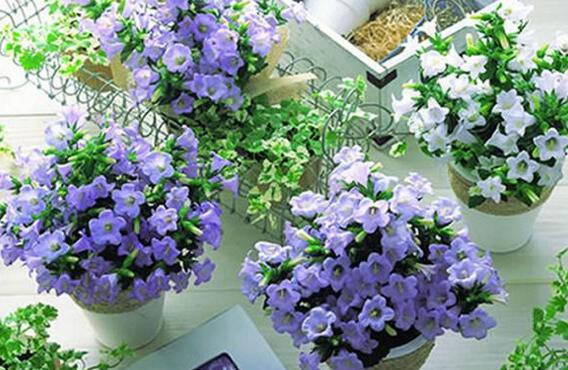
Before planting, you need to be familiar with the growing habits of Campanula. It is characterized by being fairly sensitive to temperature; its optimum growing temperature is 13-18 degrees, in winter the temperature must not fall below 2 degrees, and in summer temperatures above 30 degrees will cause the leaves to turn yellow. It also likes a moist environment with plenty of light, and has low requirements for fertilizer and soil.
Growing Methods and Key Cautions for Campanula
I. Growing Methods for Campanula
1. Soil and Flower Pot
Campanula is generally grown in a shallow pot. The best soil to use is sandy soil, ideally slightly acidic or slightly alkaline, with a pH between 5.5-6.2. If the soil is too acidic, you can add a small amount of lime to neutralize it. You can mix garden soil with livestock manure to make a growing medium.
2. Light
During the germination stage, Campanula does not need light. After germination, you can gradually increase the light. During the vigorous growth period, you need to ensure at least 14 hours of light per day, which will help it bloom earlier and produce more vivid flower colors. In everyday care, however, you only need to ensure fairly abundant light and avoid overly dark conditions.
3. Temperature
Among the growing methods and key cautions for Campanula, temperature is a very important factor, because Campanula is fairly sensitive to temperature. Its optimum growing temperature is 13-18 degrees, the optimum temperature for germination is 20-22 degrees, in winter the temperature must be kept below 2 degrees, and in summer it needs to be kept below 28 degrees.
4. Water
When it comes to watering, how do you grow potted Campanula? After the seedlings emerge, you can keep the soil slightly moist rather than soaked. During the growing period, follow the principle of watering after the soil surface turns pale and begins to dry out, and water thoroughly each time. In everyday care, you need to water flexibly according to changes in the weather; for example, water more often in summer and reduce watering in winter.
5. Fertilizing
Campanula does not need frequent fertilizing during its growth process, as its demand for fertilizer is fairly low. During the seedling growth stage, you can apply calcium and nitrogen fertilizer to promote growth, and during the later growing period you can apply phosphorus and potassium fertilizer as a top dressing.
II. Key Cautions for Growing Campanula
1. Because Campanula has fairly high temperature requirements, temperatures below 2 degrees or above 30 degrees can both cause the leaves to wither and yellow and the plant to wilt, so in winter and summer you must pay attention to keeping it warm and cooling it down. In addition, the temperature difference between day and night should not be too great.
2. Campanula can adapt to semi-shaded environments, and it also likes places with plenty of light. In summer, however, it must be placed in a shaded spot for care, and must not be exposed to the blazing sun. Otherwise, not only is this bad for cooling it down, it can also scorch the leaves.
3. To prevent Campanula from growing too tall and making it hard to manage, you need to pinch it during the seedling stage. That is, when it grows to 7-8 cm, remove the tender buds at the top. This can control its height and encourage side branches to sprout, while also increasing the number of flowers.
4. Pay attention to the prevention and control of pests and diseases. It is susceptible to red spider mites, aphids, powdery mildew, and leaf spot. If you notice yellowing, curling, or similar symptoms on the leaves, find the cause as soon as possible, otherwise it can easily affect its normal growth.
Growing Methods and Key Cautions for Campanula: How to Grow Campanula
Floral Bonsai Network Introduction: Today, the Floral Bonsai Network editors share with you an article about the growing methods and key cautions for Campanula. How do you grow Campanula? Let's take a look.
Propagation Methods for Campanula
Campanula (scientific name: Campanula) is a genus of flowering plants in the family Campanulaceae. Its flowers resemble little bells, hence the name bellflower.
Campanula, also known as bellflower, is a perennial herbaceous plant. So how is Campanula propagated, and what propagation methods are there? Let us tell you!
The genus Campanula contains about 300 species and several subspecies, distributed in the temperate zones of the Northern Hemisphere, with the greatest diversity from the Mediterranean to the Caucasus. Species in the genus Campanula include annual, biennial, and perennial plants, ranging in height from 5 cm in polar and mountain regions to 2 m in temperate grasslands and woodlands.
Seed Propagation of Campanula
One of the most important propagation methods for Campanula is seed propagation.
First, choose the sowing time. Sow in spring or in late winter to early spring. Choose fine, small seeds. First dry the seeds in the sun, then store them, and wait until spring to sow.
Second, in spring, scatter the seeds evenly over the soil. When covering with soil, be careful not to cover them too thickly. The soil should also be kept moist, but not waterlogged. Provide shade and avoid direct sunlight.
Once the seedlings emerge, water them on schedule and in the right amount, and apply fertilizer, mainly compound fertilizer.
Finally, for raising seedlings, you can use division or cuttings to raise them, then plant them out. After planting out, water thoroughly to settle the roots, and from then on follow ordinary care.
If you choose to sow in autumn: the seedlings that grow must be cultivated until between spring and summer of the following year before they will bloom and mature.
Cultivation Management for Seed Propagation
After sowing, you need to carry out cultivation management:
First, transplanting: around the 8th week after the plant sprouts, you can transplant and cultivate it using a flower pot with an opening about 11 cm wide.
When cultivating, choose a soil with good drainage whose medium contains clay.
Second, light. During the daytime hours, be sure to give it enough light. But at night, interrupt the supplementary lighting to benefit the plant's growth.
Finally, fertilizer management: when fertilizing, you need to alternate fertilizers each week. Pay attention to the amount of fertilizer the plant needs; keep it moderate.
Do not fertilize in mid-September.
The leaves of the genus Campanula are alternate leaves, and the leaf shape on a single plant already varies, from broader at the bottom to narrower at the top. Leaf edges can be smooth or serrated. The leaves and stems of many species contain white latex. The flowers have pedicels, and the corolla has 5 petals; the petals are large and range from blue to purple, and are sometimes white or pink. Below the corolla, 5 leaf-like sepals form the calyx. Some species have additional leaf-like appendages between each sepal, and these appendages can be used to distinguish closely related species. The fruit is a capsule containing large numbers of tiny seeds.
Campanula is generally used as food by Lepidoptera larvae, including Eupithecia vulgata, the common rustic moth, the spotted cutworm, the mottled umber moth, and the mouse moth.
Famous species include the round-leaved bellflower of Northern Europe and the bellflower of Southern Europe. Besides wild Campanula species in Northern Europe, there are also many cultivated varieties. Campanula rapunculoides is a biennial plant widely grown in Europe. The Brothers Grimm's "Rapunzel" is named after this plant.
Growing Methods and Key Cautions for Campanula
Campanula has a sturdy plant form and strong growth vigor, and its shape resembles a bell. It is a common herbaceous flower of late spring and early summer. Its cute appearance often makes it suitable for growing in pots for ornament. Below, the editors introduce the growing methods and key cautions for Campanula!
Sowing Methods for Campanula
Sowing Time
Campanula is a cool-loving plant. It is best sown in late summer. After growing slowly through winter, it can complete its entire growth process in spring. During this process, the light duration must be at least 14 hours per day, and it will bloom in about 30 days, with a longer ornamental period as well.
Seedling Care
After sowing, once the seedlings grow small roots, they can be transplanted. Choose a slightly shallow flower pot. During planting, be careful not to break the roots. If the seedlings grow to about 5 cm, they can be transplanted into a flower pot about 10 cm wide. After the roots fill the pot, repot again. Do this 2-3 times, and you can harvest a pot full of bells.
Growing Methods for Bellflower
Watering and Fertilizing
Bellflower seedlings need fairly high humidity, so water them often. If necessary, you can cover the seedlings with a layer of vermiculite to retain moisture. When watering, however, do not pour water directly over the seedlings, lest the water flow break the stems of the seedlings.
To promote rapid growth of Campanula, you can appropriately increase the application of calcium and nitrogen fertilizer, and then on that basis apply phosphorus and potassium fertilizer as a top dressing.
Light and Temperature Care
Campanula likes long-day conditions, and with more than 14 hours of light per day it can bloom naturally. If you want it to bloom earlier, you only need to carry out dark treatment for 4 hours per day, 30 days before flowering.
Campanula does not need its plant form controlled. It is naturally short, and in its early stages it looks rather messy. Do not prune it; let it grow slowly, and later it will naturally become neat and compact.
Key Cautions for Growing Campanula
Patience
Campanula will not bloom until it has gone through two winters, so growing it requires patience. This is especially true in the scorching summer weather, which can easily cause the plant to wilt.
Sun Protection
Potted Campanula must not be placed on the shady side of high-rise buildings to prevent scorching, and you should strengthen misting of the leaves and cooling at the appropriate times. Campanula is also a sun-loving plant, so it cannot be placed in a shady spot for a long time, lacking light.
Growing Methods and Key Cautions for Campanula
Sowing Methods for Campanula
Sowing Time
Campanula is a cool-loving plant. It is best sown in late summer. After growing slowly through winter, it can complete its entire growth process in spring. During this process, the light duration must be at least 14 hours per day, and it will bloom in about 30 days, with a longer ornamental period as well.
Seedling Care
After sowing, once the seedlings grow small roots, they can be transplanted. Choose a slightly shallow flower pot. During planting, be careful not to break the roots. If the seedlings grow to about 5 cm, they can be transplanted into a flower pot about 10 cm wide. After the roots fill the pot, repot again. Do this 2-3 times, and you can harvest a pot full of bells.
Growing Methods for Bellflower
Watering and Fertilizing
Bellflower seedlings need fairly high humidity, so water them often. If necessary, you can cover the seedlings with a layer of vermiculite to retain moisture. When watering, however, do not pour water directly over the seedlings, lest the water flow break the stems of the seedlings.
To promote rapid growth of Campanula, you can appropriately increase the application of calcium and nitrogen fertilizer, and then on that basis apply phosphorus and potassium fertilizer as a top dressing.
Light and Temperature Care
Campanula likes long-day conditions, and with more than 14 hours of light per day it can bloom naturally. If you want it to bloom earlier, you only need to carry out dark treatment for 4 hours per day, 30 days before flowering.
Campanula does not need its plant form controlled. It is naturally short, and in its early stages it looks rather messy. Do not prune it; let it grow slowly, and later it will naturally become neat and compact.
Key Cautions for Growing Campanula
Patience
Campanula will not bloom until it has gone through two winters, so growing it requires patience. This is especially true in the scorching summer weather, which can easily cause the plant to wilt.
Sun Protection
Potted Campanula must not be placed on the shady side of high-rise buildings to prevent scorching, and you should strengthen misting of the leaves and cooling at the appropriate times. Campanula is also a sun-loving plant, so it cannot be placed in a shady spot for a long time, lacking light.