What to do about cold damage in Dieffenbachia? Warm it up, prune, then apply plant ash to the wounds
Dieffenbachia (also known as dumb cane) is currently one of the most popular foliage plants. Although it is toxic, it is kept as a potted plant in many homes because it looks good and has strong benefits. However, because many flower lovers are beginners, they do not know that Dieffenbachia is sensitive to cold, so they fail to provide adequate winter protection, ultimately causing the Dieffenbachia to suffer cold damage. What should be done at this point? Today the editor will tell everyone the answer.
I. When Dieffenbachia suffers cold damage, assess the degree of damage
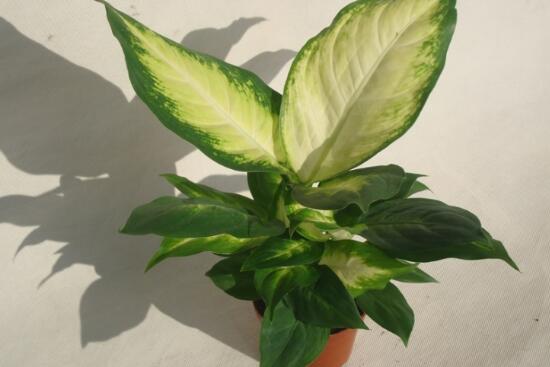
Dieffenbachia likes warmth and is not cold-tolerant. Its optimal growing temperature is between 25-30°C, and in winter the temperature must not fall below 5°C. In winter, once the temperature is too low, Dieffenbachia is prone to cold damage and is likely to die. So what should be done when Dieffenbachia suffers cold damage? At this point, everyone should calmly assess the degree of cold injury to the plant, then address it accordingly. For specifics, keep reading below.
II. Degrees of cold damage in Dieffenbachia and solutions
1. Slight cold damage
If it is discovered in time, or in a southern winter, the cold damage to Dieffenbachia is generally slight. At this point, the leaves lose their luster, the leaves lose water and droop, and after a longer time, the symptom of Dieffenbachia leaves turning yellow will also appear.
Solution: If it is slight cold damage, flower lovers can place the Dieffenbachia in a somewhat warmer place (13-18°C is sufficient), and it will slowly recover. Note: the temperature should be raised slowly, not suddenly increased too quickly, as this is bad for the growth of Dieffenbachia.
2. Mild cold damage
Above slight, if further subdivided, there are also mild, moderate, and severe cold injury. If it is not discovered in time, the degree of cold damage to Dieffenbachia will reach mild, which manifests as: leaves drooping, and cold injury spots appearing on the leaf surface.
Solution: If it is mild cold damage, flower lovers can first use scissors to cut off the cold-injured areas on the Dieffenbachia leaves, then place it in a relatively warm place. Likewise, the temperature should be raised slowly.
3. Moderate cold damage
In winter, the temperature will drop sharply. If everyone has not taken protective measures against the cold, Dieffenbachia grown at low temperatures will, over time, reach moderate cold injury. It manifests as: not only do large numbers of cold spots appear on the Dieffenbachia leaves, but the affected area will also expand to the leaf stalks.
Solution: What should be done when Dieffenbachia suffers cold damage? If it is moderate cold damage, everyone should pay attention. First, cut off the Dieffenbachia together with the leaf stalks, then apply plant ash or the like to the wounds, and finally place it in a relatively warm place, control watering, and it can recover after a period of time.
4. Severe cold damage
When Dieffenbachia is kept at low temperatures for a long time, or is exposed to extremely low temperatures, it will suffer severe cold injury! It manifests as: the plant is obviously damaged, and even the underground roots may already be cold-injured. At this point, the hope of saving it is already very slim!
Solution: When the cold injury has not yet spread through the whole plant, take the plant out of the pot, cut off all the affected branches, leaves, and roots, disinfect them, then store them in moist sand, and carry out cuttings in spring (refer to the propagation methods for Dieffenbachia); when the entire plant is cold-injured, it cannot be saved, so everyone should just buy a new pot.
How to save Dieffenbachia that has suffered cold damage
When the winter temperature is below 5°C, Dieffenbachia is extremely prone to cold damage, and rescue measures should be taken promptly, otherwise it will cause death.Slight cold damage: Leaves droop, and the leaf surface loses its proper luster. At this point, as long as the Dieffenbachia is moved to a warmer place, it can return to normal, but note that the temperature must not be raised abruptly.
Mild cold damage: In addition to drooping, the leaves will develop cold damage patches resembling scalding by boiling water. At this point, in addition to promptly moving the Dieffenbachia to a warmer place, the cold spots on the leaves should also be cut off.
Moderate cold damage: Most of the leaves show cold spots, and the leaf stalks show water-soaked patches and lose their green color. At this point, they should be cut off together with the leaves and stalks, and the wounds should be coated with plant ash or coal ash, then placed in a warmer place, and watering should be controlled.
Severe cold damage: The young branches and new leaves lose their green color and show water-soaked patches, and the underground root system also rots due to cold damage. The rescue method is to promptly dig up the plant, cut off the rotten root parts, and cut off the affected branches and stems. After coating the wounds with plant ash, store them in moist sandy soil, and carry out cuttings after the beginning of spring. If severe cold damage occurs and disease spots appear on the entire plant, then the hope of survival after rescue is very slim, and replacement should be considered.
Dieffenbachia is native to the tropical and subtropical regions of South America. It likes a warm, humid, semi-shaded environment, is not cold-tolerant, and fears drought. Although it likes sufficient sunlight, it also fears strong direct sunlight, so it can be kept in a place with bright light but no direct sunlight.
The suitable growing temperature is 18°C to 25°C. Because the leaf area is large, the amount of water evaporation is also large. In the growing season, in addition to watering abundantly, it is also necessary to frequently spray water on the leaf surface to increase air humidity and prevent the leaf edges from drying and scorching. Apply a fully decomposed dilute liquid fertilizer or compound fertilizer once about every 10 days. In winter, place it indoors in bright light, appropriately reduce watering, and maintain a room temperature above 10°C. If there is heating in the room, you can spray the plant with water close to room temperature to avoid affecting plant growth due to dry air.
Because this species rarely grows side branches on its own, during cultivation you can pinch off the top or prune it to control plant height, keep the plant shape attractive, and promote side buds, so as to achieve the goal of more flowering. After the flowers fade, the remaining flowers should be cut off promptly to avoid consuming too many nutrients and affecting plant growth. After the flowering period, the plant has a dormancy period of 4 to 6 weeks, during which watering should be restrained and fertilizing stopped. At the end of the dormancy period, carry out one repotting. The potting soil should be rich in humus and have good air permeability. It can be mixed using leaf mold or peat soil plus 1/3 vermiculite or perlite. After repotting, place the plant in a warm, semi-shaded place, keep the soil and air moist, and wait for new branches to sprout.
The above is Zuihua Network's introduction to the care knowledge for Dieffenbachia. I hope everyone can gain something from it!