How do you pronounce Cypress Vine and how do you grow it? Six tips to help you grow it lush and flourishing
Cypress Vine belongs to the Convolvulaceae family, and its features are remarkably distinctive: the leaves resemble feathers, with linear and slender lobes. Though it lacks the grand, sword-like leaves of gladiolus, the delicate little leaves of cypress vine have a charm all their own. Many flower lovers like it but do not really understand it, so how do you pronounce Cypress Vine? How is it best grown? Let me give you the answers.
How to pronounce Cypress Vine
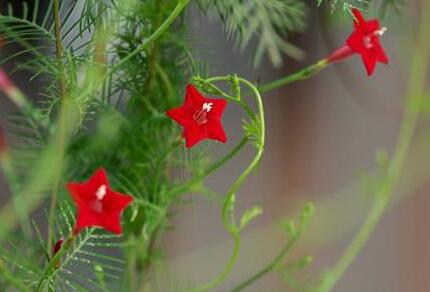
The correct pronunciation of Cypress Vine is [niǎo luó huā]. It originated in Mexico and other parts of the Americas, and is now distributed around the world. Due to its growth habits, it is mainly grown in temperate and tropical regions. It is a very common hedge plant, and since cypress vine has many benefits and uses, it is extremely popular.
How to grow Cypress Vine
1. Propagation
Cypress Vine is generally propagated by sowing seeds, though if you already have a mature plant at home you can choose cuttings. Sowing is usually done in spring, in April. Select good-quality seeds and scatter them on the seedbed; keep the seedbed moist and seedlings will emerge after 1 week.
2. Pot and soil
Choose a fairly breathable plastic pot or ceramic pot. For the soil, use a mix of breathable, fertile leaf mold, fine sand, garden soil and so on. Before use, it is best to sterilize the soil and pot first by sunning them in the sun for 24-48 hours.
3. Temperature
When sowing, the temperature should be kept at 20-25 degrees to let the seeds germinate and take root faster. During the growing period, a temperature above 15 degrees is sufficient. Cypress Vine is rather afraid of cold, so in cypress vine growing methods, care must be taken to keep it warm in winter, and the temperature must not drop below 10 degrees, otherwise it is prone to frost damage.
4. Light
Except in summer, give Cypress Vine plenty of sunlight in the other seasons. To let the branches and leaves in every part of the plant enjoy ample light, you also need to make sure its branches and leaves do not become too dense. If they are dense, you can use pruning to increase light penetration.
5. Fertilizer and water
Cypress Vine has relatively high water requirements and relatively low fertilizer needs, so how should it be grown with regard to fertilizer and water? Pay attention to reasonable watering at ordinary times. If the soil is fairly dry, water thoroughly; afterward watch the soil surface, and water a second time once it turns white. Fertilizer is generally added once every 3-4 weeks, mainly a dilute liquid fertilizer.
6. Pest and disease prevention
Common pests and diseases of Cypress Vine include aphids, scarab beetles, leaf spot, powdery mildew and so on. Both the two insect pests and the two diseases need to be prevented. The method is to ensure a suitable environment, moderate water and fertilizer, and good ventilation where the cypress vine is kept, with moderate light and temperature, which will give a very good preventive effect.
How to water potted flowers
Different kinds of flowers have different water requirements. For example, succulents such as cacti and cactus balls are fairly drought-tolerant and do not need much watering, while flowers like umbrella plant and crab claw orchid prefer a humid environment and need more watering. The same flower also has different water requirements at different growth stages: during the vigorous growth period it needs a larger amount of water, so water appropriately more to promote growth; during the flower bud differentiation period, water appropriately less to promote flower bud differentiation.
Choosing water quality for watering flowers
Natural water is divided into hard water and soft water. Hard water has a high content of mineral salts, and long-term watering with it will have an adverse effect on flower growth. Soft water has a low content of mineral salts and is the ideal water for watering flowers. Rainwater, river water and lake water have low hardness and can be used directly for watering, but spring water, well water and other groundwater have very high hardness and cannot be used directly to water flowers. Tap water, because it contains chlorine and other disinfecting substances, is also not suitable for direct use; it is best stored in an open vat, pool or other container for 3-5 days, and used after the harmful substances in the water have volatilized and settled.
Watering the settling-in water well
The first watering after planting is called the settling-in water. The settling-in water must be given amply and thoroughly. Because the freshly planted soil has not completely settled, there are many gaps in the soil, and only after watering thoroughly can the soil and roots fully combine. Generally, after planting, water twice in succession: after the first watering has drained and water is seen flowing out of the drainage hole at the bottom of the pot, water once more. Only in this way can the soil fully absorb it and closely contact the roots.
When watering, most flowers use the sprinkling method. This can both increase air humidity and wash dust off the leaf surface. However, for flowers with fuzzy leaves or those currently in bloom, do not spray water; instead, set the pot in a basin of water and let water seep in through the hole at the bottom of the pot to keep the potting soil moist.
In summer, potted flowers respire vigorously and require good air permeability in the potting soil. Therefore, when the potting soil is not dry, generally do not water, so as to avoid too much water affecting air permeability; but once it is dry, water immediately and thoroughly. In summer, potting soil often cracks due to excessive dryness, so watering cannot be done all at once, otherwise the water will leak straight down through the cracks to the bottom of the pot while most of the potting soil remains very dry. After the first watering, wait a moment, and water once more after the soil cracks have closed.
If you forget to water for many days and the plant becomes drought-stricken and wilted, do not rush to pour a large amount of water. First move the potted flower to a cool, ventilated place, spray the leaves with a watering can 2-3 times, and after the leaves have recovered, water a small amount, then after the root system has recovered its water-absorbing function, water thoroughly.
Be careful with watering in midsummer and deep winter
Water temperature has a direct effect on the physiological activity of flower roots. If the water temperature and soil temperature differ greatly (more than 5℃), watering will cause a sudden change in soil temperature and damage the root system, instead affecting the roots' absorption of water and producing physiological drought. Therefore, it is better to water when the water temperature is close to the soil temperature, and this should be paid even more attention to in winter and summer. In winter, it is best to first store the water indoors for a period, or add a little warm water, to raise the water temperature to 15-20℃ before watering. In summer, avoid watering under the scorching sun and during the high temperatures at noon.
Watering time for flowers
The choice of watering time should, as far as possible, keep the water temperature close to the soil temperature. Under ordinary circumstances, when the difference between water temperature and soil temperature is within 5℃, watering flowers is fairly safe and will not cause root damage. As for the specific daily watering time, spring, summer, autumn and winter are all different.
In spring, autumn and winter, around 10 a.m. and after 4 p.m. are suitable times to water flowers. At noon in midsummer, the temperature is very high, and the temperature of flower leaves can often reach around 40℃. Transpiration is strong, and water evaporates quickly at the same time. The root system needs to continuously absorb water to make up for the loss from leaf transpiration. If cold water is poured at this time, although water is added to the potting soil, because the soil temperature suddenly drops, the root hairs are stimulated by the low temperature and will immediately hinder the normal absorption of water. At this time, since the flower body is unprepared and the leaf stomata are not closed, water loses its balance of supply and demand, causing the leaf cells to change from a tense state to a wilted one, producing "physiological drought" in the plant, with scorched leaves, and in severe cases causing the death of the whole plant.
This phenomenon is especially obvious in herbaceous flowers, such as geranium, cypress vine, China aster and so on, which most avoid being watered with cold water at noon in hot weather. Therefore, never water flowers at noon in the hot summer. By the same reasoning, since the temperature difference between morning and evening is large in winter, of course flowers should be watered at noon when the soil temperature and air temperature are relatively close. Many flower growers are used to watering in the evening and mistakenly think this is best, but in fact it is the opposite; especially in winter or indoors, if watered at night, water dissipates slowly, increasing the humidity of the potting soil and air and making flowers prone to disease infection and frost damage.
Watering at different developmental stages
Seedling stage
The potting soil should preferably be on the dry side. As the saying goes, "dry grows roots, wet grows leaves"; soil that is on the dry side easily grows roots and strengthens seedlings. Too much water will cause seedlings to grow leggy.
Vegetative growth stage
Only with sufficient watering can the branches and leaves flourish; otherwise the plant grows slowly. But do not blindly water too much and cause waterlogging and root rot in the potting soil. The general watering principle is to water when the potting soil is dry and stop when wet, alternating dry and wet, with the principle of keeping the soil below the surface moist. The "dry" mentioned here does not mean the potting soil has no moisture at all. The saying "water thoroughly when completely dry, until water is seen flowing from the bottom hole" is unscientific. Because when the soil is completely dry, cracks form between the pot and the soil, and when watering, the water quickly runs off in large amounts along the cracks, so obviously it cannot be watered thoroughly. In this case, loosen the soil first and then water, or directly use the soaking method to supply water.
Reproductive growth stage
When flowers transition from vegetative growth to flower bud differentiation, if there is too much water or too much nitrogen fertilizer is applied, already-formed flower buds will also turn into leaf buds. Therefore, during the flower bud differentiation period, the method of withholding water (controlling watering) can be used to suppress excessive growth of branches and leaves and promote flower bud formation. For example, for bougainvillea, plum blossom, ornamental peach, magnolia and so on, control water 2-3 times respectively in June-July, and water again after the branch tips and leaves wilt, which can effectively increase the flowering rate.
Flowering and fruit-setting stage
Once flowers enter the stage of budding and flowering and fruiting, they consume the most water, and water cannot be in short supply, still less can the branch tips and leaves be allowed to wilt, otherwise the flowering period will become shorter and flowering will be poor. But it should not be too much either, especially not waterlogged; long-term waterlogging will cause flowers and fruit to drop.
The above describes general rules. The number of waterings should also be flexibly controlled according to the local climatic and environmental conditions at the time, such as air humidity, the material and size of the flower pot, the condition of the potting soil and so on.
How to water potted flowers
Different kinds of flowers have different water requirements. For example, succulents such as cacti and cactus balls are fairly drought-tolerant and do not need much watering, while flowers like umbrella plant and crab claw orchid prefer a humid environment and need more watering. The same flower also has different water requirements at different growth stages: during the vigorous growth period it needs a larger amount of water, so water appropriately more to promote growth; during the flower bud differentiation period, water appropriately less to promote flower bud differentiation.Choosing water quality for watering flowers
Natural water is divided into hard water and soft water. Hard water has a high content of mineral salts, and long-term watering with it will have an adverse effect on flower growth. Soft water has a low content of mineral salts and is the ideal water for watering flowers. Rainwater, river water and lake water have low hardness and can be used directly for watering, but spring water, well water and other groundwater have very high hardness and cannot be used directly to water flowers. Tap water, because it contains chlorine and other disinfecting substances, is also not suitable for direct use; it is best stored in an open vat, pool or other container for 3-5 days, and used after the harmful substances in the water have volatilized and settled.
Watering the settling-in water well
The first watering after planting is called the settling-in water. The settling-in water must be given amply and thoroughly. Because the freshly planted soil has not completely settled, there are many gaps in the soil, and only after watering thoroughly can the soil and roots fully combine. Generally, after planting, water twice in succession: after the first watering has drained and water is seen flowing out of the drainage hole at the bottom of the pot, water once more. Only in this way can the soil fully absorb it and closely contact the roots.
When watering, most flowers use the sprinkling method. This can both increase air humidity and wash dust off the leaf surface. However, for flowers with fuzzy leaves or those currently in bloom, do not spray water; instead, set the pot in a basin of water and let water seep in through the hole at the bottom of the pot to keep the potting soil moist.
In summer, potted flowers respire vigorously and require good air permeability in the potting soil. Therefore, when the potting soil is not dry, generally do not water, so as to avoid too much water affecting air permeability; but once it is dry, water immediately and thoroughly. In summer, potting soil often cracks due to excessive dryness, so watering cannot be done all at once, otherwise the water will leak straight down through the cracks to the bottom of the pot while most of the potting soil remains very dry. After the first watering, wait a moment, and water once more after the soil cracks have closed.
If you forget to water for many days and the plant becomes drought-stricken and wilted, do not rush to pour a large amount of water. First move the potted flower to a cool, ventilated place, spray the leaves with a watering can 2-3 times, and after the leaves have recovered, water a small amount, then after the root system has recovered its water-absorbing function, water thoroughly.
Be careful with watering in midsummer and deep winter
Water temperature has a direct effect on the physiological activity of flower roots. If the water temperature and soil temperature differ greatly (more than 5℃), watering will cause a sudden change in soil temperature and damage the root system, instead affecting the roots' absorption of water and producing physiological drought. Therefore, it is better to water when the water temperature is close to the soil temperature, and this should be paid even more attention to in winter and summer. In winter, it is best to first store the water indoors for a period, or add a little warm water, to raise the water temperature to 15-20℃ before watering. In summer, avoid watering under the scorching sun and during the high temperatures at noon.
Watering time for flowers
The choice of watering time should, as far as possible, keep the water temperature close to the soil temperature. Under ordinary circumstances, when the difference between water temperature and soil temperature is within 5℃, watering flowers is fairly safe and will not cause root damage. As for the specific daily watering time, spring, summer, autumn and winter are all different.
In spring, autumn and winter, around 10 a.m. and after 4 p.m. are suitable times to water flowers. At noon in midsummer, the temperature is very high, and the temperature of flower leaves can often reach around 40℃. Transpiration is strong, and water evaporates quickly at the same time. The root system needs to continuously absorb water to make up for the loss from leaf transpiration. If cold water is poured at this time, although water is added to the potting soil, because the soil temperature suddenly drops, the root hairs are stimulated by the low temperature and will immediately hinder the normal absorption of water. At this time, since the flower body is unprepared and the leaf stomata are not closed, water loses its balance of supply and demand, causing the leaf cells to change from a tense state to a wilted one, producing "physiological drought" in the plant, with scorched leaves, and in severe cases causing the death of the whole plant.
This phenomenon is especially obvious in herbaceous flowers, such as geranium, cypress vine, China aster and so on, which most avoid being watered with cold water at noon in hot weather. Therefore, never water flowers at noon in the hot summer. By the same reasoning, since the temperature difference between morning and evening is large in winter, of course flowers should be watered at noon when the soil temperature and air temperature are relatively close. Many flower growers are used to watering in the evening and mistakenly think this is best, but in fact it is the opposite; especially in winter or indoors, if watered at night, water dissipates slowly, increasing the humidity of the potting soil and air and making flowers prone to disease infection and frost damage.
Watering at different developmental stages
Seedling stage
The potting soil should preferably be on the dry side. As the saying goes, "dry grows roots, wet grows leaves"; soil that is on the dry side easily grows roots and strengthens seedlings. Too much water will cause seedlings to grow leggy.
Vegetative growth stage
Only with sufficient watering can the branches and leaves flourish; otherwise the plant grows slowly. But do not blindly water too much and cause waterlogging and root rot in the potting soil. The general watering principle is to water when the potting soil is dry and stop when wet, alternating dry and wet, with the principle of keeping the soil below the surface moist. The "dry" mentioned here does not mean the potting soil has no moisture at all. The saying "water thoroughly when completely dry, until water is seen flowing from the bottom hole" is unscientific. Because when the soil is completely dry, cracks form between the pot and the soil, and when watering, the water quickly runs off in large amounts along the cracks, so obviously it cannot be watered thoroughly. In this case, loosen the soil first and then water, or directly use the soaking method to supply water.
Reproductive growth stage
When flowers transition from vegetative growth to flower bud differentiation, if there is too much water or too much nitrogen fertilizer is applied, already-formed flower buds will also turn into leaf buds. Therefore, during the flower bud differentiation period, the method of withholding water (controlling watering) can be used to suppress excessive growth of branches and leaves and promote flower bud formation. For example, for bougainvillea, plum blossom, ornamental peach, magnolia and so on, control water 2-3 times respectively in June-July, and water again after the branch tips and leaves wilt, which can effectively increase the flowering rate.
Flowering and fruit-setting stage
Once flowers enter the stage of budding and flowering and fruiting, they consume the most water, and water cannot be in short supply, still less can the branch tips and leaves be allowed to wilt, otherwise the flowering period will become shorter and flowering will be poor. But it should not be too much either, especially not waterlogged; long-term waterlogging will cause flowers and fruit to drop.
The above describes general rules. The number of waterings should also be flexibly controlled according to the local climatic and environmental conditions at the time, such as air humidity, the material and size of the flower pot, the condition of the potting soil and so on.