What is the disease pattern of root rot in fuchsia?
Root rot is a physiological disease of fuchsia. Fuchsia likes a cool, moist, semi-shaded, well-ventilated environment, is not tolerant of hot, high temperatures, and dislikes extreme summer heat and stuffiness. The optimal growth temperature is 15 to 25 degrees, and when the temperature exceeds 30 degrees it enters a semi-dormant state.
In cultivation, improper water and fertilizer management can very easily cause root rot. After the beginning of summer, watering too much, especially in the height of summer when the temperature exceeds 30 degrees, at which time fuchsia is in a dormant or semi-dormant state, with weak metabolic activity and very little need for water and fertilizer.
If watering is excessive at this time, filling the soil gaps with water and causing oxygen deficiency, root rot is very likely to occur; at the same time, if fertilizing continues, it can also very easily cause the roots to turn black and rot.
After fuchsia develops root rot, in mild cases the branches and leaves yellow and wilt, affecting flowering, and in severe cases the whole plant dies. It is mainly caused by Pythium, and disease is likely when the potting soil is too wet.
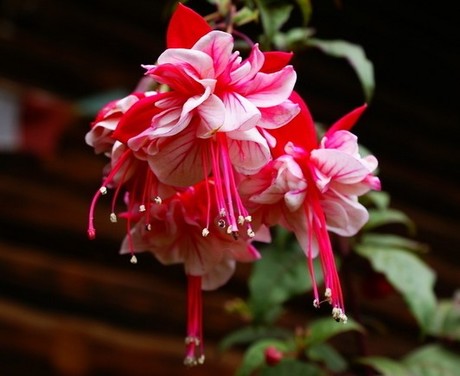
It occurs on leaves, stems and flowers. Brown lesions form on the edges of diseased leaves, with ring-patterned wavy wrinkles on the surface, and in humid conditions gray mold-like material grows on the lesions, namely the pathogen's conidia. After the stems and flower buds are affected, purplish-brown lesions form, with soft rot and gray mold growing on them, causing the stems and flower buds to rot. The pathogen is Botrytis of the family Moniliaceae, order Moniliales, class Deuteromycetes. This fungus is strongly saprophytic and has a wide host range. Conidiophores are produced in groups, erect, clustered at the tip of the stalk, elliptical to obovate, single-celled, colorless, 12-18×9-13 micrometers, and the pathogen can form sclerotia.
Disease pattern: The pathogen mainly overwinters as sclerotia in the tissues of diseased plant residues and in the soil, and the following year the sclerotia germinate and produce conidia for primary infection. During the plant's growth period, if conditions are suitable, repeated re-infection can occur. With years of continuous cropping, high humidity conditions favor the mass formation and spread of conidia. Plants that are too densely planted, with insufficient light and tender, weak growth, are easily infected by the pathogen.
Root rot control methods1.) Strengthen cultivation management; planting should not be too dense, and pay attention to ventilation when air humidity is high.
2.) When potting, use disease-free new soil or sterilized soil.
3.) Remove diseased leaves or diseased plants and burn them in a centralized manner.
4.) Mix 70% quintozene wettable powder and 65% zineb wettable powder in equal amounts to treat the soil, using 8-10 grams per square meter.
5.) In the early stage of disease, spray 200-fold Bordeaux mixture of equal amounts, or 50% amobam aqueous solution or 70% thiophanate wettable powder at 1000-fold.
Fuchsia physiological root rotThis disease often occurs when watering is excessive and the potting soil is too wet, especially in hot summers, and it is even more likely to occur during the dormant period of fuchsia. It is mainly caused by overly wet soil, which causes oxygen deficiency and leads to the roots turning black and rotting; mildly affected plants have yellow, wilted branches and leaves, and severely affected plants die entirely.
Root rot control methods1.) Water moderately to prevent excessive moisture, loosen the soil frequently, and keep the soil well aerated.
2.) In summer, move fuchsia to a shaded, ventilated place for care.
Fuchsia - Fuchsia cultivation methods | Fuchsia flower pictures
Fuchsia
Fuchsia (scientific name: Fuchsia hybrida Voss.) is a plant of the order Myrtales, family Onagraceae, genus Fuchsia, also known as lantern flower and hanging bell begonia. It is native to Mexico. Fuchsia is a perennial shrub; when in bloom, the hanging flowers are graceful and charming, like hanging colorful lanterns. As a potted plant it is suitable for decorating guest rooms, flower stands and desks; placed in a bottle of clean water, it can be enjoyed and can also root and propagate.Fuchsia cultivation methods
1. Soil: For potted fuchsia, the growing medium should be fertile, loose, well-drained potting soil. Generally, leaf mold plus sandy loam plus well-rotted organic fertilizer and phosphate fertilizer mixed evenly can be used, and no base fertilizer is needed, to avoid root rot.
2. Watering: For everyday watering of fuchsia, follow the principle of watering when dry and letting it dry between waterings. In dry spring weather and hot summer weather, spray water on the branches and leaves 1-2 times a day, and do not water too much and cause waterlogging in the potting soil. In winter, when room temperature is low, watering must be strictly controlled and fertilizing stopped to prevent root rot. After each fertilizing and watering, loosen the soil promptly to aid aeration.
Fuchsia flower pictures
Coral Red Fuchsia: a clumping dwarf variety, with dark leaf color and large, round flowers; the calyx is crimson and the corolla is violet.
Globe-shaped short-tubed fuchsia (var. globosa): branches hairless and drooping, leaf veins red, pedicels long, sepals crimson; petals bright blue-violet, about 1/2 the length of the calyx lobes.
Two-colored short-tubed fuchsia (var. discolor): a clumping dwarf variety, with branches dark purplish-red. Leaves small, in whorls of 3, ovate-lanceolate. Flowers small, numerous; calyx red, tube slender and short; petals obtuse, shorter than the calyx lobes.
Riccarton short-tubed fuchsia (var. riccartonii): branches slender and drooping. Leaves very small. Flowers long and drooping; calyx tube bright red, petals violet.
Fuchsia flower meaning
Fuchsia is the birth flower for May 22, and its meaning is a passionate heart.
People blessed by the fuchsia flower have relatively broad interests, but will focus on one particular thing, and they are naturally optimists. To satisfy their own interests, no matter how busy they are, they will squeeze out time to entertain themselves. In love, they devote themselves wholeheartedly.
Fuchsia flowering period
Fuchsia has a long flowering time and can bloom from April to December.
Fuchsia has a peculiar flower shape and brilliant colors; when in bloom it looks like little colorful lanterns hanging upside down, and it is deeply popular in China, which has a long tradition of decorative lanterns. There are many horticultural varieties of fuchsia, widely cultivated throughout the world. It is widely cultivated in our country, especially growing extremely well in greenhouses in the north or on the plateaus of the northwest and southwest; there are many household potted plants, and it has become an important ornamental flower plant.
Fuchsia pest and disease control
Fuchsia pests and diseases: 1. Gray mold. Gray mold occurs in continuous rainy weather, or when too much nitrogen fertilizer is applied, or when light is insufficient. It mainly harms stems, leaves and flowers, causing water-soaked spots on the affected parts; if not controlled in time, they gradually expand into a rotting state covered with gray hairy mycelium, and in severe cases can cause the plant to die.
Solution: In the early stage of disease, promptly spray 500-fold 65% zineb or 50% carbendazim or other new fungicides, once every 7-10 days, for 3-4 consecutive sprays. Usually pay attention to ventilation and light so the plants grow well and their disease resistance is improved. After disease occurs, promptly prune and dispose of diseased branches and leaves to reduce the source of infection.
Is fuchsia poisonous?
Is fuchsia poisonous? Is it okay to keep it at home? It is not poisonous. As a potted plant it is suitable for decorating guest rooms, flower stands and desks; placed in a bottle of clean water, it can be enjoyed and can also root and propagate.
Fuchsia medicinal value
Fuchsia (scientific name: Fuchsia hybrida) has relatively high ornamental value, mainly because fuchsia has brilliant flower colors and a very unique flower shape. In addition, in terms of medicinal value, fuchsia is also a traditional Chinese medicinal material, with the functions of promoting blood circulation to remove stasis and cooling the blood to dispel wind. It is pungent and sour in taste, slightly cold in nature, and enters the liver and pericardium meridians; its functions are to invigorate the blood and dissipate stasis, and to cool the blood and dispel wind. It mainly treats irregular menstruation, amenorrhea and abdominal masses, postpartum breast swelling, skin itching, acne and other conditions.
Related encyclopedia
Pocket scale non-woven bag rush pith bamboo shoot crab claw redmi note3 ykk zipper ybs zipper Prunus sargentii climbing rose wild senna winter plum green pine wristwatch Omega Longines famous watch children's building blocks flint cymbidium club moss soursop