What soil does an Oncidium orchid use? Growing methods and precautions to avoid low temperatures
We know there are many benefits to growing Oncidium orchids, and the main one is enjoying the flowers, but to make it produce pure yellow, elegant blooms, you not only need to choose the right variety but also need to master certain care techniques. For flower lovers, what is the best way to grow Oncidium orchids? What soil does an Oncidium orchid use? Let's look at the growing methods and precautions for Oncidium orchids.
How to grow Oncidium orchids
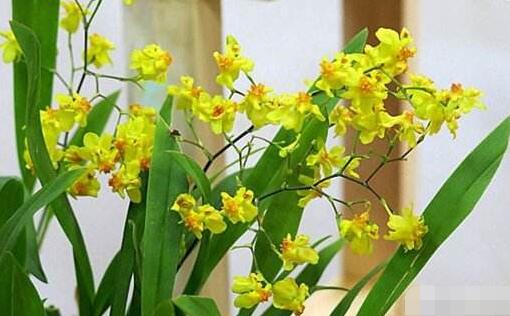
Oncidium orchids originate from the tropical regions of the Americas. They like high temperatures and humid environments, and some varieties, such as the sword-leaf type Oncidium, prefer cool environments, but most Oncidium orchids like heat and fear cold, so keep them warm in winter. In addition, Oncidium orchids are suited to semi-shady, humid environments, so pay attention to watering and moisture retention, and avoid light that is too strong.
Growing methods and precautions for Oncidium orchids
I. Growing methods
1. What soil does an Oncidium orchid use
For soil selection, use a mix of crushed fern roots, peat soil, crushed charcoal, vermiculite and sphagnum moss in a 4:1:2:2:1 ratio. Of course, you can also use a mix of leaf mold, garden soil and fine sand. Be sure the soil is sufficiently fertile, and that drainage and aeration are both very good.
2. Choosing a flower pot
When growing Oncidium orchids in pots, choose pots with relatively many air holes, and shallow pots are best, such as a 15 cm pot. When potting, you can place some weathered stone or small brick granules, tile pieces and the like at the bottom of the pot, which helps with moisture retention and drainage.
3. Light
In the growing methods and precautions for Oncidium orchids, light is an important factor. Since it does not like semi-shady environments, the light must not be too strong when growing it, otherwise it easily causes scorching that damages the plant, and may cause leaves to turn yellow and thus trigger anthracnose. The light must not be too weak either, otherwise the leaves droop and the number of flowers decreases.
4. Temperature
The suitable temperature differs among Oncidium varieties. For example, the suitable temperature for the thick-leaf type is 18-25 degrees, while for the thin-leaf type it is 10-22 degrees. But no matter which type of Oncidium orchid it is, take care not to let the temperature get too low, otherwise cold damage is likely.
5. Humidity
The ideal humidity is 60%-80%, but when growing them, flower lovers need to choose moisture retention measures according to climate changes. Another rather important and useful technique is keeping the environment ventilated, which is very helpful for increasing air humidity.
6. Fertilizer and water
Watering: Oncidium orchids have a fairly strong tolerance for drought, so the soil can be kept appropriately on the dry side, but when you find the soil surface is fairly dry, you need to water thoroughly. In spring and summer, when growth is relatively vigorous, it is best to water once in the morning and once in the evening.
Fertilizing: Usually fertilizing should focus on fertilizers with relatively slow effects, and during cultivation you can often water with some carbendazim or thiophanate-methyl solution, thereby reducing the possibility of fungal diseases and pest problems.
II. Precautions
1. Provide appropriate shade. If growing on a large scale, it is best to add shade netting for Oncidium orchids, keeping the light transmission rate at about 40%. In winter you can appropriately increase light so that it blooms smoothly once the flowering period arrives. If the light is too weak, it is not conducive to flower bud differentiation.
2. Repot regularly. When growing Oncidium orchids in pots, you can change the pot and soil every 2-3 years. The repotting time is generally chosen after the flowering period, and spring is best. During repotting, take care to protect the roots and avoid root damage.
3. Alternate wet and dry. When watering, generally pay attention to alternating wet and dry, trying to keep the soil slightly moist, and water again after the soil surface becomes slightly dry. In winter, when the temperature is below 10 degrees, watering needs to be strictly timed, while in spring and summer you need to spray water appropriately.
October flower care knowledge introduction
Flowers suitable for courtyard display. In October, temperatures drop across most of the country, with monthly average temperatures between 10°C and 19°C.
This month there are many kinds of potted ornamental plants suitable for courtyard display. Among the woody ornamental plants are: Norfolk Island pine, five-needle pine, Japanese umbrella pine, lacebark pine, Japanese fir, spruce species, Buddhist pine, Japanese nutmeg yew, sago palm, Canary Island date palm, Dutch iron, Chinese jasmine, cinnamon (cinnamon), sweet osmanthus, cotton rose, rubber tree, Schefflera, variegated weeping fig, Chinese hibiscus, golden larch, croton, Brazil wood, money tree, bamboo palm, ponytail palm, leatherleaf mahonia (leatherleaf mahonia), Japanese fatsia, spotted laurel (spotted laurel), thick-leaf fig (thick-leaf fig), fish-tail palm, areca palm, king coconut, Cordyline, beautiful phoenix palm, fiddle-leaf fig, desert rose, South American cycad, Garcinia subelliptica (Garcinia subelliptica), giant Buddha's belly bamboo (giant Buddha's belly bamboo), red maple, silver birch, Aglaia, Michelia alba, Chinese tiger's paw (Chinese tiger's paw), orange jasmine, heavenly bamboo, etc. Herbaceous flowers include: scarlet sage, large-flowered Canna, dahlia, China aster, chrysanthemum, small chrysanthemum, bamboo-joint begonia, snapdragon (snapdragon), French marigold, African marigold, five-color pepper, cockscomb, pot marigold, Madagascar periwinkle, globe amaranth, petunia, Guinea impatiens, etc. Note: In North China, Northeast China and other places, when the temperature drops below 10°C, pay attention to cold protection for southern flowers grown in the north.
Cultivation of courtyard flowers
1. Sowing. Woody flower species that can be sown include: tree peony, red-flowered camellia, Michelia species, magnolia species, Manglietia species, buckeye species, summer sweetshrub, lucky fruit (lucky fruit), soapberry, kuding tea, Buddhist pine, Japanese nutmeg yew, French holly, Elaeocarpus, beautiful phoenix palm, yew, Chinese fan palm, privet, small-leaf privet, camphor, Weigela coraeensis (Weigela coraeensis), palm, pond cypress, etc. Among them, when sowing buckeye, the hilum should face downward, and before sowing summer sweetshrub the seeds should first be soaked for 24 to 36 hours. Except for summer sweetshrub and Weigela coraeensis seeds, which can be stored dry until sowing the following spring, all the other kinds can be cleaned and stored in moist sand to promote germination until the seeds crack and show white the following spring before sowing. Note that before storage for germination promotion, the seeds should be rinsed clean. The moisture content of the sand should be such that it forms a ball when held in the hand and crumbles when released, and the ratio of seeds to sand is about 1:3. During storage and germination promotion, check frequently to prevent the seeds from drying out or becoming moldy. Herbaceous flowers that can be sown include: hollyhock, musk mallow, corn poppy, pot marigold, snapdragon, Dianthus species, pansy, Boston ivy, blackberry lily, dwarf catchfly, tall catchfly, California poppy, daisy, black-eyed Susan, iris, verbena, etc. Greenhouse flowers such as nasturtium, gloxinia, petunia, cineraria, fairy primrose, African daisy and calceolaria can also be sown in plastic tunnels.
2. Cuttings. Woody flower species that can be propagated by cuttings include: red-back eucalyptus, Schefflera, night-blooming jasmine, lantana, firethorn, Mahonia, finger citron, bleeding glory-bower, Cordyline, Michelia, aucuba, Chinese hibiscus, bougainvillea, jasmine, pearl orchid, red-leaf barberry, golden-leaf privet, four-season osmanthus, gardenia, Weigela coraeensis (Weigela coraeensis), bridal wreath spiraea (bridal wreath spiraea), red-flowered spiraea, snow spray spiraea (snow spray spiraea), St. John's wort, red-leaf plum, rose, Viburnum macrocephalum (Viburnum macrocephalum), crape myrtle, rose of Sharon, oleander, fig, flowering quince (flowering quince), etc. The cutting medium can be ordinary sandy loam or yellow subsoil, or a mixture of half sand and half rice-hull ash, using fully enclosed moisture-retaining cuttings. In addition, for some southern flowers propagated by cuttings, when Frost's Descent arrives, pay attention to cold protection. Herbaceous flowers that can be propagated by cuttings include: scarlet sage, globe amaranth, African marigold, four-season begonia, bamboo-joint begonia, inch plant, golden pothos, clearweed, coral flower, golden shrimp plant, shrimp plant, golden-vein shrimp plant, winter chrysanthemum (winter chrysanthemum), etc. Succulent flowers that can be propagated by cuttings include: jade plant, houseleek (houseleek), Dutchman's pipe cactus, epiphyllum, purslane tree, etc.
3. Grafting. Use 1- to 2-year-old black pine seedlings as rootstock, and graft five-needle pine (including Osaka pine) and Japanese black pine (Japanese black pine) with bagging for moisture retention; use peony roots as rootstock to graft fine varieties of tree peony; use one-year-old Japanese maple seedlings as rootstock, and graft red maple, feather maple and the like with bagging for moisture retention; use one-year-old white magnolia seedlings as rootstock to bud-graft fine varieties of white magnolia, Yulan magnolia (Yulan magnolia), red-flowered magnolia and the like; use three-edged arrow cactus as rootstock to graft various cactus balls; use one-year-old citrus seedlings as rootstock to bud-graft kumquat.
4. Layering. Flower species that can be propagated by simple layering include: camellia, plum blossom, Weigela coraeensis (Weigela coraeensis), bigleaf hydrangea, weigela, flowering quince (flowering quince), August osmanthus, snowball, Viburnum macrocephalum (Viburnum macrocephalum), purple magnolia, gardenia, St. John's wort, French holly, winter jasmine, forsythia (forsythia), Michelia, snow spray spiraea (snow spray spiraea), red-flowered spiraea, etc.
5. Division. Woody flower species that can be propagated by division include: heavenly bamboo, leatherleaf mahonia (leatherleaf mahonia), Mahonia, tree peony, flowering quince (flowering quince), bridal wreath spiraea (bridal wreath spiraea), double-flowered kerria, snow spray spiraea (snow spray spiraea), spiraea, sago palm, etc. Herbaceous flowers that can be propagated by division include: peony, hosta, spring orchid, purple hosta, bird of paradise, cymbidium, Cymbidium ensifolium (Cymbidium ensifolium), Persian buttercup, black-eyed Susan, iris, blackberry lily, lily of the valley, Guangdong evergreen, silver queen aglaonema (silver queen aglaonema), purple triangular wood sorrel (purple triangular wood sorrel), multi-head green emperor (multi-head green emperor), Boston fern, cast-iron plant, etc. Flower species that can be propagated by dividing bulbs include: calla lily, amaryllis, freesia, lycoris, tulip, Mediterranean bluebell, etc.
Management of courtyard flowers planted in the ground
1. Transplanting. For some deciduous ornamental plants, according to local climate changes, transplant after Frost's Descent arrives and the leaves fall, such as rose of Sharon, redbud, elm-leaf plum, pomegranate, lilac, red-leaf plum, purple magnolia, ornamental peach, longevity peach, floribunda rose, red-leaf barberry, golden-leaf privet, etc. For some evergreen flowering shrubs, such as leatherleaf mahonia (leatherleaf mahonia), heavenly bamboo, Sichuan juniper (Sichuan juniper), dragon juniper, golden-edge thousand-head arborvitae (golden-edge thousand-head arborvitae), four-season osmanthus, gardenia, large-leaf boxwood, Chinese boxwood (Chinese boxwood), boxleaf holly (boxleaf holly), etc., when transplanting, first, prune back before transplanting; second, keep a good soil ball; third, strengthen watering and misting management after transplanting. Courtyard herbaceous flowers that can be planted out include: Dianthus, daisy, hollyhock, ornamental kale, pansy, pot marigold, verbena, Phlox, snapdragon, autumn zephyr lily, dwarf lilyturf, lily turf, etc. Bulb flowers that can be planted in the ground include: narcissus, red-mouthed narcissus, tulip, hyacinth, etc.
2. Pruning. Carry out the last pruning of the year for hedges and ball-shaped plants in the courtyard, requiring fine and precise work, with the standard being flat surfaces, straight lines and round balls. Courtyard color-block and hedge plant species suitable for pruning include: golden-edge privet, red-leaf barberry, red-leaf barberry (red-leaf barberry), golden-edge thousand-head arborvitae (golden-edge thousand-head arborvitae), golden-edge boxwood, large-leaf boxwood, Chinese boxwood (Chinese boxwood), French holly, privet, Chinese photinia (Chinese photinia), small-leaf privet, etc. Ball-shaped plants that need pruning include: dragon juniper, boxwood, Chinese bayberry, holly, wintergreen, photinia, Pittosporum, firethorn, etc. For ground-planted flowers in the courtyard that bloom continuously, such as rose, crape myrtle, lantana and bougainvillea, continue cutting off spent flowers and faded stems, and moderately prune back the branches that have flowered. For ground-planted herbaceous flowers in the courtyard, such as scarlet sage, African marigold and globe amaranth, promptly cut off the open flower spikes to encourage the side shoots to continue producing buds and blooming, thereby extending the ornamental period.
3. Watering. For courtyard flowers newly planted this year, continue good watering and misting work. First, keep the root soil moist, but there must be no standing water; second, continue misting the leaves. In addition, for newly planted herbaceous flowers, also do good misting and moisture-retention work.
4. Fertilizing. For autumn herbaceous flowers planted in the courtyard, it is suitable to apply quick-acting fertilizer balanced in nitrogen, phosphorus and potassium; for osmanthus types that have already flowered, you can open ring-shaped trenches and bury base fertilizer; for rose, crabapple, crape myrtle, cotton rose, camellia, Michelia, plum blossom, wintersweet and the like that have already been pruned, you can bury an appropriate amount of compound fertilizer; for heavenly bamboo and firethorn that are in the fruit-viewing stage, as well as southern finger citron, kumquat, bitter orange and golden bullet (golden bullet), you can appropriately apply a small amount of quick-acting phosphorus-potassium fertilizer by watering, which can effectively extend the fruit-viewing period.
5. Pest and disease control. For trunk-boring pests appearing on ground-planted plum blossom, red-leaf plum, cherry blossom and crabapple, continue using poison sticks for control. For fallen dead branches and leaves in the courtyard, promptly sweep them up, gather them and burn them. In the north, for thick large trunks in the courtyard, you can whitewash the trunks at the end of the month, or directly apply lime-sulfur mixture to the trunks.
6. Seed collection. Woody plant species from which seeds can be collected include: Buddhist pine, Japanese nutmeg yew, soapberry, buckeye, purple magnolia, white magnolia, Manglietia, southern magnolia, mountain magnolia, Huangshan magnolia, yellow magnolia, golden-leaf Michelia, deep-mountain Michelia, red-flowered Manglietia, broad-petal Michelia (broad-petal Michelia), pond cypress, bamboo palm, Ardisia crenata (Ardisia crenata), beautiful phoenix palm, Chinese fan palm, kuding tea, French holly, camphor, privet, small-leaf privet, Viburnum macrocephalum (Viburnum macrocephalum), weeping crabapple, papaya, sago palm, ginkgo, yew, oil tea, etc. These seeds must all be stored in moist sand. Seed types that can be stored dry include: crape myrtle, Chinese tulip tree, red maple, Japanese maple, golden larch, dawn redwood, Japanese cedar, Chinese tallow, silk tree, goldenrain tree, cotton rose, southern sour jujube, redbud, camptotheca, Chinese bishopwood (Chinese bishopwood), five-angle maple, etc. Herbaceous flowers from which seeds can be collected include: scarlet sage, cockscomb, zinnia, globe amaranth, small dahlia, African marigold, French marigold, China aster, impatiens, four-o'clock, Kochia, strawflower, cosmos, snow-on-the-mountain (snow-on-the-mountain), painted euphorbia (painted euphorbia), sensitive plant, telegraph plant (telegraph plant), etc.
In addition, at the end of October, for Canna, dahlia and the like, when their aboveground parts are close to withering, dig up the underground rhizomes and store them in sand indoors, keeping the room temperature no lower than 5°C, and cut and replant them the following spring. CourtyardManagement of potted flowers
1. Watering. Although the weather has turned cooler, in most areas south of the Huai River the temperature is still above 17°C and the air is quite dry, so watering management for potted flowers must be careful and thorough. For some moisture-loving foliage plants, such as rubber tree, cast-iron plant, Swiss cheese plant, golden pothos, arrowhead plant, Chinese jasmine, cinnamon (cinnamon), giant taro, red gem and the like, water once a day on sunny days, supplemented by misting the leaves; for summer-dormant flowers that resume growth after autumn, including semi-dormant kinds such as calla lily, cyclamen, clivia, purslane tree, Daphne, geranium and fuchsia, increase the amount of watering. For wintersweet, plum blossom, camellia and the like that bloom in winter and early spring, control watering and mist more, to help the flower buds swell. In northern regions, for flower species that are relatively sensitive to cold, reduce watering, which can accelerate the lignification of new shoots and help them survive the winter safely. The best watering times are 10 a.m. or 3 p.m.
2. Fertilizing. For summer-dormant flowers that resume growth after the autumn cool, promptly apply low-concentration quick-acting liquid fertilizer; for camellia, plum blossom, wintersweet, cineraria, primrose, clivia, cyclamen, Chinese cymbidium (Chinese cymbidium), Belgian azalea, red-mouthed narcissus and the like that bloom in winter or early spring, continue applying a mixture of 0.2% potassium dihydrogen phosphate and 0.1% urea; for most foliage plants, after mid-October, stop applying nitrogen fertilizer and appropriately apply some low-concentration potassium fertilizer to increase the plant's cold resistance; for fruit-viewing potted plants, such as bitter orange, lemon, kumquat, heavenly bamboo, winter coral, lucky seed (lucky seed) and golden bullet (golden bullet), a small amount of phosphorus-potassium fertilizer can be applied in early to mid-October.
3. Shading. For some foliage plant species that are very shade-loving, such as dieffenbachia, Swiss cheese plant, Calathea species, arrowhead plant, green gem, Boston fern and pepperomia species, shading is still needed for 2 to 3 hours around noon.
4. Pruning. For most bonsai and potted flowers that must be moved indoors in winter, in mid-to-late October, first cut off dead branches and withered leaves, pest- and disease-damaged branches, and weak branches; for leggy branches, carry out strong pruning back; for binding materials that have been in place for 1 to 2 years, you can remove them, or remove and then re-bind them, to prevent long-term binding at fixed positions from injuring the cambium of the branches and causing the branches and leaves to die.
5. Cold protection. In northern regions, in mid-to-late October, ornamental plant species that cannot tolerate temperatures below 10°C can be moved into tunnels in time; for relatively cold-tolerant woody potted flowers or tree-stump bonsai, they can be buried at the end of the month in wind-sheltered, sunny soil to prevent the potting soil from freezing. In the Yangtze River basin, accurately grasp weather change information and avoid the threat of southward cold waves.
6. Pest and disease control. Cut off dead branches and fallen leaves on potted flowers and trees, collect them uniformly and burn them. For potted chrysanthemums, control pests such as aphids, chrysanthemum beetles, leaf-miner larvae and inchworms. Potted plants suitable for balcony display. In early to mid-October, the balcony still has strong light and dry air. Only potted flowers and trees that have been placed on the balcony for a long time and have relatively strong resistance can adapt to the open-air balcony environment. They are: black pine, Japanese white pine, Chinese elm, plum yew, trident maple, water birch, Chinese fringe tree, Fujian tea, Buddhist pine, Oriental arborvitae, Chinese juniper, dragon juniper, boxwood, pomegranate, bougainvillea, thick-leaved fig, ginkgo, rose, jasmine, Aglaia, sago palm, firethorn, lantana, tamarisk, red maple, etc. Some cold-sensitive southern flower species can no longer remain on the balcony when the temperature drops to 10°C. For some flower species that like a relatively cool environment, they can be placed in an ordinary indoor space at the beginning of the month. Such as large-flowered cymbidium, crystal anthurium, nerve plant, Cattleya, Phalaenopsis, Oncidium, etc. For some common foliage plants, they can be moved indoors for 3 to 4 hours around noon, and placed on the balcony at other times, such as bamboo palm, Brazil wood, money tree, golden pothos, cast-iron plant, areca palm, fish-tail palm, king coconut, Schefflera, etc. In northern regions, when the temperature drops to 10°C, the vast majority of flowers and trees can no longer be placed on the balcony. Cultivation of balcony flowers. In early October, you can continue to use wide-mouthed large flower pots on the balcony as cutting containers, filled with a mixed cutting medium of rice-hull ash and moist sand at 1/2 each, or use vermiculite alone as the cutting medium, covered with plastic film for moisture retention, to propagate a small number of ornamental plants by cuttings, such as gardenia, Schefflera, rubber tree, aucuba, Michelia, jasmine, pearl orchid, Guangdong evergreen, coral flower, golden shrimp plant, shrimp plant, Chinese hibiscus, finger citron, silver queen, golden pothos, geranium, etc.
Management of balcony flowers
1. Watering. For woody ornamental plants placed on the balcony, such as sago palm, banyan, rubber tree, Schefflera, Brazil wood, money tree, Aglaia, Michelia alba and jasmine, water once a day, while also misting the leaves; for kinds that have already formed flower buds and will bloom in winter and early spring, such as wintersweet, plum blossom, camellia, sasanqua, Belgian azalea and the like, watering should not be excessive, and misting the branches and leaves at the same time can effectively promote the swelling of their flower buds. For potted foliage plants placed indoors, such as Swiss cheese plant, Philodendron, little angel, cast-iron plant, Cordyline, bird's-nest fern, anthurium, money tree, Calathea species and golden pothos, all should focus on misting with watering as a supplement, to keep the potting soil from drying out.
2. Fertilizing. For potted flower species resuming growth from dormancy and semi-dormancy, such as clivia, cyclamen, calla lily, as well as large-flowered cymbidium, bromeliads and New Year orchid, you can apply a mixture of 0.2% potassium dihydrogen phosphate and 0.1% urea by watering; for those mainly grown for fruit, such as bitter orange, kumquat, golden bean, lemon, heavenly bamboo, golden bullet, lucky seed, firethorn and winter coral, you can continue to apply a small amount of low-concentration quick-acting phosphorus-potassium fertilizer by watering; for Aglaia, Michelia alba, pearl orchid and jasmine, you can apply 1 to 2 times of dilute phosphorus-potassium fertilizer in early October to help them pass the winter smoothly.
3. Shading. In early to mid-October, for tree-stump bonsai and potted flowers placed on the balcony receiving full light, in order to reduce the amount of watering, protect the nutrient fibrous roots distributed on the potting soil surface and prevent the potting soil from caking, you can continue to cover the potting soil surface with wet grass, moss, wet cloth and the like. This is especially important for shallow-pot tree-stump bonsai. For some shade-loving foliage plants, on fine days you can move them indoors for 3 to 4 hours around noon. Shade netting set up in summer can be removed after mid-October.
4. Pruning. In mid-to-late October, for tree-stump bonsai placed on the balcony, such as Chinese elm, plum yew, trident maple, banyan, Fujian tea, Oriental arborvitae (stump), Buddhist pine, Chinese juniper, dragon juniper, privet and Chinese fringe tree, necessary pruning and shaping must be carried out. For metal or non-metal wire that has been bound for more than a year, you can first untie it. If the shaping requirement has not yet been met, you can re-bind and fix it at a different binding position, which can avoid deep constriction marks causing serious harm to the plant. For ordinary potted flowers and trees, such as rose, wintersweet, plum blossom, spectabilis chaenomeles and weeping crabapple, appropriate pruning can also be carried out.
5. Pest and disease control. In late October, all dead branches and fallen leaves of potted flowers on the balcony can be collected and burned together. For tree-stump bonsai whose trunk xylem is partially exposed, you can apply lime-sulfur mixture to the trunk, which can both protect the trunk xylem and reduce the occurrence of pests and diseases the following year.