How to grow Anthurium andraeanum? Cultivation methods and precautions, the environment needs high temperature and high humidity
The flower colors of Anthurium andraeanum are very rich and varied, and its functions and benefits also include attracting wealth, boosting romantic luck, and so on, so it is cultivated all over the world. So how do you grow such a popular Anthurium andraeanum? What kind of soil do we need to use? How do we water and fertilize? Below, the editor will bring you the cultivation methods and precautions for Anthurium andraeanum.
How to grow Anthurium andraeanum
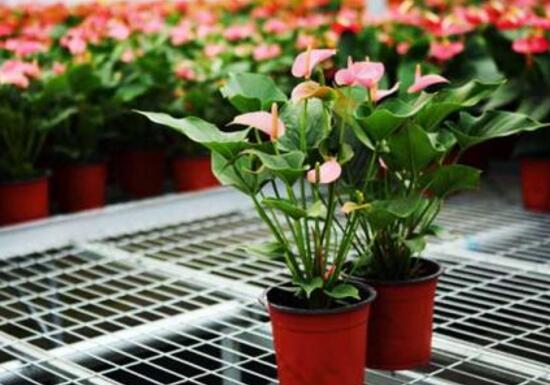
Since Anthurium andraeanum is a plant from the tropical rainforests of South America, its suitable growing environment is high temperature and high humidity, fertile and loose soil, sufficient but not strong light, frequent watering but no waterlogging, a climate that is not cold, and so on. Below, let us learn in detail about several important factors that affect its growth.
Cultivation methods and precautions for Anthurium andraeanum
I. Cultivation methods
1. Soil conditions. The basic requirement is good drainage and looseness; a further requirement is fertile sandy soil; the best soil is a mix of peat soil, perlite and fine sand, and it is best to add some organic fertilizer to the soil as a base fertilizer. This kind of soil is most favorable for the growth of Anthurium andraeanum.
2. Temperature requirements. The most suitable growing temperature is 20-28 degrees, but gardeners only need to ensure that the temperature does not exceed 35 degrees and that the minimum temperature is not lower than 14 degrees. If the temperature is too high, growth will be poor, and if the temperature is below 10 degrees, the leaves may be frostbitten.
3. Humidity management. Humidity that is too high or too low is both incorrect, because too much moisture can cause pests and diseases, while too low humidity can cause the leaves to wither. Keeping humidity at 70-80% is ideal, and it should not be below 50% at the lowest, otherwise the leaves will lose their luster.
4. Light conditions. Anthurium andraeanum likes sufficient light, but it also has strong shade tolerance. So in terms of light, how do you grow Anthurium andraeanum? The answer is that it should never be grown under full light at any time; instead, it should be kept in an environment with weak light but no lack of light.
5. Watering method. Anthurium andraeanum is a plant that is not drought-tolerant, so the soil should be kept moist as much as possible, but it should not be overwatered. Generally, watering is done according to whether the soil is dry or wet, keeping the soil slightly moist. Do not let the soil surface turn white and dry out.
6. Fertilization techniques. In theory, if the soil is relatively fertile, not much fertilizer is needed, but in order to promote its growth, liquid fertilizer should be applied during the growing period, generally mainly compound fertilizer, ensuring a balance of elements such as nitrogen, phosphorus and potassium.
II. Precautions
1. The flowerpot does not need to be too large, otherwise after watering the soil will not be able to absorb the water, which is unfavorable for the root growth of Anthurium andraeanum. In addition, there should be no standing water in the flowerpot, so do not water too much or too often. If standing water appears, drain it promptly.
2. In the cultivation methods and precautions for Anthurium andraeanum, if the day-night temperature difference where gardeners are located is large, it is best to place Anthurium andraeanum indoors for care. This also makes it easier to keep it warm in winter, because Anthurium andraeanum is not cold-tolerant, and the winter temperature should be kept above 10 degrees.
3. As Anthurium andraeanum grows, the flowerpot used at the beginning may be too small and no longer suitable for it, so the flowerpot and soil need to be changed once every 1-2 years. When changing the pot, soak the pot in water for 1-2 days, and the soil needs to be disinfected to ensure the soil is healthy and the flowerpot is breathable.
How to grow hydroponic Anthurium andraeanum: cultivation methods and precautions for hydroponic Anthurium andraeanum
Anthurium andraeanum is a plant of the Araceae family and is a plant with relatively strong hydrophilic properties. However, hydroponic cultivation is much more difficult than spider plant or pothos. Below, let us talk about how to grow hydroponic Anthurium andraeanum and look at what cultivation methods and precautions there are for hydroponic Anthurium andraeanum.
Introduction to Anthurium andraeanum
Anthurium andraeanum (Latin scientific name: Anthurium andraeanum), also called flamingo flower, Anthurium, flamingo lily, etc., is a perennial evergreen herbaceous flower. It likes a warm, humid and well-drained environment, and fears drought and strong direct sunlight. Its suitable daytime growing temperature is 26-32°C, and nighttime temperature is 21-32°C. The highest temperature it can tolerate is 35°C, and the low temperature it can tolerate is 14°C. The suitable light intensity is 16000-20000 lx, and the ideal relative air humidity (RH) is 70%-80%. Its plant height is generally 50-80 cm, varying by variety. It has fleshy roots and no stem. Leaves emerge from the rhizome, have long petioles, are solitary and heart-shaped, bright green, with sunken veins. Flowers are axillary, with a waxy spathe, from perfectly round to ovate, bright red, orange-red fleshy color, or white, with a spadix, cylindrical and upright. It blooms in all four seasons.
How to grow hydroponic Anthurium andraeanum——Introduction to cultivation methods
Anthurium andraeanum is a very good ornamental plant. Many gardeners are not satisfied with soil cultivation of Anthurium andraeanum and begin trying hydroponic cultivation, but they repeatedly fail. Below, let us talk about how to hydroponically grow Anthurium andraeanum.
Anthurium andraeanum is a plant of the Araceae family and is a plant with relatively strong hydrophilic properties. However, hydroponic cultivation is somewhat much more difficult than spider plant or pothos. Generally, gardeners mistakenly think that it can survive once inserted into water. Because of its strong hydrophilic nature, it can still survive for several months even when inserted into water.
The roots of Anthurium andraeanum breathe very strongly, and putting them directly into water can easily obstruct their breathing. The best method is to use a substrate, and the best substrate is ceramsite. Since the roots of Anthurium andraeanum are fleshy roots and the leaves emerge from the roots, the usual method of fixed orchid + stones + easy [substrate] is not easy for small leaves to emerge. Ceramsite, however, is light in texture and provides enough space, making it easy for small leaves to emerge. The hydroponic Anthurium andraeanum I currently have in the office is cultivated with ceramsite. It has already been grown for 2 years, and each plant has 3-4 flowers.
To hydroponically grow Anthurium andraeanum with ceramsite, first wash the roots clean, trim old roots and residual roots, and remove the flowers. Then place the plant into a container. Fill it with ceramsite, then dilute rooting powder according to the proportion, spray and wet the ceramsite, and be careful not to let too much water accumulate below. If there is too much water, pour it out. After a long wait, you will be pleasantly surprised to find that the thick, white fleshy roots of Anthurium andraeanum are growing on all sides, all clinging to the edge of the container. At this point, congratulations, a hydroponic Anthurium andraeanum is considered complete. What remains is to regularly add nutrient solution and care for its growth.
Precautions for hydroponic cultivation of Anthurium andraeanum:
1. A newly ceramsite-hydroponic Anthurium andraeanum is not suited to direct sunlight; just place it in a shady room.
2. At the beginning of hydroponic cultivation, do not add nutrient liquid; adding rooting powder is best.
3. The container for growing Anthurium andraeanum should be slightly larger, preferably wide at the top and narrow at the bottom, V-shaped, and it should also have a certain height.
4. How long can hydroponic Anthurium andraeanum live? Those grown hydroponically with ceramsite can live for a very long time. I have grown mine for 2 years and it still produces leaves and flowers every year. It is estimated that it can last even longer.
5. If you want to hydroponically grow Anthurium andraeanum, it is recommended to use ceramsite to induce it first, then switch to pure hydroponic cultivation. It is not recommended to put it directly into water.
How to hydroponically grow Anthurium andraeanum. Regarding the cultivation methods and precautions for hydroponic Anthurium andraeanum, the editor has introduced this much. Anthurium andraeanum is a very good ornamental plant, and hydroponic Anthurium andraeanum has higher ornamental value than potted ones.
Cultivation methods for potted Anthurium andraeanum:
1. Soil: When growing Anthurium andraeanum, soil that is loose, breathable, well-draining, and able to retain water and fertilizer should be used. It is best if the soil contains a certain amount of nutrients. You can choose leaf mold or peat soil plus some perlite or coal cinder and base fertilizer to make nutrient soil. Some broken bricks can be added at the bottom of the pot to help with drainage.
2. Watering: Anthurium andraeanum likes moisture and fears drought. The soil should often be kept moist. In summer, water according to how dry or wet the soil is, about once every one to two days. Never let water accumulate in the pot, so as not to damage the roots. Especially in winter, watering should be reduced; if there is too much water, the root system will rot. Slightly acidic water is best, and water with a pH value between 4.5-5 can be used. In dry seasons, the plant should also be sprayed with water.
3. Light: Anthurium andraeanum is a shade-loving plant, so it is best to place it in a shaded area, but it also should not be completely unable to receive any light source, as this will make the plant lack colored light. When in sunlight, a certain amount of shading should be provided so that it is not fully exposed to the sun. But in winter, when sunlight is weak, there is no need to shade it, and it can be placed in the sun with confidence.
4. Temperature: Anthurium andraeanum likes warmth and fears cold, so in summer high temperatures should be prevented and in winter frost damage should be prevented. The suitable growing temperature is 19-25 degrees. Below 13 degrees, the plant enters dormancy and should be placed indoors or wrapped in a plastic bag to prevent frost damage. When the temperature is above 32 degrees, growth stops. Generally, when it is above 25 degrees, windows should be opened for ventilation to alleviate the adverse effects of high temperatures.
5. Fertilization: Fertilizer can promote the growth of Anthurium andraeanum. When fertilizing, you can choose liquid fertilizer or a compound fertilizer with a nitrogen-phosphorus-potassium ratio of 1:1:1. Fertilize about once every 7-12 days. It is best to fertilize in the morning or evening, as the effect will be better. Alternatively, regularly apply fertilizer water, which means adding one or two drops of fertilizer liquid to the water when watering. For fertilizer water, once every three days is generally enough, but only one fertilization method can be chosen, not both.
6. Pests and diseases: Common diseases of Anthurium andraeanum include leaf blight and root rot. For leaf blight, use a small spray bottle to spray fungicides such as mancozeb and copper-based disinfectants for control, once about every month. Common pests mainly include termites and aphids. When there are not many, they can be removed with a brush, a writing brush, or a damp cloth.
Precautions for potted cultivation of Anthurium andraeanum:
1. When potting, the flowerpot should not be too large. It should be suitable for the size of the plant. If it is too large, the soil will not dry for a long time after watering, thereby damaging the root system.
2. Do not let water accumulate in the pot. It is better to keep the soil moist, and watering too frequently is also inadvisable.
3. In winter when it is cold, it should be placed indoors, and in summer when it is too hot, it should also not be placed in the sunlight.
4. Do not water at night in winter, because the day-night temperature difference is large. Watering at night, as the temperature drops, may freeze and damage the rhizome.
5. Repotting must be done in time to avoid affecting plant growth. If changing to a ceramic pot, the new pot needs to be soaked in water for one or two days before use.
6. When repotting, avoid damaging the root system.
Propagation methods for Anthurium andraeanum:
Anthurium andraeanum is commonly propagated by division. When repotting an old plant, cut off side shoots with 3-4 leaves and aerial roots, and plant them separately.
How to grow Anthurium andraeanum? Introduction to cultivation methods and precautions for Anthurium andraeanum
Anthurium andraeanum is a perennial evergreen herbaceous flower. It is also called flamingo flower, Anthurium, flamingo lily, etc. It likes a warm, humid and well-drained environment, and fears drought and strong direct sunlight. Its suitable daytime growing temperature is 26-32°C, and nighttime temperature is 21-32°C. The highest temperature it can tolerate is 35°C, and the low temperature it can tolerate is 14°C. Its plant height is generally 50-80 cm, varying by variety. This article focuses on introducing the key care points for Anthurium andraeanum for everyone's reference and learning.
Anthurium andraeanum has fleshy roots and no stem. Leaves emerge from the rhizome, have long petioles, are solitary and heart-shaped, bright green, with sunken veins. Flowers are axillary, with a waxy spathe, from perfectly round to ovate, bright red, orange-red fleshy color, or white, with a spadix, cylindrical and upright. It blooms in all four seasons.
Key care points
1. Temperature
Control the room temperature well. In summer, measures should be taken to lower the room temperature to within 35°C. In winter, if the indoor temperature is below 12°C, methods such as covering with a plastic bag or making an insulation box can be used to raise the room temperature.
2. Humidity
Maintain relatively high air humidity. This is the key to indoor care. Measures must be taken to increase the air humidity of the environment where Anthurium andraeanum is placed. Methods such as spraying the leaf surface can be used (be sure to ensure there is no water on the leaf surface at night). Keep the leaf surface clean regularly.
3. Fertilization and watering
Supply sufficient fertilizer water. In spring and autumn, generally apply fertilizer water once every 3 days. If the temperature is high, apply fertilizer water once every 2-3 days depending on whether the substrate in the pot is dry or wet. In summer, apply fertilizer water once every 2 days, and when the temperature is high, one additional watering can be added. In winter, generally apply fertilizer water once every 5-7 days. For fertilizer, liquid fertilizer is recommended. A complete fertilizer with NPK 1:1:1 can be chosen. The applied N concentration should not exceed 0.2%. In the fertilizer, attention should also be paid to the supply of elements such as Mg, S, Ca, B, Mo, Cu, and Zn, or a special fertilizer for Anthurium andraeanum can be used directly.
4. Soil
When growing Anthurium andraeanum, soil that is loose, breathable, well-draining, and able to retain water and fertilizer should be used. It is best if the soil contains a certain amount of nutrients. You can choose leaf mold or peat soil plus some perlite or coal cinder and base fertilizer to make nutrient soil. Some broken bricks can be added at the bottom of the pot to help with drainage.
5. Pests and diseases
Common diseases of Anthurium andraeanum include leaf blight and root rot. For leaf blight, use a small spray bottle to spray fungicides such as mancozeb and copper-based disinfectants for control, once about every month. Common pests mainly include termites and aphids. When there are not many, they can be removed with a brush, a writing brush, or a damp cloth.
6. Propagation methods
Anthurium andraeanum is commonly propagated by division. When repotting an old plant, cut off side shoots with 3-4 leaves and aerial roots, and plant them separately.
In addition, Anthurium andraeanum can be grown not only in soil but also hydroponically. Below, let us talk about the precautions for hydroponic cultivation of Anthurium andraeanum:
(1) A newly ceramsite-hydroponic Anthurium andraeanum is not suited to direct sunlight; just place it in a shady room.
(2) At the beginning of hydroponic cultivation, do not add nutrient liquid; adding rooting powder is best.
(3) The container for growing Anthurium andraeanum should be slightly larger, preferably wide at the top and narrow at the bottom, V-shaped, and it should also have a certain height.
(4) How long can hydroponic Anthurium andraeanum live? Those grown hydroponically with ceramsite can live for a very long time. I have grown mine for 2 years and it still produces leaves and flowers every year. It is estimated that it can last even longer.
(5) If you want to hydroponically grow Anthurium andraeanum, it is recommended to use ceramsite to induce it first, then switch to pure hydroponic cultivation. It is not recommended to put it directly into water.
Summary: The above is an introduction to knowledge on how to care for Anthurium andraeanum. I hope it is helpful to friends who grow Anthurium andraeanum.