How Does Nasturtium Climb? Pinch the Seedlings, Set Up a Support, Tie Evenly and Strengthen Care
It is well known that nasturtium has a semi-trailing habit, so with proper care it can climb on supports and walls. Of course, this requires some skill. How does nasturtium climb? When should we prune it? And when should we set up a support? The editor below will answer your questions.
How Does Nasturtium Climb
1. Pinching During the Seedling Stage
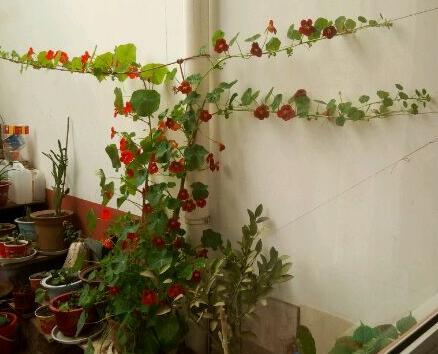
After nasturtium is propagated, it will take root in 2-3 weeks, and when it grows 7-8 leaves, you can pinch it. The purpose of doing this is to make it sprout side branches so it can climb more easily. Otherwise, if the main vine is too long and there are too few side branches, climbing will be difficult to achieve.
2. Set Up a Support
After pinching, replenish fertilizer and water in time, and then in about 10 days its new branches will grow out. When the plant height reaches 15-20 cm, this confirms the key period for climbing. At this time, how does nasturtium climb? You need to set up a support in time, then evenly tie the nasturtium's vines to the support, and let the leaves face one direction.
3. Daily Care
As nasturtium grows, its branches and leaves will become longer and longer, so it needs to be tied in time according to the growth of the stems to distribute it evenly on the support. While tying, you also need to pinch the tips. For the method, you can refer to the detailed introduction in how to prune nasturtium.
Nasturtium Planting and Management
1. A nasturtium growing as a climbing vine is very beautiful. The reason its leaf surface should face one direction is that its flowers and leaves are phototropic, and it prefers an environment with light. So you need to change its position in time according to the light to make its leaves and flowering branches grow in one direction. Otherwise, it easily becomes messy.
2. During the growing season, fertilize once every 3-4 weeks, and water in time after each fertilization. Also pay attention to loosening the soil often to keep the soil sufficiently breathable, which is good for fertilizer absorption and root development. If the soil is too compacted, root growth will be hindered.
3. In winter, the temperature must not be lower than 8°C. At ordinary times, keep the temperature between 15-25°C. Too large a temperature difference will cause the leaves to turn yellow. After the temperature drops in autumn, place it indoors in a spot with plenty of sunlight, which can keep the nasturtium's leaves still green in winter.
4. Nasturtium has a relatively low chance of being infected by pests and diseases, but we cannot ignore the harm of pests and diseases. It is mainly attacked by leaf miners, mosaic disease, and so on. Prevention is to strengthen daily care and management, and treatment is to spray with dimethoate emulsifiable concentrate and so on. When diseased plants are found, they should be pulled out in time.
How to Prune Nasturtium: The Method, Time and Technique of Pinching Nasturtium Are Key
We know that nasturtium has the characteristic of twining and trailing growth. If it is allowed to grow unchecked, its branches may intertwine and appear rather messy. Although this is its natural growth state, it is not attractive and also affects light penetration between branches and leaves, so it needs to be pruned in time. So how do you prune nasturtium? When do you pinch nasturtium? Learn the correct pruning method with the editor below.
How to Prune Nasturtium
When pruning nasturtium, techniques such as pinching, thinning, and shortening are generally used. Among them, pinching is the most critical. It can control nasturtium's growth so that it does not grow too tall or too fast. Thinning is often carried out after the plant matures, which can keep the overall nasturtium more attractive.
When to Pinch Nasturtium
Pinching is also called tip pruning. It needs to start when nasturtium is a seedling. Generally, wait until it grows 7-8 leaves, then pinch it by removing the tender buds at the top, then let it continue growing. During the entire seedling stage, pinching may be done 1-3 times.
Although removing its tender buds during the seedling stage may seem like it could hinder nasturtium's growth, in fact it can promote growth. It can make nasturtium sprout more side branches and keep its overall plant height from being too tall. Otherwise, due to space issues, it may not be possible to place it indoors.
Nasturtium Pruning Methods
How do you prune nasturtium at the mature stage? At this time, it needs thinning and shortening. Thinning is cutting off part of its dense and messy branches. Shortening is using scissors to cut off vines with sideways-growing nodes to prevent them from growing sideways too quickly.
To make the overall plant shape more attractive, you also need to use supports or strings to guide it so it grows in the intended direction, making it more beautiful while having abundant flowers and leaves. In addition, thinning and shortening may be used many times during nasturtium's growth process, depending specifically on the plant's growth and personal aesthetics.
Care After Pruning
1. After pinching, there is no need to fertilize or water immediately. You can wait until it grows new branches a few centimeters before replenishing fertilizer and water. During the seedling stage, when the plant grows to about 15 cm, it is best to set up a support and tie the main vine to the support with string, which can help it achieve the ideal shape after maturity.
2. For pruning at the mature stage, you can replenish a certain amount of water after completing the pruning, but try to avoid splashing water on the cut openings. In addition, when repotting and transplanting nasturtium, you can also prune its roots, but only cut off excess fibrous roots. Do not damage the main roots.
A Detailed Explanation of Pinching (Topping) Nasturtium
Pinching nasturtium and topping nasturtium mean the same thing. The purpose is to control the plant shape and make nasturtium grow more branches and bloom more. Of course, nasturtium does not have to be pinched or topped. This mainly depends on whether the grower wants to do it.
Pinching (topping) nasturtium is not suitable too early. It needs to be judged appropriately according to the condition of the seedlings. If the seedlings are too small, pinching and topping will not only fail to promote seedling growth, but will also weaken the seedlings' growth, which is very unfavorable to them. The same principle applies to any plant, so the timing of pinching is very particular. Generally speaking, topping nasturtium depends not only on the number of true leaves, but even more on branch length. At least wait until the branches are over 10 cm long and there are 7 or 8 or more leaves before doing it. If the branches are very short, then even if there are many true leaves, there is no need to consider topping.
The method of pinching nasturtium is very simple. In the picture below, the position in the red box is the seedling's growing tip. Just remove it. It is that simple.