What to do when petunia wilts? Waterlogging is the main cause, water scientifically to prevent waterlogging
Growing petunias is relatively easy; as long as they get enough light and a moist environment, they grow quickly. But sometimes a lack of attention to detail causes the plant to wither and droop, which gives some flower lovers a headache. So what should you do when petunias wilt? Let's look at the causes and solutions together.
What to do when petunias wilt
1. Too much watering
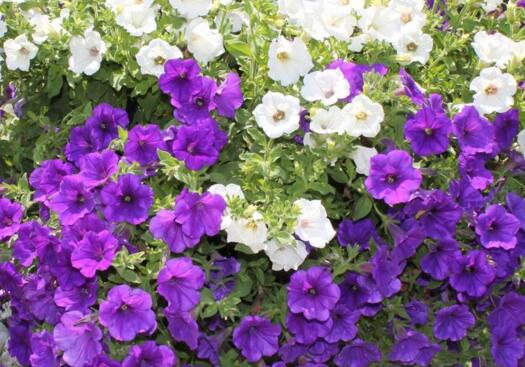
Petunias like a moist environment, so you should normally create a humid environment for them. But some flower lovers water twice a day, causing the potting soil to become excessively wet, which then causes problems with root growth. Plant wilting caused by watering is also very common when growing other flowers.
Solution: Immediately control the frequency and amount of watering. Do not water while the soil is still moist, and especially do not let water accumulate, otherwise root rot can easily occur. For detailed watering methods, refer to the guide on how to water petunias.
2. Poor drainage
Besides watering easily causing water accumulation, failing to pay attention to drainage during the rainy season can also easily cause the above situation. The reason is that some flower lovers keep petunias on balconies or outdoors, and when it rains they do not move them indoors in time, resulting in rainwater collecting in the pot and rotting the petunia roots.
Solution: Heavily prune the petunia by cutting off all its branches, then keep it in a cool place and wait for new shoots to sprout from the roots. After that, pay attention to drainage and waterlogging prevention during the rainy season, and do not ignore the harm water accumulation can do to petunias.
3. Not enough light
Petunias need fairly sufficient light. Except in summer, they can be kept in sunlight at other times. If kept in a rather dark environment, their branches and leaves will wither after a period of time, because of a lack of photosynthesis.
Solution: What should you do when petunias wilt due to a light problem? There is no doubt that you need to increase light. Move them out of the dark environment, preferably to a brighter place. If they can get 12 hours of sufficient light each day, their flowers will also be more vivid.
4. Pests and diseases
White mold, leaf spot, aphids and so on can all cause petunias to wilt if not treated in time. They make the leaves lack nutrients and also keep spreading. Aphids in particular can trigger more diseases. If not removed as soon as possible, they will not only cause poor plant growth but can also kill the petunia.
Solution: Do a good job of preventing and treating pests and diseases. Normally, avoid wind damage, rain damage, excessively high humidity and so on. You can often water with some chlorothalonil solution. When pests are found, spray with chemicals such as omethoate, amobam and so on.
How to water petunias, how often to water petunias / water when the soil surface turns white / do not let water accumulate
When growing petunias, water affects how fast they grow and can even affect their health. If the soil is too wet, the roots will rot and age, while if it is too dry, the roots will grow poorly. So watering must be done well. So how do you water petunias? Let me tell you the watering techniques.
How to water petunias
Before introducing watering methods, we need to first clarify the water requirements in the petunia's growth habits. First, it likes a moist environment but is rather afraid of wetness, so during the rainy season you must do a good job of drainage and waterlogging prevention. Watering should not cause water accumulation. The watering method stresses: do not water when not dry, and water thoroughly when you do water.
How often to water petunias
1. Seedling stage
When propagating by sowing, water thoroughly after sowing the seeds, and then no further watering is needed. If the soil is rather dry, you can spray water. After the seedlings grow true leaves, water moderately. Be sure the humidity is not too high, otherwise root growth will be hindered.
2. Growth stage
Petunias have a fairly high water demand, but to prevent the soil from being too wet, you should not water frequently during the growth stage. So how do you water petunias at this time? Generally, water once a week. As long as each watering is thorough, it can meet normal growth needs.
3. High-temperature period
Petunias can tolerate a high-temperature environment of 35 degrees, but at this time water must be replenished in time, otherwise transpiration will cause the stems and leaves to lack water and turn yellow. So in high temperatures, generally water once in the morning and once in the evening, and you must keep the soil slightly moist.
4. Low-temperature period
When the temperature is relatively low, you should not water too frequently; instead, try to control the number of waterings. As long as the soil does not completely dry out, no watering is needed. One method is to spray more water, which can both keep humidity moderate and ensure petunias do not lack water. Also note that the water temperature must be controlled well.
Notes on watering petunias
1. Check soil drainage. In the petunia growing method, we have repeatedly emphasized avoiding water accumulation. To achieve this, besides not watering excessively, you also need to regularly check whether the soil drains well. The bottom drainage holes must ensure excess water can flow out, otherwise it means there is a drainage problem and you need to loosen the soil or repot in time.
2. Watering should take climate changes into account. The four techniques above can serve as references when watering, but in actual operation you need to adjust flexibly according to climate changes. For example, during the rainy season petunias consume water relatively slowly, so watering should be reduced. Specifically, base it on whether the soil is dry or wet.
Petunia - Petunia growing method | Petunia pictures | How to grow petunias
Petunia
Petunia (Latin scientific name: Petunia hybrida Vilm), also known as garden petunia, hybrid petunia, lingzhi peony, shuttlecock flower, dwarf trumpet, sweet potato flower, and petunia, is a perennial herb often cultivated as an annual or biennial; plant height 15-80 cm, with both clustered and trailing types; leaves elliptical or ovate; it can bloom in the same year after sowing, with a flowering period lasting several months, and trumpet-shaped corollas.Petunia growing method
1. Soil: Petunias are afraid of too much water, which can cause root rot and other problems, so potted petunias should use loose, fertile, well-drained sandy loam.
2. Watering: Petunias should usually be watered moderately to prevent them from becoming too dry or too wet. If too dry, the plant easily wilts; if too wet, the roots easily rot. In summer, when the weather is hot and evaporation is greatest, water should be replenished in time to keep the potting soil moist but not waterlogged. During the rainy season, drain and prevent waterlogging in time.
3. Light: Petunias are long-day plants and require fairly strong light conditions for photosynthesis to proceed smoothly. Therefore, whether potted or planted in the ground, they need sufficient light. With enough sunlight they grow strong, with lush leaves and abundant flowers; if light is insufficient, branches and leaves easily become leggy and they bloom less or with poor flower quality. If given more than 12 hours of light per day and a night temperature above 10°C, they can bloom in all four seasons.
Petunia propagation methods
Petunia cutting propagation method:
Petunia cuttings are best taken from late spring to the plum rain period, when the temperature is not very hot, as they root and survive more easily. They can also be cut after the autumn cools. Cut the sprouted tender tips, 10 cm long, and insert them into a sand bed. The cutting medium temperature should be 20-25°C. Note that except for the first watering after insertion, which can be slightly heavier, later watering should be frequent light sprinkling rather than heavy watering, otherwise the part of the branch inserted underground can very easily rot and die. They root 15-20 days after cutting and can be transplanted into pots after 30 days.
Petunia sowing propagation method:
Petunia seeds are very small. With proper sowing and care, the germination rate can reach above 60^. Petunia sowing propagation is suitable for indoor pot sowing, using a mix of high-temperature sterilized culture soil, leaf mold and fine sand. After sowing, no soil covering is needed; just press lightly. The suitable germination temperature is 20-22°C, and they germinate 7-10 days after sowing. When true leaves appear, the room temperature should preferably be 13-15°C.
Complete list of petunia varieties
Fantasy: A single-flowered, densely flowering variety, plant height 25-30 cm, small flowers, belonging to the mini type, flower diameter 2.5-3 cm, strongly branching, among which SkyBlue is the most outstanding.
Merlin: A single-flowered, densely flowering variety, plant height 25 cm, an early-flowering type, strongly branching, with diverse flower colors. It takes 80 days from sowing to flowering and is a disease-resistant variety.
Carpet: A single-flowered, many-flowered variety, a heat-resistant variety, strongly branching, with compact flowers. Among them Flame has red petals with a golden-yellow throat.
Mirage: Flower diameter 10 cm, petals with dark vein patterns, flower colors include orange, blue, pink, purple and so on.
Dream: Plant height 18-20 cm, a disease-resistant variety. Among them Rose Dream has rose-red flowers with a yellow center and a flower diameter of 8-10 cm.
Uses of petunias
Uses of petunias: 1. Decorating the home
Petunia flowers are large and brightly colored, with rich flower colors, and as vigorous decorative flowers they can be widely used in flower bed arrangements, flower trough configurations, scenic spot displays, windowsill accents, home decoration and so on. In the home, whether grown in pots for viewing or in hanging baskets as accents, they have a very good beautifying effect and are a good helper for beautifying the home.
Uses of petunias: 2. Gift-giving
Petunias can also be given as gifts to express one's feelings. The petunia flower language is peace of mind, of one heart with you; with you I feel warm; the flower language of white petunias is existence; the flower language of purple petunias is broken love. Different flower color varieties of petunias also have different meanings, but the meanings of petunia flowers are all fairly beautiful, and giving them to express one's feelings is also a good choice.
Petunia leaves turning yellow
1. Soil and water tend toward alkaline. Petunias are suitable for growing in slightly acidic soil and water. If the soil and water are alkaline, the water lacks soluble iron and other elements that can be absorbed, and the leaves will gradually turn yellow. When planting, choose acidic soil and water, and often water with alum fertilizer water during the growth period.
2. Humidity too low. When indoor air is excessively dry, petunias often show phenomena such as dry leaf tips or scorched leaf edges. Attention should be paid to methods such as spraying water and covering with plastic film to increase air humidity.
Petunia pest and disease control
Petunia white rust:
White rust mainly harms petunia leaves, petioles and tender stems. On affected leaves, light green small spots first appear on the leaves, then gradually turn pale yellow, and in severe cases expand into large diseased spots. Later, white scar-like protrusions appear on the back of the diseased part. When tender stems are affected, flowers and stems become distorted. When the diseased spots surround the petiole or tender shoot, the host part above the girdling grows poorly, shrivels and dies. Solution: In the early stage of disease, spray 1% Bordeaux mixture or 50% metalaxyl 500x solution. Spraying once every 10-15 days has a fairly good control effect.
Related encyclopedia
Pocket scale non-woven bag lamp wick bamboo shoot crab claw red rice note 3 ykk zipper ybs zipper large mountain cherry climbing rose wild senna winter plum green pine wristwatch Omega Longines famous watch children's building blocks flint bamboo orchid curling iron soursop