5 major differences between foxglove and lupine: appearance, region, propagation, blooming period
Foxglove and lupine are two completely different plants, but because they look fairly similar, they are often confused by people. In fact, these two plants themselves still have many differences, and as for the specific ways in which foxglove and lupine differ? Let us walk you through them below.
Differences between foxglove and lupine
1. Family and classification differences
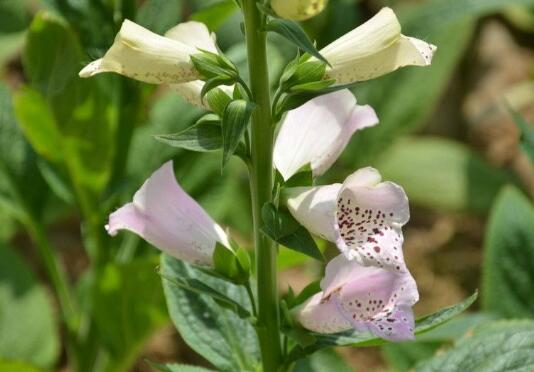
Foxglove: Angiosperms, Dicotyledons, Sympetalae, Tubiflorae, Scrophulariaceae, Digitalis.
Lupine: Angiosperms, Dicotyledons, Archichlamydeae, Rosales, Rosineae, Fabaceae, Faboideae, Genisteae, Lupinus.
2. Regional differences
Foxglove is a flowering plant native to Europe, later introduced to China, and today it is planted on a large scale in places such as Alishan, Taipingshan, Qingjing Farm and Nantianchi in China, and it is also often kept as a potted plant at home. Lupine is a flowering plant native to Mexico in North America, later introduced around the world, and today it is widely cultivated in countries such as the Soviet Union, the Netherlands, Belgium, the United States and New Zealand.
3. Propagation differences
In terms of propagation methods, these two plants also differ to some extent. Foxglove is generally propagated by sowing seeds. Lupine has more propagation methods; besides sowing seeds, it can also be propagated by cuttings, and the survival rates are all fairly high.
4. Blooming period differences
From the flowering time we can also see the difference between foxglove and lupine. Lupine generally blooms in spring each year, with its blooming period from March to May. Foxglove, however, blooms in summer, with its blooming period from May to June, so it can be said that when lupine finishes blooming, that is when foxglove begins to flower.
5. Appearance differences
Foxglove: Foxglove is a biennial or perennial herb. Its basal leaves are mostly in a rosette, the petioles have narrow wings, and can reach up to 15 cm long; the leaf blades are ovate or long elliptic, 5-15 cm long, acute or obtuse at the tip, gradually narrowed at the base, with rounded teeth bearing short tips along the margin, rarely serrate; the lower cauline leaves are the same shape as the basal leaves, gradually becoming smaller upward, with the petiole short until sessile and becoming bracts.
Lupine: Lupine has palmately compound leaves, with 5-8 leaflets; the petiole is much longer than the leaflets; the stipules are subulate, lanceolate to oblanceolate, up to 1 cm long, and the leaflets number 10-17, with thick leaf texture, mostly attached at the base, with the lower half fused to the petiole; the leaflets are obovate, oblanceolate to spatulate, 15-70 mm long and 5-15 mm wide, obtuse or acute at the tip, with a short point, gradually narrowed at the base, smooth on the upper surface and with coarse hairs on the underside.
These 15 flowers and plants should be grown in early autumn~
The weather is starting to turn cool, and we know everyone is already getting itchy to act. The cute girls who adore succulents are starting to prepare to get little succulent seedlings, and the gorgeous ladies who are crazy about herbaceous flowers are also eager to make a big autumn planting move. Today we are making a painstakingly compiled recommendation of 15 autumn-planted herbaceous flowers, so your spring garden can be as beautiful as a painting.
So-called autumn-planted herbaceous flowers are those flowers and plants suitable for planting in autumn. Most of them go through the severe cold of winter and then bloom in all their beauty in spring. Most of the plants recommended today are ones whose planting process we have taken part in ourselves; they are all good-looking and fairly easy-to-grow "girls," and if you like them, you can try growing them yourself.
These 15 flowers and plants should be grown in early autumn~
01. Verbena, Verbenaceae Verbena.
Verbena, as its name suggests, has rich and colorful flower colors. Small flowers cluster into balls and hug tightly together, and when fully in bloom they look like a sea of flowers, very spectacular. It also has another feature, which is that its blooming period is especially long, flowering continuously from April until before frost. So we can often see it in flower borders, and it is excellent for creating a ground-cover effect.
Tips
There are a few care points for verbena that everyone should remember
1. Verbena likes sunlight and is not afraid of being sunburned, so it must be placed in full sun for care
2. Verbena is not drought-tolerant and its root system is fairly shallow, so water it frequently, and be gentle when watering
These 15 flowers and plants should be grown in early autumn~
02. Snapdragon, Scrophulariaceae Antirrhinum.
Snapdragon, as its name suggests, means its flowers look like little goldfish, very cute, and they also grow in strings, making them look even cuter. If you look carefully at the picture, you can find that the snapdragon flower has upper and lower parts. There is a little trick for playing with snapdragons: you pinch the middle position of the upper and lower parts with two fingers, and the little goldfish will open its mouth. Every time we see snapdragons we cannot resist pinching them.Tips
If you also want to grow these cute snapdragons, remember the following care points
1. Snapdragon is very sensitive to water, so be sure to remember to keep the soil moist
2. Although snapdragon likes sunlight, it is cold-tolerant but not heat-tolerant, so try to avoid direct sunlight. These 15 flowers and plants should be grown in early autumn~
03、Annual phlox, alias: phlox. Polemoniaceae Phlox.
Annual phlox also has a name everyone is more familiar with, which is phlox. This name has a strong Chinese deity-and-Buddha flavor and easily makes people think of the three stars Fu, Lu and Shou. Phlox flowers are quite large, and the colors are also very rich. All the flowers gathered together look like a little tower.
Tips
1. During the growth period, phlox must maintain sufficient moisture, and because the leaves are too dense, in order to avoid water accumulating on the leaf surface, water from the roots
2. Phlox is not tolerant of high temperatures, and above 35°C it will develop yellow leaves, so it needs shading in summer
These 15 flowers and plants should be grown in early autumn~
04. Forget-me-not, alias: forget-me-not. Boraginaceae Myosotis.
Forget-me-not, also called forget-me-not, and many things on the market are called forget-me-not; the Limonium genus, which can be used for dried flowers, is also called forget-me-not. Forget-me-not has small flowers, sky blue, with a small yellow and white ring in the center, small and delicate, super cute.
Tips
If you also fall in love with it, when caring for it pay attention:
1. Forget-me-not likes sunlight, but the most suitable temperature is 22-28°C, so it still needs shading in summer
2. Forget-me-not does not like dryness or wetness; keeping the soil slightly moist is enough
These 15 flowers and plants should be grown in early autumn~
05. Lobelia, trade name: lobelia. Campanulaceae Lobelia.
Lobelia is also called lobelia, which is indeed quite vivid, because lobelia flowers only open on "half the side," which is one of its very important features: the lower three petals are longer, and the upper two are shorter. Because lobelia flowers are small and numerous and also have an excellent trailing effect, many flower lovers grow them pot by pot and then place them on windowsills or hang them up.
These 15 flowers and plants should be grown in early autumn~
06. Foxglove, Scrophulariaceae Digitalis.
Strings of little bells opening outward, foxglove is also called foxglove gloves; we introduced it before in an article, and everyone can look back through the history records. (Can a link to that previous article be inserted here?) Grandma Tasha used her specially made fertilizer to grow foxglove to more than 2 m tall, so foxglove's potential is enormous, and planting it by the wall in a courtyard is very grand.
Tips
Note! When sowing foxglove, do not cover with soil; just press lightly.
These 15 flowers and plants should be grown in early autumn~
07. Candytuft, alias: candytuft. Brassicaceae Iberis.
Candytuft is also very distinctive. It belongs to Brassicaceae, and the flowers are cross-shaped, but the petals are two long and two short. The flowers are tightly packed together and look as if there is only one large flower.
These 15 flowers and plants should be grown in early autumn~
08. Columbine, Ranunculaceae Aquilegia.
This one truly grows very, very alluringly; at first glance it has a goddess-like quality. After flowering it has a very obvious long spur (that is, a long tail), the flowers are large, and its colors are especially rich and gorgeous. If you plant it in your yard, guests are sure to be attracted by it at first sight.
Tips
To grow this one, note that it likes a cool environment, so in summer do not let it be exposed to the blazing sun
09. Lupine, alias: lupine flower. Fabaceae Lupinus.
Lupine also grows in big strings, and its leaves look like a big palm, also very beautiful. If you plant it together with foxglove in the yard, vertical-line plants will enhance the sense of space in your garden, very nice. Lake Tekapo in New Zealand is an excellent place to view lupines; if you have money and time, you can go take a look.
These 15 flowers and plants should be grown in early autumn~
10. Geranium, Geraniaceae Pelargonium.
Geranium, many flower lovers grow it in pots on balconies and often take backlit portrait photos of it; it is truly so beautiful it defies description. All kinds of flower forms are available for you to choose from, and what those small flower stems support are all "beauties."
These 15 flowers and plants should be grown in early autumn~
11. Corn poppy, Papaveraceae Papaver.
If we cannot grow opium poppies, then we grow corn poppies; they are in the same family and genus, and their appearance is not much different. The name is beautiful and the flower is beautiful too, and when it sways in the wind, it is probably hard for anyone to resist its charm.
Tips
1. Water less when overwintering, and water more during the spring growth period, so it grows taller
2. During the seedling stage, keeping the soil moist is enough; watering too much will drown it
These 15 flowers and plants should be grown in early autumn~
12. Chinese pink, Caryophyllaceae Dianthus.
Chinese pink is commonly seen in our daily life, but it has many varieties, which can satisfy the needs of different groups of people. Chinese pink itself gives off a faint fragrance and has a bactericidal effect.
These 15 flowers and plants should be grown in early autumn~
13. California poppy, Papaveraceae Eschscholzia.
California poppy also belongs to Papaveraceae, but it is not as alluring as the corn poppy; it has only a small and delicate orange-yellow color, yet it gives people a calm and peaceful feeling.
These 15 flowers and plants should be grown in early autumn~
14. Petunia, Solanaceae Petunia.
Petunia, also known as Petunia, is a "shorty" that grows short but has a heart for wall-slamming. Petunia's trumpet-shaped flowers are especially large and numerous, and when in bloom they almost completely cover the leaves, so from a distance it looks like a big flower ball. Petunia has rich flower colors and a long blooming period, easily fills its pot, and has an excellent trailing effect. You can choose a good-looking pot and hang it on the balcony, and from far away you can see your home's profusion of flowers.
Tips
Place it in a sunny place such as a balcony to ensure sufficient sunlight.
These 15 flowers and plants should be grown in early autumn~
15. Hollyhock, Malvaceae Alcea.
Hollyhock can reach up to 2 m tall, with a pair of straight "long legs," and its flowers are huge, each one alluring. Because it can reach about 1 zhang tall and is mostly red, it has a domineering alias, "one zhang red." Planting it in rows by the courtyard wall or in clumps in the yard would make such an intoxicating scenic line.
These 15 flowers and plants should be grown in early autumn~
Alright, today's recommendations end here. So many beautiful pictures have been tossed over to you all. If there are autumn-planted flowers you like, you can leave a comment to discuss together. We are also preparing a round of autumn planting, and are also about to start getting succulents.