Detailed Explanation of Pest and Disease Control Methods for Daphne odora 'Aureomarginata'
Main Diseases
Control of Stem Rot
Daphne odora 'Aureomarginata' is a precious flowering plant beloved by the public, but it is delicate and difficult to grow. The main cause is stem rot.
Symptoms: In the early stages of the disease, it is not easily noticed. The first part to show symptoms is the root crown. The phloem of the affected area turns black and rots, gradually spreading toward the roots. However, the xylem appears normal, the leaves remain green and normal, and do not fall off until death, with no symptoms observed on the surface.
2. Disease characteristics: The disease occurs from June to October, with peak incidence from July to September. This coincides with periods of high temperature and strong light. Through observation, the incidence rate for plants placed in full-day sunlight was 37.5%, while for those shaded from sunlight between 9:00 AM and 4:00 PM, the incidence rate was only 5%.
Affected plants are mainly 1-year to 5-year-old plants that grow rapidly in spring and have abundant leaves, and the disease is highly contagious.
Regarding the growing medium, the incidence rate was significantly higher in potting soil that dries out easily than in soil with good water retention. Soil containing 80% leaf mold and 20% river sand had a significantly lower incidence rate than soil with equal amounts of leaf mold and river sand. Soil made of 100% burned manure soil had a lower incidence rate than soil with high sand content.
Control methods: Based on the disease characteristics of Daphne odora 'Aureomarginata' and three years of practice, stem rot control can be approached from five aspects:
1. Selection of growing medium: Choose humus-rich soil with good drainage and water retention. This soil can be obtained by digging surface leaf mold directly from mountain forest areas and mixing in a small amount of river sand and decomposed cake fertilizer, or by using vegetable garden soil with some leaf mold, a small amount of river sand, and decomposed cake fertilizer added.
2. Selection of placement environment for potted plants: Daphne odora 'Aureomarginata' is a plant that prefers a cool and ventilated environment. From June to October, between 9:00 AM and 4:00 PM, potted plants should be placed in a shaded area. Alternatively, a shade frame can be set up to solve this.
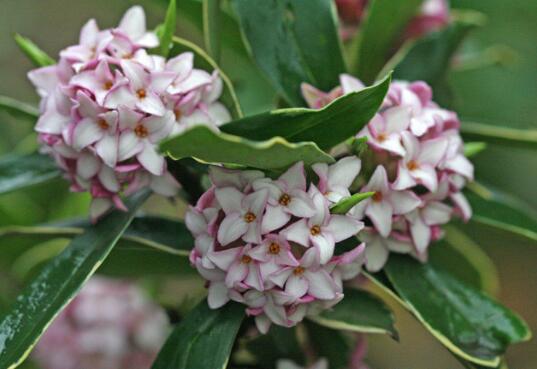
If you want to know what to do when Daphne odora 'Aureomarginata' gets infested with insects, first you need to know what kind of insect it is, so that you can deal with it accordingly, because the treatment methods for each pest and disease are different. Specific details are introduced below, and interested friends can take a look.
II. Pest and Disease Control for Daphne odora 'Aureomarginata' (Insect Pests)
Aphids
Aphids are one of the most destructive pests on Earth. This pest is harmful to many plants, and Daphne odora 'Aureomarginata' is no exception. They mainly suck the sap from the plant, causing a massive loss of nutrients, and eventually the plant gradually withers and dies.
Control method: For aphids, a pest and disease of Daphne odora 'Aureomarginata', we can use a 1500-2000 times dilution of 40% imidacloprid water-soluble concentrate to spray and kill them. Generally, 2-3 consecutive sprays will eliminate them.
Scale insects
Scale insects are a type of pest that appears during the growth of many plants, and Daphne odora 'Aureomarginata' is no exception. This pest mainly feeds on the sap in the leaves and stems of Daphne odora 'Aureomarginata', gradually sucking out the sap, causing the plant to gradually lose nutrients and eventually shrivel.
Control method: When dealing with scale insects, a pest and disease of Daphne odora 'Aureomarginata', we can use a 2000 times dilution of 10% omethoate to spray and kill them. Generally, three consecutive sprays will completely kill this pest.
III. Pest and Disease Control for Daphne odora 'Aureomarginata' (Diseases)
Stem rot
Stem rot is a relatively common disease of Daphne odora 'Aureomarginata'. This disease mainly harms the roots of the plant. When it occurs, the phloem of the roots turns black and rots, and it gradually spreads toward the roots, eventually causing the entire plant to rot and die.
Control method: When dealing with this pest and disease of Daphne odora 'Aureomarginata', we can use a 1000 times dilution of 38% oxadixyl-cymoxanil-kresoxim-methyl fungicide to drench the roots. Generally, once every 5-7 days, and after 3-4 treatments, it can be cured.
Fusarium wilt
Fusarium wilt is a disease caused by fungi. The pathogen generally invades through root wounds and gradually spreads over time. From onset to death, the disease course is generally 15-45 days. It is an extremely harmful disease.
Control method: When targeting this pest and disease of Daphne odora 'Aureomarginata', we can use a 800-1000 times dilution of carbendazim or benomyl to irrigate the roots of Daphne odora 'Aureomarginata'. Generally, once a week, and after 5-6 treatments, it can be cured.
Leaf spot disease
Leaf spot disease is a disease that can appear in many plants, and Daphne odora 'Aureomarginata' is no exception. When it occurs, small chlorotic round spots appear on the leaf surface, and in the later stages they expand into larger nearly circular lesions. In severe cases, it can cause all the leaves to drop, weakening the growth, until the entire plant dies.
Control method: When dealing with this pest and disease of Daphne odora 'Aureomarginata', we can use a 500-800 times dilution of thiophanate-methyl to spray the affected plants. Generally, spray once every 7-10 days, and after 2-3 treatments, it can be cured.
Pest and Disease Control Methods for Daphne odora 'Aureomarginata'
The main diseases of Daphne odora 'Aureomarginata' are stem rot, root rot and mosaic disease, and the main pests are aphids, scale insects, etc. Control should adhere to the principle of “prevention first, integrated control”.
(1) Strengthen flower garden management.
1. Strictly control the movement of diseased seedlings and the use of diseased branches for propagating young plants.
2. Fertilize reasonably and water scientifically. Nitrogen fertilizer should not be applied too heavily; appropriately increase phosphorus and potassium fertilizer to enhance the plant's disease resistance.
3. Maintain flower garden hygiene. Diseased plants, dead branches, fallen leaves and weeds in the flower garden should be promptly removed to eliminate the source of pathogenic organisms.
(2) Chemical control.
1. Stem rot. It mainly harms the root crown, which turns yellow-brown and rots, causing the plant to wither and die. Use a 500 times dilution of 50% carbendazim or an 800 times dilution of 40% triadimefon-carbendazim wettable powder, alternately spraying continuously 4-5 times for better control.
2. Root rot. It is mainly caused by waterlogged potting soil from overwatering or excessive or overly concentrated fertilizer burning the root system. Use a 1000 times dilution of 30% validamycin powder or a 500 times dilution of root rot fungicide, alternately spraying continuously 4-5 times for better control.
3. Mosaic disease. Spray with a 600 times dilution of 10% virus-killing agent, while also controlling aphids.
4. Pests. Pests can occur in all four seasons. Mainly use a 1000 times dilution of 40% omethoate emulsion or a 1000 times dilution of 40% isocarbophos emulsion and other chemicals for control.