What are the common pest and disease identification and control methods for cyclamen?
Cyclamen is highly prone to disease and should be planted in a clean, well-drained location. The main diseases include Fusarium wilt, wilt disease, soft root rot, gray mold, verticillium wilt, and spider mites.
1. Fusarium wilt. The pathogen often lies dormant on seedlings until transplanting, when the disease begins to develop; during transport, temperature and humidity management must be carefully controlled, with strict disinfection, and soil and flower pots must also be disinfected. Discard yellowed seedlings. From the 5th week after transplanting, apply thiophanate-methyl or chlorothalonil as a preventive measure.
2. Wilt disease. After transplanting, the stems and leaves of seedlings develop poorly, black fungus appears on leaf margins, and the vascular system of petioles and corms shows light red lesions; large patches of light orange spores appear on the remains of the plant organs, and this disease spreads rapidly; remove affected plants and apply thiophanate-methyl or chlorothalonil for control.
3. Soft root rot. Symptoms include sudden wilting of the plant, followed by lodging, and small corms; the main causes are planting the corm too deep, excessively high temperatures, and excessive humidity; avoid overhead watering during hot seasons.
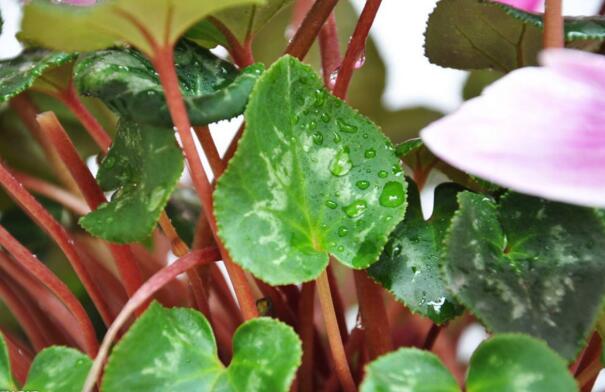
Indoor cultivation is not the same as outdoor cultivation; every condition must be created artificially. In the cultivation methods for cyclamen, we introduce indoor potted growing. Cyclamen has requirements for soil, light, water, and so on, and if any operation is improper, the leaves will develop pests or diseases. As for what to do when cyclamen gets pests, take a look at the symptoms and solutions for the following pests, and you will know what to do.
(1) Symptoms of cyclamen pest infestation and solutions
① Mites
Mites are one of the main pests and diseases of cyclamen. These pests mainly suck sap from young leaves and tender buds. The symptoms of infestation are: cyclamen leaves curl inward along the leaf margins, the leaf surface turns brown with a greasy sheen, and the leaves become wrinkled and deformed, flower buds turn black and rot, petals do not extend, and flowering is abnormal.
Solution: Apply dicofol, pyridaben, propargite emulsifiable concentrate, etc. When spraying, be sure to spray the solution onto the young leaves, tender buds, and flower buds in the center of the corm, as only this will harm the pests. Mites have strong pesticide resistance, so several pesticides should be used in rotation.
② Slugs
Slugs are also one of the common pests and diseases of cyclamen. They mainly damage young leaves and the tips of young buds. When infested by this pest, cyclamen leaves develop notches or holes, and young leaves become incomplete.
Solution: Simply catch them by hand. In addition, to prevent this pest from reappearing, reduce the air humidity at ground level in the greenhouse, promptly clean the greenhouse interior, and minimize the slug's living environment as much as possible.
③ Aphids
Aphids are one of the main pests that damage flowers, and this naturally includes cyclamen. They mainly infest the undersides of cyclamen leaves, sucking sap from young leaves and tender buds. When infested, the leaves become wrinkled, withered and yellow, and may even fall off.
Solution: Buy a sticky insect trap from the market and use it to catch and kill them; in addition, you can apply dichlorvos, omethoate, menazon, fenpropathrin, etc. for spraying and killing. When spraying, be careful to spray the solution onto the undersides of the leaves. Aphids have strong pesticide resistance, so several pesticides should be used in rotation.
④ Cabbage caterpillars
Cabbage caterpillars parasitize cyclamen's young buds, young leaves, new and old leaves, flower buds, petals, and other parts, and they prefer to feed on the undersides of leaves. The symptoms of this pest's appearance are holes bitten into the leaves and notches on leaf margins.
Solution: When this pest is found, spray with pesticides such as deltamethrin, trichlorfon, dichlorvos, etc.; during the larval damage period, the biological pesticide B1 suspension concentrate can also be used for spray control on the undersides of leaves; in addition, the environment around the cyclamen should also be properly cleaned up so that it can grow healthily.
⑤ Cyclamen flies
This pest mainly damages the internal tissues of cyclamen's roots and corms, causing the affected areas to constrict and become sunken, which then leads to leaves wilting and turning yellow, and in severe cases can cause plant death.
Solution: If they are larvae, apply trichlorfon, dichlorvos, omethoate, phoxim, etc. as a root drench to kill them; if they are adults, apply trichlorfon, dichlorvos, etc. for spraying and killing.
(2) Symptoms of cyclamen diseases and solutions
In addition to pest infestation, diseases also constantly threaten the health of cyclamen. It is understood that cyclamen mainly has four diseases: damping-off, leaf rot, wilt disease, and anthracnose. Among these, leaf spot disease is very serious, and we should remedy it promptly. The specific symptoms and solutions are as follows:
① Damping-off
This disease mainly affects seedlings and generally appears during the stage from emergence to transplanting. When affected by this disease, cyclamen develops brown lesions at the base of the stem, which expand around the stem and eventually result in drying and death. Damping-off is caused by infection with Rhizoctonia solani and is prone to occur under conditions of low temperature and high humidity.
Solution: In the early stage of the disease, spray or drench the roots with a 1000-fold dilution of 50% liningjing; this disease is very troublesome once contracted, so we should focus on prevention. After cyclamen seeds germinate, pesticide must be sprayed within 3 days of entering the greenhouse to prevent damping-off, and preventive spraying should be carried out regularly throughout the seedling stage.
② Leaf rot
Leaf rot is one of the common pests and diseases of cyclamen. It mainly damages various parts of cyclamen, including leaves, petioles, buds, and tubers.
Symptoms on petioles: dark brown water-soaked lesions appear, leaves lose vitality and turn yellow. The vascular bundles of the diseased petioles turn brown and spread to the tuber, causing young buds to turn black and form bud blight.
Symptoms on tubers: vascular bundles near the bud points turn brown, then become dark brown and rot. The rot spreads from the vascular bundles to the entire corm, eventually causing death, and the aboveground parts wilt.
Solution: In the early stage of the disease, copper-based preparations can be used, such as a 1000-fold dilution of 70% keshade or a 1000-fold dilution of 1 million units of oxytetracycline, sprayed or used as a root drench to prevent the disease.
③ Wilt disease
After cyclamen contracts this disease, the initial symptoms are that some leaves near the ground lose vitality and turn slightly yellow, then the number of yellowed leaves increases, gradually spreading upward. Except for a few leaves at the top that remain intact, the rest all wither and die. When the corm is cut open, the vascular bundles are brown.
Solution: In the early stage of the disease, spray with a 800-fold dilution of 50% carbendazim or a 1000-fold dilution of 50% liningjing. Or drench the roots with a 1000-fold dilution of 50% root rot ning or a 500-fold dilution of 70% mancozeb. Use 200 ml per plant for root drenching, once every 7 to 10 days, for 3 to 4 consecutive times. Generally, root drenching is more effective than spray control.
④ Anthracnose
Anthracnose is one of the common pests and diseases of cyclamen, and it occurs throughout the year. Symptoms: cyclamen leaves develop circular lesions, with the center of the lesions being light brown or white, bearing many small black spots, which are conidia. In severe cases, it can cause the leaves to wither and die.
Solution: In the early stage of the disease, use a 800-fold dilution of 80% anthracnose fumei or a 500-fold dilution of 70% mancozeb for control; in addition, promptly prune and burn diseased leaves.
⑤ Gray mold
Gray mold often occurs in winter. Once there is continuous rainy, humid, and sunless weather, gray mold can get out of control. When affected by this disease, brown spots appear on cyclamen leaves, branches, and inflorescences, and as the disease worsens, it spreads throughout the entire plant.
Solution: In winter, maintenance and management must be strengthened by raising the indoor temperature, enhancing light transmission, and reducing humidity. Once an affected plant is found, immediately move it to a ventilated place and place it in sunlight, which can achieve effective control. In addition, when the disease is severe, Bordeaux mixture can be sprayed for treatment.
That is all the editor has to introduce regarding the prevention and control of pests and diseases in cyclamen. For such a small plant, there are quite a lot of pests and diseases, which is truly hard to believe. Therefore, in order to avoid the effects of pests and diseases, flower lovers must pay attention to care during the process of growing cyclamen, otherwise it will be difficult to deal with once it gets sick. Of course, even if it does get sick, following the methods above can also solve the problem.
What pests and diseases does cyclamen have? How to prevent and control them?
What pests and diseases does cyclamen have? How to prevent and control them?
The main pests and diseases include soft rot, anthracnose, spore nematodes, root-knot nematodes, aphids, red spider mites, cutworms, leaf rollers, etc.
The control methods are as follows:
(1) For soft rot, disinfect the storage room with 1% formalin, ensure the cultivation bed is well ventilated and dry, and practice crop rotation. For potted plants, change the soil every year. Use pesticides such as phoxim as a drench to kill underground pests; use a 600-800 fold dilution of dichlorvos to drench the soil around the roots of diseased plants, and spray a 1000-fold dilution of agricultural streptomycin.
(2) For the control of other pests and diseases, follow the same control methods as for the same types of pests and diseases in the previously mentioned flowers.