Differences Between Climbing Roses and Multiflora Roses: Appearance, Blooming Period, and Propagation Explained
Climbing roses and multiflora roses are two completely different plants, but because they belong to the same family and look somewhat similar, they are often easily confused. In fact, on closer inspection, these two plants still have many differences. What exactly are the differences between climbing roses and multiflora roses? Let's take a look below.
I. Differences Between Climbing Roses and Multiflora Roses
1. Leaf Differences
The leaflets of climbing roses generally number 3-5, and the leaves are very flat and smooth, while the leaflets of multiflora roses generally number 5-9, with toothed leaf margins, and although the leaves are flat, they have soft hairs. So when distinguishing these two plants, we can look at two points: the number of leaves and whether they have soft hairs.
2. Flower Appearance Differences
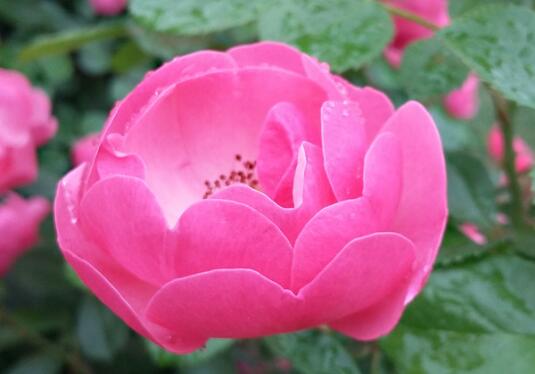
The flowers of climbing roses are basically upright, and rather large, with relatively thick petals, and they come in many colors, including striped color blocks and other variations, with relatively long pedicels. The flowers of multiflora roses, on the other hand, are relatively smaller, with relatively thin petals, and the flower colors are only pink and white, and the pedicels are shorter than those of climbing roses.
3. Flower Quantity Differences
In terms of flower quantity, we can also distinguish climbing roses from multiflora roses. The flowers of climbing roses are generally solitary, with only one flower opening per branch tip, while the flowers of multiflora roses grow in clusters, generally with 6-7 flowers clustered together per branch tip, and they generally grow at the top of the branches.
4. Different Propagation Methods
In terms of propagation methods, these two plants also have certain differences. The main propagation method for multiflora roses is cuttings, and layering and grafting can also be used. The propagation methods for climbing roses are mostly asexual methods such as grafting, and cuttings are difficult to keep alive.
5. Blooming Period Differences
The difference between climbing roses and multiflora roses also lies in their blooming time. Multiflora roses only bloom in spring, with a few varieties blooming in both spring and autumn, while climbing roses bloom in multiple seasons. Most varieties on the market in China now bloom in three seasons, and the blooming period of climbing roses is a bit longer than that of multiflora roses.
II. Photo Appreciation of Climbing Roses and Multiflora Roses
Climbing Rose Photos
Multiflora Rose Photos
An Introduction to Climbing Rose Cultivation Methods!
Climbing roses have large, fragrant flowers and are precious ornamental plants. They can be used as greening material for trellises and balconies, and are also climbing greening plants suitable for promotion in most parts of China. Climbing roses have many flowers and brilliant colors, blooming all over the plant with numerous flower heads, making a spectacular sight. In gardens, they are mostly attached to various well-ventilated trellises and corridors, and can form landscapes such as flower balls, flower columns, flower walls, flower seas, arch shapes, and corridor shapes. Today, let's briefly introduce the cultivation methods for climbing roses.
Climbing Rose Cultivation Methods - Propagation Methods:
Climbing roses are difficult to root from cuttings, so asexual propagation methods such as grafting are usually used. In the central Jiangsu region, wild multiflora rose is mostly used as rootstock, because wild multiflora rose can adapt to harsh environments and is easy to keep alive. Branch, bud, and root grafting are all possible. For branch grafting, the rootstock must first be stored in sand. Bud grafting can be done in all four seasons, and buds can be taken and grafted at any time, commonly using the U-shaped grafting method.
Watering and Fertilizing:
Climbing roses must not lack water throughout their entire growth period. From budding to leafing out and blooming, attention should be paid to supplying sufficient water. Especially during the blooming period, the water requirement is relatively large, and the soil should be kept moist often to ensure the flowers are plump and vivid. After climbing roses enter dormancy, their water requirement is relatively reduced, and water should be appropriately controlled.
Since climbing roses bloom abundantly, sufficient base fertilizer should be applied during the winter dormant period. Fertilizer should be applied promptly during the growing season, generally topdressing after the full bloom in May to facilitate summer blooming and a full autumn bloom. In late autumn, fertilization should be controlled to prevent excessive autumn shoots from being damaged by frost. When leaves begin to unfold in spring, because new roots are growing in large numbers, do not use concentrated fertilizer, so as not to damage the new roots.
Light and Temperature:
Climbing roses have wide adaptability and are not strict about soil, but loose, fertile soil rich in organic matter is more suitable. They like warm environments with ample sunlight and good drainage. The optimal growth temperature is 15—25°C. Below 5°C they begin to go dormant, and above 33°C the flower quality is poorer. When light is insufficient, the stems and vines become thin and weak, the flowers become smaller, the number of flowers decreases, and the flower color fades.
Climbing roses relatively like fertilizer and water. Under conditions of abundant fertilizer and water, the branches and leaves are lush and the flowers are abundant and brightly colored. Conversely, the flowers become smaller and the flower color fades. They have strong drought tolerance, cold tolerance, and resistance to pests and diseases, with well-developed root systems, strong growth, rapid shoot sprouting, strong branching ability, and good regeneration. Each plant sprouts 7-8 main branches per year, and each main branch can sprout several side branches.
Pruning and Shaping:
Climbing roses have relatively long vines. Letting them grow freely not only makes them shapeless but also affects growth and blooming, so they need to grow attached to a prefabricated support frame. Therefore, one of the tasks of shaping and pruning is to let them grow well on a pre-arranged support frame according to the needs of garden landscaping, so as to form a unique ornamental landscape.
Before transplanting, first thin out aging branches, thin and weak branches, damaged branches, and diseased and pest-infested branches. After digging up the seedlings, the root system should also be pruned, removing old roots and diseased roots, and cutting the cut surfaces of damaged roots smooth to facilitate healing. After the seedlings are planted, a relatively heavy pruning is generally needed, often cutting the branches at about 10 cm from the base, so as to first build a good root system before they can send out branches.
Blooming Period Control:
Climbing roses can be planted in different regions of northern and southern China. In the North China region, they generally begin to sprout in mid-March, unfold leaves in late March, first bloom in mid-May, and multi-flowered varieties can bloom repeatedly until mid-November, gradually losing leaves after frost. Multi-flowered varieties set fruit after their first bloom, and by November the fruit turns orange or red.
Know the Price of Climbing Roses and Create a "Beautiful as a Flower" Home
Many romantic girls love roses. If we could live all day in a world full of roses, that would truly be wonderful.
But roses are expensive and relatively hard to grow, and it is difficult for non-professionals to grow them. But have you forgotten the rose's sister,
the Chinese rose? Although its appearance is not as beautiful as the rose, we still like it very much. If those colorful
Chinese roses covered the fence like multiflora roses and made us feel as if in a dream, we would be even more overjoyed. Now this dream may come true, because climbing
roses exist. So now let's learn about them.
Climbing Roses
Plant genus: Climbing roses belong to the Rosaceae family and are climbing plants.
Origin: They are a new variety that ordinary Chinese roses changed into due to adapting to the environment, and there are two kinds: climbing Chinese roses and trailing Chinese roses.
Characteristics: Their growth differs from ordinary Chinese roses. They produce new branches from the base, and their growth speed is extremely fast. Their vines can also
cling to walls and fences, and during the two blooming periods of early summer and midsummer, the flowers are abundant and the colors are brilliant.
Flower colors: The flower colors include bright red, pink, yellow, white, purple, orange, hybrid colors, and so on. There are many colors, and each
flower has a different posture, and they can bloom continuously.
Growth habits: Their adaptability is not very strong, and their growth vigor is also very strong. Whether in cold winter or drought, they can grow well. Suitable light
can make the flower buds develop better.
Uses of Climbing Roses
1. As garden ornament: Climbing roses have relatively large flowers, and there are many types with brilliant colors, looking very beautiful. In some tour
parks and some gardens, you can see climbing roses blooming in all their fragrance and splendor.
2. For decoration: If you have a small yard at home, you can plant climbing multiflora roses around the yard's railing, which will make the whole home look ro
mantic and beautiful. If it is a villa-type house, then plant several seedlings around the base of one wall, and with careful cultivation you can let the roses cover the house, so that you
can be accompanied by a romantic sea of flowers every day.
Climbing Rose Prices
| Supplier | Height (cm) | Price (yuan/plant) |
| Hangzhou Xiaoshan Liang Horticulture Farm | 50 | 1.8 |
| Changsha Xinchun Nursery Farm | 80 | 3.5 |
| Jiangsu Muyang Fuli Garden Nursery | 100 | 3.8 |
| Muyang Liangjing Landscaping | 120 | 4.0 |
In today's life, I also often see Chinese roses of various colors by the roadside. I never expected that better varieties would now appear. Although they are not as gorgeous as
roses, nor as mysterious as multiflora roses, they indeed combine the beauty of both and are flowers suitable for many of us to grow. Friends
can go home and try planting them!