How to grow rain lilies until they fill the pot? Learn these 7 tips, water and fertilizer are the key to a house full of blooms
Rain lily (Zephyranthes), a flower that blooms after rain, with flowers shaped like lilies and in a variety of colors, looking absolutely beautiful! In the world of flowers, rain lilies are both easy to grow and beautiful, but if you want them to fill the pot and extend their blooming period, you still need some care techniques. So how do you grow rain lilies until they fill the pot? For this, the editor has summed up 7 tips, so everyone hurry up and take a look!
1. How to grow rain lilies until they fill the pot, 7 tips
1. Choosing a flower pot
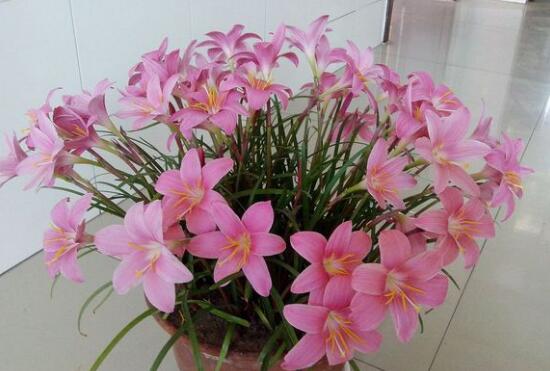
If you want rain lilies to bloom until they fill the pot, you have to start from the basics, and the first step is choosing a good flower pot. Many flower lovers may think the pot is not important, but this is a wrong idea. As for what kind of pot to choose, it depends on how big the rain lily bulbs are. Generally speaking, a 20-30 cm pot can hold about 5-6 bulbs, and a slightly larger pot can hold 10 bulbs, with the specific number depending on the actual situation.
2. Choosing soil
Rain lilies have strong adaptability and are not very demanding about soil. But if you want rain lilies to bloom until they fill the pot, the soil is best kept a bit fertile, which can give them enough nutrients to bloom. For this, it is recommended to use sandy loam soil.
3. Planting the bulbs
How to grow rain lilies until they fill the pot? After the potting soil is chosen, start planting the bulbs. Method: as shown in the picture above, dig holes evenly along the edge of the flower pot, plant 1 bulb in each hole, with the best spacing being 3-5 cm, then cover with 2-3 cm of soil and that's it!
4. Watering to keep moist
The method for planting rain lily bulbs is described in detail above, and those interested can go take a look. After the bulbs are planted, flower lovers should water them appropriately, with the specific amount mainly aimed at keeping the soil moist, and it is best to choose morning and evening to water.
5. Applying fertilizer appropriately
Sufficient nutrients are the key to rain lilies filling the pot, so applying fertilizer appropriately is very important! Fertilizer can be organic fertilizer, nitrogen-phosphorus-potassium fertilizer, or compost, all of which are fine, and the frequency does not need to be high, once every 2-3 months is enough. Do this well, and the rain lily flowers will bloom beautifully and more abundantly!
6. Light and temperature
How to grow rain lilies until they fill the pot? Besides watering and fertilizing, light and temperature are also very crucial. Flower lovers should place rain lilies in a place with sufficient light, and the temperature is best kept at 22-30°C. It should be noted that insufficient light, or unsuitable temperature, may cause rain lilies not to bloom.
7. Careful maintenance
Once the above steps are done, what remains is maintenance, and maintenance means paying attention to the above points, and then persisting, not working by fits and starts! Do the maintenance well, and rain lilies will surely fill the pot!
Overall, as a common potted plant, the cultivation method for rain lilies is very simple, and it can be said that with just casual care, they will bloom beautiful flowers. However, if you want rain lilies to fill the pot, you need to master the above care techniques, and only by doing all of them will your rain lilies bloom more flowers and bloom more beautifully!
Notes:
Flat peach pit bracelets crack very easily, so in the early stage when you are polishing them red, you definitely must not go out showing them off and exposing them to wind. In fact, after polishing a flat peach pit bracelet for two weeks, the patina is initially formed, and at that point it is not too late to wear it out and show it off.
If a new flat peach pit is prickly to the touch, to solve this problem, you can first rub the bracelet with a bath scrub towel for a week, and once the edges and corners of the peach pit are round and smooth, then put it on.
That's all for today's introduction, and I hope it can help friends who need it!
Grow a pot of pothos to make a newly renovated room healthier
Pothos is a large evergreen climbing plant that grows in tropical regions, often climbing on rocks and tree trunks. Next, let's take a look at the effects and benefits of pothos.
It has a lovely appearance. Pothos, also known as golden pothos, devil's ivy, and golden vine, is an evergreen perennial herbaceous plant of the genus Epipremnum in the Araceae family. The stems and vines of pothos are thick and strong, can reach several meters long, and have aerial roots at the nodes. The young leaves are egg-heart shaped; the leaves of newly propagated seedlings are relatively small and lighter in color, and as the plant ages, the mature leaves become long egg-shaped, about 15 cm long and about 10 cm wide. The dark green leaf surface is dotted with irregular yellow-white spots or stripes.
Its life needs are somewhat different from other plants. Pothos is generally propagated by cuttings, and because it has aerial roots at the stem nodes, cuttings root very easily.
It is a child with personality. It likes warm, humid environments and requires loose, fertile soil with good drainage. Potted pothos should use fertile, loose, well-draining leaf mold soil, preferably slightly acidic.
Its hometown determines its personality. Pothos is native to the Indonesian islands, and in tropical regions it often climbs on rocks and tree trunks. It likes high temperature, high humidity, and semi-shaded environments, is not tolerant of cold, and its suitable growing temperature is 15°C to 25°C. Below 15°C it grows slowly, and the overwintering temperature should not be lower than 10°C.
So what specific effects does pothos have for us? Let's understand them one by one below!
First is its decorative effect. Growing such a pot of pothos indoors or outdoors, seeing its vivid, dripping green can give people an aesthetic sense of pleasure and make body and mind feel refreshed, so its decorative effect is very prominent.
The effects and benefits of pothos
The effect of purifying air. Pothos is a large evergreen climbing plant, and like spider plants and ivy, it has a very strong ability to purify air. Pothos can absorb benzene, trichloroethylene, formaldehyde, and so on from the air, making it the perfect choice to place in a newly renovated home. According to environmental scientists' research, one pot of pothos in a room of 8-10 sq m is equivalent to an air purifier. It can be seen that pothos's air-purifying ability is quite strong.
The effect of inviting airflow. Pothos can invite airflow and let indoor spaces ventilate. Why say this? Plants themselves also breathe, absorbing carbon dioxide and exhaling oxygen. Pothos is generally placed by the window; when it is too windy outside, it blocks some of it, and if there is no wind, it itself also releases new oxygen, and the oxygen enters the space we live in, making us more energetic and making the indoor air fresher.
The effect of absorbing kitchen odors. This is actually also one aspect of purifying air. Placing pothos in the kitchen can effectively absorb some of the cooking oil fumes caused by stir-frying and cooking, and remove some other kitchen odors, keeping our kitchen's air fresh.
Pothos is suitable for being placed in the kitchen, where there is the most oil smoke. Placing it in the kitchen both achieves the environmental protection goal and adds a bit of green to the kitchen, killing two birds with one stone. Environmental scientists have found that one pot of pothos in a room of 8-10 sq m is equivalent to an air purifier and can effectively absorb harmful gases in the air such as formaldehyde, benzene, and trichloroethylene. Pothos not only has strong vitality, but when placed indoors, its air-purifying ability is no less than that of ivy and spider plants. Newly laid floors very easily produce harmful substances. Since pothos can simultaneously purify benzene, trichloroethylene, and formaldehyde in the air, it is very suitable for placement in newly renovated rooms.
Pothos is also suitable for being placed on windowsills. If you pay careful attention, we can find that the plants generally placed on the windowsills of ordinary homes are pothos, because its size is especially small, and placing it on the windowsill is just right, neither crushing the windowsill nor blocking the beautiful scenery the owner sees beyond the windowsill.
The above is the relevant introduction in this article. I believe after reading it you also have a simple understanding of this. If needed, you can continue to follow No.1 Home Network to learn more information.