Why Are the Leaves of the Golden Shrimp Plant Curling? Three Main Causes and Solutions
Although the golden shrimp plant (Pachystachys lutea) is famous for its yellow bracts and small white flowers, its leaves are actually very attractive too. The oval-shaped leaves stay bright green year-round, with very prominent veins, but if cared for improperly, the leaves can curl. So why do the leaves of the golden shrimp plant curl? There are mainly the following causes.
Why Do the Leaves of the Golden Shrimp Plant Curl?
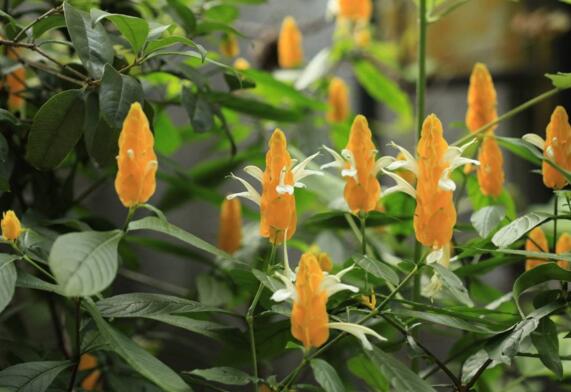
According to the growing experience of gardeners, there are three main causes of leaf curling in the golden shrimp plant: drought from lack of water, nutrient deficiency, and pests and diseases. So to solve this problem, you need to address these three aspects and adjust your care methods based on your usual maintenance habits.
Solutions for Curling Leaves of the Golden Shrimp Plant
1. Drought from Lack of Water
Cause: The golden shrimp plant is a plant that loves high-humidity environments. It has high humidity requirements and also needs a fair amount of water. During the growing season, the soil must be kept moist, with humidity around 80%. If you water too little, the leaves will become dehydrated and curl.
Solution: Curling usually happens in summer, because temperatures are higher then and water evaporates and is used up quickly. So you cannot water once every 3-5 days as in spring; instead, water once every 1-2 days, and also mist the leaves frequently to raise humidity. For specific methods, you can refer to the detailed introduction in how to water the golden shrimp plant.
2. Nutrient Deficiency
Cause: Normally, if the soil used for planting the golden shrimp plant is a mix of leaf mold, river sand, vermiculite and so on, combined with reasonable fertilization, its leaves will look very nice. Conversely, if the soil is poor and fertilization is too little, the golden shrimp plant will curl due to lack of nutrients.
Solution: One way to improve poor soil is to add some base fertilizer when potting, such as compound fertilizer or cow manure. In addition, during regular care, fertilizer needs to be supplemented reasonably, for example applying a diluted fertilizer solution once every 2-3 weeks during the growing season.
3. Caused by Pests and Diseases
Cause: Some pests and diseases harm the plant's roots, causing root rot and damage, so the roots cannot normally absorb nutrients and water. This then causes the leaves to lack essential nutrients and curl. Root rot is one example; when it occurs, it mainly damages the roots, so it is often hard to notice.
Solution: Pests and diseases are mainly caused by soil that has not been sterilized, an environment that is too closed and poorly ventilated, or humidity or temperature that is too high. The solution lies in prevention and treatment. Prevention mainly involves sterilizing the soil and ensuring the environment is well ventilated, while treatment involves spraying with solutions such as mancozeb.
Golden Shrimp Plant
Other Names for the Golden Shrimp Plant
The golden shrimp plant has quite a few other names, such as yellow bract flower, variegated shrimp plant, yellow shrimp flower, golden shrimp plant, little shrimp flower, shrimp flower, coral acanthus, gold-wrapped silver, golden pagoda, and golden pagoda flower.
The Flowers of the Golden Shrimp Plant
The golden shrimp plant originates from Mexico, Peru and South America. There are two main varieties: one with purple bracts and one with yellow bracts. The common golden shrimp plant has yellow bracts, spike-like inflorescences with layer upon layer of bracts, and small white flowers.
The golden shrimp plant has a relatively long flowering period, and the flowers are also long-lived, lasting up to several weeks. Plants grown at home are generally about 1 chi in height.
Growing Habits of the Golden Shrimp Plant
The golden shrimp plant likes a hot and highly humid growing environment and requires ample light, but it can also tolerate shade. The ideal growing temperature is 18°C-25°C, and in winter it should be kept above 5°C. The soil should be fertile and well-draining.
How to Fertilize the Golden Shrimp Plant: Two Key Points / Four Techniques to Master / Fertilization Methods Included
Although the golden shrimp plant entered China relatively late, it quickly became extremely popular, because it has many uses, so more and more people grow it. To grow it well, you need to understand how to cultivate the golden shrimp plant, and fertilization is a very important part of that. How do you fertilize the golden shrimp plant? Let me tell you the specific fertilization techniques.
How to Fertilize the Golden Shrimp Plant
(1) Key point one: the concentration of fertilizer must not be too high. It is better to apply it several more times than to burn the roots with too high a concentration. This is also what we often call the technique of frequent light fertilization. Each time you fertilize, you can use a diluted fertilizer solution, letting the fertilizer be diluted before use.
(2) Key point two: fertilization should be adjusted according to growth conditions and climate changes. Temperature in particular has a great influence on fertilization, because it affects the growth of the golden shrimp plant, so fertilization cannot be done the same way all year round. This is very similar to watering.
Fertilization Methods for the Golden Shrimp Plant
1. Peak Growing Season
When fertilizing during this period, generally do it once every 15-20 days, and remember that the concentration must not be too high. So when is the peak growing season for the golden shrimp plant? When the temperature is 16-28°C, that is when it grows fastest; this period is generally April-May and September-October.
2. Before the Flowering Period
After flower bud differentiation, the flower buds begin to form, and this process is also the key stage of bud formation. When fertilizing, we can add a 0.2% potassium dihydrogen phosphate solution. Its effect is to make the flower color more vivid, and after the flowers open, we can also increase the application of phosphorus and potassium fertilizer to produce more flowers.
3. Fertilizing in Summer
Generally speaking, when the temperature is above 30°C, the growth of the golden shrimp plant begins to slow down, and when the temperature is above 35°C, its growth basically stops. How do you fertilize the golden shrimp plant at this time? At this point, fertilization should be stopped, and cooling measures should be taken promptly to help the golden shrimp plant get through midsummer.
4. Late Autumn and Winter
In winter, not only should you keep it warm, but you also need to stop fertilizing, because when the temperature is below 10°C the golden shrimp plant enters dormancy and has very low fertilizer needs. However, in late autumn we can apply an extra dose of compound fertilizer. Its effect is to improve the cold tolerance of the golden shrimp plant and reduce the possibility of frost damage in winter.
Precautions for Fertilizing the Golden Shrimp Plant
1. When fertilizing, never sprinkle the fertilizer solution directly on the leaves of the golden shrimp plant, otherwise it may cause pests and diseases. This is a completely different concept from misting with water, and gardeners must pay attention to this when fertilizing.
2. When we notice signs of yellowing in the leaves of the golden shrimp plant, we can add some green vitriol, that is, ferrous sulfate, to the fertilizer solution. It can improve the yellowing of the leaves, but this is only a technique. The real cause of the yellowing still needs to be investigated by gardeners based on their usual care habits.