How to grow Pachystachys lutea (golden shrimp plant)? Growing methods and precautions, temperature should not be too low
Pachystachys lutea is native to Peru, but after being introduced to China in the 1980s, it quickly won the affection of many flower enthusiasts. The main reason is that Pachystachys lutea has many uses: it is not only ornamental but also cultivates character and regulates mood. But how do you grow Pachystachys lutea better? Let's look at the growing methods and precautions for Pachystachys lutea.
How to grow Pachystachys lutea
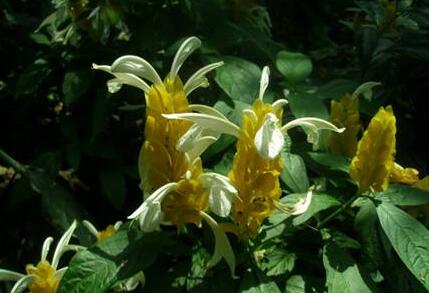
Since Pachystachys lutea is a plant native to Peru and Mexico, it prefers the climate of the South American tropical rainforest, especially high temperature and high humidity. Its light requirement is full sunlight, but it is also fairly shade-tolerant. It likes temperatures of 16-28 degrees and is not very cold-hardy, so insulation must be done well in winter. As for soil, it prefers a fertile, well-draining type.
Growing methods and precautions for Pachystachys lutea
1. Soil
In northern regions, Pachystachys lutea is often grown as a potted plant. The soil should be chosen on the principle of being loose, fertile and containing plenty of humus. It can be made by mixing peat soil, turf, vermiculite, river sand and so on. If you want to increase the soil's fertility, you can also add decomposed base fertilizer.
Precautions: Although peat soil, vermiculite and the like are the most suitable soils for growing Pachystachys lutea, flower enthusiasts can actually also grow it in ordinary soil, or buy potting soil from a professional flower shop. No matter what soil is chosen, the most basic requirements are good drainage, looseness and breathability.
2. Temperature
Different plants have different suitable growing temperatures. For example, violets like a cool climate, but Pachystachys lutea likes a warm climate. Its optimal growing temperature is 16-28 degrees. When the temperature is below 10 degrees or above 30 degrees, growth will be affected, so attention should be paid to insulation in winter.
Precautions: In the growing methods and precautions for Pachystachys lutea, in winter it is best to move it indoors for care, keeping the temperature at around 18 degrees during the day and at least above 10 degrees at night. If the temperature is too low, leaves will drop, and prolonged low temperatures will cause root rot and the plant may freeze to death.
3. Light
When growing Pachystachys lutea, you must give it sufficient light. In spring, autumn and winter, it should be allowed to enjoy sunlight. Only in the hot summer does it need slight shading, because only sufficient light can make it grow robustly and have fewer diseases.
Precautions: Although Pachystachys lutea is also strongly shade-tolerant and can grow normally in a semi-shaded environment, weaker light will cause a problem: leaves will grow leggy and it will not bloom. So try not to place it in a semi-shaded place lacking light.
4. Watering
Pachystachys lutea has average drought tolerance, so attention should be paid to timely watering in normal times. Especially during the growing period, not only should the soil be kept moist, but water should also be sprayed frequently to control humidity. So in spring and autumn, water once every 2-3 days, and in summer, water once every 1-2 days.
Precautions: No matter when you water, pay attention to one key point: there must be no water accumulation. This is also the most basic principle. In addition, in winter the potting soil should be kept slightly moist, and watering should not be too frequent.
5. Fertilizing
Some flower enthusiasts dislike fertilizing when growing plants, but the correct approach is to fertilize appropriately according to the plant's growth condition. When growing Pachystachys lutea, apply urea or organic fertilizer once every 15-20 days during the growing period. Stop fertilizing during the high temperatures of summer and when it is too cold in winter.
Precautions: When fertilizing, do not apply only nitrogen fertilizer, otherwise the flower stems are likely to become thin and long and the number of flowers will also be relatively small. Before the flowering period, a 0.2% potassium dihydrogen phosphate solution can be applied to make the flower color more vivid. During flowering, 1-2 additional applications of phosphorus and potassium fertilizer can be added to make budding smoother.
Pruning methods for Pachystachys lutea
During the seedling stage, Pachystachys lutea needs to be pinched back. The timing is when the seedling grows to 6 cm tall. After that, pinch again when the branches reach about 4 cm. Pinching multiple times can make it sprout side branches, control plant height, and increase the ornamental value of the overall plant shape.
Growing methods for Pachystachys lutea
1. Temperature
The suitable temperature for Pachystachys lutea growth is about 15°C-25°C. If the temperature is too high or too low, it is unfavorable for its growth. If the temperature is too low, leaves will fall off, and in severe cases the plant may even wither and die. In winter, it should be placed indoors in a sunny spot, watering should be slightly controlled, and the temperature should be at least above 10°C.
2. Light
During the growing period, except for slight shading in the hot summer, sufficient light should be given at other times. In a semi-sunny and semi-shaded environment, Pachystachys lutea can still grow fairly well, but it must never be too shaded, otherwise leggy growth will occur, and it will bloom very late and produce very few flowers, failing to achieve the desired ornamental effect.
3. Soil
The soil should be loose and fertile and contain a large amount of humus. Usually peat soil and leaf mold are used with a small amount of decomposed cow manure mixed in as base fertilizer. This can ensure that Pachystachys lutea has a good growing environment and thus grows healthily.
4. Fertilizer and water
During the growing period of Pachystachys lutea, not only should the potting soil be kept moist, but there are also relatively high requirements for relative air humidity. In spring and autumn, water once every day; in summer, water 2-3 times every day; in winter, simply keeping the potting soil moist is enough. During the growing season, generally apply organic fertilizer once every 15 days. Note that when the temperature is above 35°C or below 15°C, fertilizing should be stopped.
5. Pruning
Newly rooted cuttings should be pinched back. Pinch back when the seedling is about 6 cm tall and when the branches grow to about 4 cm. After that, in one month it can form buds and bloom on the new branches. Pruning is carried out every spring.
Now that you know the growing methods for Pachystachys lutea, you must also want to know about its propagation methods.
How to grow Pachystachys lutea in winter: keep the temperature above 10 degrees / stop fertilizing
Pachystachys lutea comes from the tropical rainforests of South America, so in its growing habits, its environmental requirements are high temperature and high humidity. In most regions of China, winter temperatures are relatively low, so how to grow Pachystachys lutea in winter becomes a very important issue. Below, the editor will tell you the winter care techniques for Pachystachys lutea.
How to grow Pachystachys lutea in winter
1. Key point one: the temperature must not be too low. Through the growing methods for Pachystachys lutea, we know that its suitable temperature is above 15 degrees, but it can grow normally in a 10-15 degree environment, so the winter temperature generally must not be below 10 degrees.
2. Key point two: the supply of fertilizer and water should be reasonable. In winter, fertilizing and watering Pachystachys lutea are different from other seasons. This is because climate changes slow down its growth rate, so the supply of fertilizer and water should also be adjusted appropriately to avoid adverse consequences caused by excess.
Winter care techniques for Pachystachys lutea
1. Insulation
Since Pachystachys lutea is not cold-tolerant, insulation measures need to be taken for it in winter. The most commonly used method is to move it indoors for care. If you are a flower enthusiast in southern regions and the outdoor temperature in winter can stay above 10 degrees, then there is no need to move it indoors; simply putting on a plastic film is enough.
2. Light
Although the growth of Pachystachys lutea slows down after winter arrives, it still needs sufficient light at this time. So after moving it indoors, it should be placed in a spot exposed to sunlight, such as a window or balcony. This can keep the leaves of Pachystachys lutea still dark green and prevent the leaves from withering.
3. Watering Pachystachys lutea in winter
In principle, keep the soil on the dry side and water once every 7-10 days. As long as the soil is not excessively dry and compacted, there is no need to water. When watering, also pay attention to the water temperature. At least let the water temperature be above 10 degrees before use. It can be made close to room temperature; it does not need to be too high.
4. Fertilizing
In winter, fertilizing Pachystachys lutea should be stopped. If fertilizer is added at this time, it will cause two consequences: one is that the leaves wither and drop; the other is that the plant's roots are burned. The former is a mild effect, while the latter may harm the plant's health. Therefore, fertilizing in winter must be avoided. For methods, you can refer to the detailed introduction in how to fertilize Pachystachys lutea.