When to Plant Gladiolus? A Detailed Guide to Spring Corm Planting Methods
Gladiolus is a plant with corm-like stems. When we grow it, the first step is to plant the corms, and then through careful care and management, let them gradually grow, sprout and bloom, so as to bring out the effects and benefits of gladiolus. So when should gladiolus be planted? Let's take a look at the method for planting gladiolus corms.
When to Plant Gladiolus
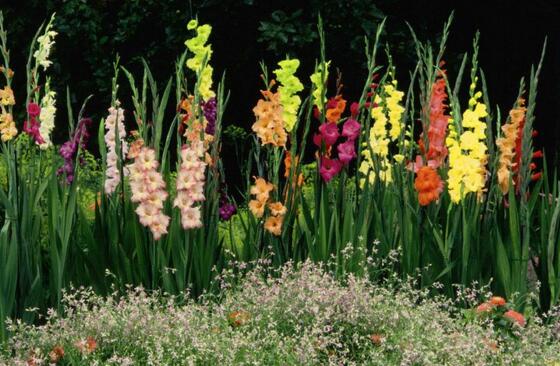
For home growing, it is best to choose spring. After planting in this season, it can take root and sprout relatively quickly and enter the growth period sooner. In greenhouse cultivation, it can be planted all year round; as long as the temperature and humidity can be kept moderate, there is no limit on planting time.
Gladiolus Corm Planting Methods
1. Treatment of the corms
First soak the corms in warm water for 15 minutes, then disinfect them with formalin solution. If it is Shenggong, the concentration is 0.5%, while formalin needs an 80-fold solution. The soaking disinfection time is generally 30 minutes. Then rinse them clean with clean water and put them in a cool place to dry.
2. Soil and flower pots
The soil used is best fertile and loose, with a pH of 5.5-6.5 being suitable. To make the soil more nutrient-rich, some base fertilizer can be added, applied at the bottom of the pot, but do not let the base fertilizer come into direct contact with the corms.
3. Pot planting or ground planting
Pot planting: Among gladiolus corm planting methods, pot planting is relatively common. Plant the corms into the soil, cover with soil and press firm, then water the soil. The first watering should be thorough to ensure both the upper and lower parts of the soil are moist. Then place the flower pot in a semi-shaded environment and wait for the gladiolus to sprout. During this process, pay attention to replenishing water in time.
Ground planting: Choose a relatively suitable piece of land and try to avoid low-lying areas, otherwise water is likely to accumulate in the rainy season. After choosing, dig furrows. The depth of the furrows should be at least more than twice the diameter of the corms, but it does not need to be too deep. Plant the corms into the furrows at a depth of 5-8 cm, then cover with soil, level it and water. Before seedlings emerge, there is no need to water too much; water again only when the soil is on the dry side.
Gladiolus Corm Storage Methods
After the gladiolus flowering period, it enters dormancy as the temperature drops, and the above-ground part slowly withers. At this time, the corms should be kept well so they can be replanted in the spring of the following year. There are mainly two storage methods: room-temperature storage and low-temperature storage.
Room-temperature storage is to dig out the corms, wrap them well with a mesh bag, and then place them in a cool, ventilated place. Be sure the air humidity is not too high. Low-temperature storage is to put the corms in a refrigerator compartment. For most flower lovers, the first method is recommended.
How to Grow Gladiolus: How Do You Grow Gladiolus?
Gladiolus is a flowering plant with especially many varieties and flower colors, and it is also relatively common in homes today. Dwarf varieties are often grown in pots and placed in living rooms, studies and other places for decoration. So how do you grow gladiolus? Let me introduce it to you below.
1、Soil:It likes fertile, deep sandy soil and requires good drainage. Well-drained sandy sloping soil is most suitable, with a pH of 5.6-6.5 being suitable. It should not be planted in heavy clay soil prone to waterlogging.
2、Watering:Gladiolus is a flower that needs a lot of water. Watering in time and keeping the soil moist are important measures to encourage it to bloom more. If there is hot, high temperature, spray in time to increase humidity and lower the temperature. After rain, pay attention to drainage.
3、Temperature:The optimum growing temperature is 20-25°C during the day and 10-15°C at night. When the temperature is higher than 27°C, growth is hindered and the petals are easily scorched. Below 10°C, growth is slow.
4、Sunlight:Gladiolus is not shade-tolerant and is a long-day plant. The most suitable is 16 hours of light per day. Cut-flower varieties are greatly affected by light. With sufficient sunlight, they grow robustly and have strong resistance, and the flower colors are bright and long-lasting. But in hot summers, avoid direct strong sunlight.
5、Fertilizing:Gladiolus is a shallow-rooted plant, so fertilizer should be applied shallowly. Fertilization should include nitrogen, phosphorus and potassium. Topdressing should be done respectively at the two-true-leaf stage (after flower bud differentiation) and the heading stage, applying once with dilute manure water plus urea; apply a heavy potassium fertilizer once in the middle stage; in the later stage, pay attention to controlling nitrogen to avoid excessive vegetative growth and lodging. For plots mainly producing corms, potassium fertilizer should be increased.
6、Pests and diseases:Common diseases of gladiolus include corm rot, leaf blight and so on; common pests include thrips, slugs and so on. Pay attention to care and handle them in time.
Gladiolus has many flower colors and looks colorful, with high ornamental value. The cultivation methods of gladiolus are introduced here. I hope it is helpful to everyone. You are welcome to continue following Duorou Huapu to learn more about growing bulb flowers.
How to Store Gladiolus (Sword Lily) Corms
Corm Storage Methods
After the flowers fall in autumn, gladiolus corms have a natural dormancy period of 2 months. At this time, the corms must be stored well to ensure they can sprout normally after dormancy. Under normal circumstances, once winter passes, plant the corms, and they can sprout as early as February in early spring. But the northern regions are relatively cold, so planting in March-April is fine. During this period, pay attention to ventilation and dryness.
Room-temperature storage: Wrap the corms directly with newspaper or a mesh bag and place them in a cool, ventilated corner.
Low-temperature storage: Place the corms in a refrigerator compartment for storage.
Keeping Gladiolus Corms for Seed
Gladiolus corms are mother corms, and many small cormels grow around the large corm. When storing the corms in autumn and winter, the small cormels can be broken off and planted in spring. Because gladiolus corms degenerate relatively quickly, they are mainly rejuvenated through propagating cormels.
Notes on Keeping Gladiolus for Seed
Try to change to new soil for planting each year. If growing in the open ground, try to change the location.
The planting depth should reach at least 5-8 cm to ensure the healthy development of the new corms.
Small cormels harvested in autumn, sown in the following spring, can produce new corms by October. However, for keeping seed, it is best to choose cormels the size of a soybean or pea.