How to plant scarlet sage? Growing methods and precautions, soil is key
Scarlet sage is cultivated in many places in China because of its strong adaptability and long flowering period, and many flower lovers also grow it in pots at home to make use of its ornamental value, but whether it is field cultivation or pot cultivation, certain techniques need to be paid attention to, so how do you plant scarlet sage? Let's take a look at the growing methods and precautions for scarlet sage.
How to plant scarlet sage
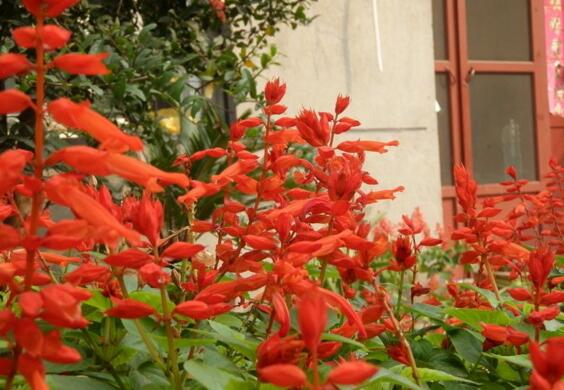
Before planting scarlet sage, flower lovers should first have some understanding of its morphological characteristics and growth habits, because only in this way can correct care techniques be adopted according to its features. For example, it is afraid of high temperatures, and if flower lovers do not cool it down in summer, the plant will easily wither and die. Let's first take a look at its morphological characteristics and growth habits.
Morphological characteristics of scarlet sage
Scarlet sage is a subshrub-like herbaceous plant, the height of the plant is generally within 1 m, the stem is bluntly four-angled, the leaves are ovate and hairless on both sides, the inflorescence is in whorled verticillasters, the bracts are red and make it look large, the flower buds are wrapped in the bracts, and when it blooms the colors are gorgeous and the flower posture is elegant and very beautiful.
Growth habits of scarlet sage
Before figuring out how to plant scarlet sage, its growth habits must be familiar, because they relate to the formulation of daily care techniques. In terms of growth habits, scarlet sage likes sunlight but can also grow in a semi-shady environment, likes fertile, loose soil, likes slightly acidic soil and is afraid of alkaline substrate, and its cold tolerance and heat tolerance are both average, so when growing it, frost, snow and high temperatures should be avoided.
Growing methods and precautions for scarlet sage
1. Soil
As for soil, scarlet sage requires fertile, loose, well-drained soil, and it must be slightly acidic, with a pH value preferably between 5.5—6.0. If the soil is alkaline, it is extremely unfavorable for its growth and will cause the plant to wither and die, so it is commonly made by mixing leaf mold and fine sand.
2. Temperature
The most suitable temperature for the growth of scarlet sage is 20-25 degrees. It is relatively afraid of high temperatures and cold, so the temperature should be kept at 15-30 degrees. If it is below 15 degrees, the leaves tend to turn yellow and fall off, and when it is above 30 degrees, the leaves and flowers will be smaller and weaker.
3. Light
Light intensity is often closely related to temperature. For example, the temperature in the sun is generally higher than indoors, so when planting scarlet sage, it is best to place it in a bright place where it can receive scattered light. In spring and autumn, it can also be given appropriate sunlight, while in summer it must not be managed in direct sunlight.
4. Water
Flower lovers who have grown scarlet sage often find watering a headache, but watering actually has certain techniques. So in terms of watering, how do you plant scarlet sage? You can water flexibly according to the moisture condition of the soil, rather than using the same watering method all year round. The specific technique is that when the soil surface is found to turn white, water immediately, and the watering must ensure thorough soaking, then let it grow normally.
5. Fertilizing
Scarlet sage likes fertilizer, so when planting, some base fertilizer can be added to the soil, and during vigorous growth a liquid fertilizer can also be applied every 10-15 days, which can make the leaves and flower colors brighter. Fertilizing is generally carried out in the morning or on sunny days.
Precautions
(1) Pinching: During the growth process, we need to pinch scarlet sage multiple times, among which pinching during the seedling stage is very important. It can control the plant's growth height and promote the sprouting of side branches. The method is to remove the tender buds at the top.
(2) Appropriate amounts of fertilizer and water: Watering and fertilizing are both important for scarlet sage, but be sure not to overdo the fertilizer and water, because scarlet sage is a plant very afraid of waterlogging. If watered too much, the fragile roots are prone to rot, which causes the plant to wither and grow poorly.
(3) Pest and disease control: Scarlet sage is also attacked by pests and diseases. For example, red spiders and aphids are very harmful to it. The preventive method is to strengthen care and management, and for control it is necessary to spray a 1500-fold omethoate solution.
Pot cultivation methods and precautions for scarlet sage
Control light and temperature
After scarlet sage is planted, place it in a shady place for 3 days to allow it to recover. Then place it in sunlight to ensure sufficient light. To make it convenient to control light intensity, a simple frame can be built above the flowerpot. When the light is too strong, especially at noon in summer, shade it by 50%. Once it is in a low-temperature condition, plastic film needs to be put on for appropriate insulation, which can usually be done at night or on cloudy and rainy days.
Maintain moisture and humidity
Scarlet sage likes a humid environment and should be sprayed with water once a day, except on cloudy and rainy days. When watering, the difference between soil temperature and water temperature cannot exceed 5 degrees C. When the temperature is relatively high, frequently spray water into the surrounding environment to lower the temperature and increase air humidity. Regularly clean the branches and leaves to improve photosynthesis, once every 15~20 days.
Mainly use foliar topdressing
Soil provides an important guarantee for the growth and development of flowers, but to ensure the plant grows robustly, the small amount of water, fertilizer and air in the soil alone is far from enough, and foliar fertilizer also needs to be applied. The specific method is as follows:
One week after potting, carry out one foliar fertilization. Then for three days, spray once a day with a sprayer. For the fertilizer, choose a mixture of urea plus monopotassium phosphate and a small amount of superphosphate. The spraying time should be chosen in the early morning and evening.
In the subsequent care, combine watering with fertilizing, and carry out foliar fertilization 8~12 hours after watering. Note that on windy days or when light is strong, it can be applied around the plant.
Control flowering dates
Sowing in different seasons results in different flowering times. Sowing in spring leads to flowering in autumn; sowing in a greenhouse in autumn leads to flowering in April~May of the following year. During the flowering period, the following methods can be used to control the flowering period:
Cut off the branch tips of the flower buds in time, which can appropriately postpone the flowering period.
After each flowering, remove the spent flowers in time and strengthen water and fertilizer management. Scarlet sage can then send out new branches and bloom again, extending the flowering period.
Prune and pinch in time
After potted scarlet sage survives transplanting, it needs to be pinched 3 times to inhibit its growth and promote the sprouting of side buds. In this way, the plant grows short and sturdy with more flower heads.
How to plant scarlet sage well: growing methods for scarlet sage
Scarlet sage is a common flowering plant for us. It is generally more commonly seen in flowerbeds, roadsides, courtyards and other places. Potted scarlet sage can also be seen in homes, but relatively rarely. In fact, scarlet sage is a flowering plant quite suitable for home decoration, because its growing method is relatively simple. Now let's take a look at how to plant scarlet sage well!
Living habits of scarlet sage
Scarlet sage likes sunlight and also tolerates semi-shade. Scarlet sage requires loose, fertile and well-drained sandy loam soil, and is very sensitive to soil treated with methyl bromide and to alkaline soil. It is suitable for growing in soil with a pH of 5.5~6.0. Its cold tolerance is poor, and the suitable growth temperature is 20~25 degrees C. It stops growing below 15 degrees C, and below 10 degrees C the leaves turn yellow and fall off.
Planting uses of scarlet sage
1. Decorating the environment: Scarlet sage has full inflorescences, scarlet flowers and a large number of blooms, appearing relatively festive. It is mostly used for environmental decoration on important holidays, and can be used alone in flowerbeds, flower borders or flower platforms, and can also be used as edging for flower clusters and flower groups. Potted scarlet sage is an indispensable material for assembling groups of potted flowers, and can form a sharp color contrast with other potted flowers.
2. Accenting the home: Dwarf varieties of scarlet sage can be grown in pots, used for beautifying home windowsills and balconies and for accenting beside houses and in front of steps, with delicate colors and a warm atmosphere. In addition, scarlet sage has many varieties and rich flower colors. The addition of pink-white, red-white bicolor varieties and other varieties in colors such as blue-white and purple-white makes the indoor environment more elegant and distinctive.
Propagation methods for scarlet sage
1. Cutting propagation: Propagating scarlet sage by cuttings can be done from May~August in summer and autumn. Take vigorous young branches as cuttings, remove the terminal buds and then insert them, and rooting is easy. In the hot and dry summer season, pay attention to shading and cooling, spray water frequently, and keep it moist. After about 15 days it can be transplanted. This is a relatively fast and simple propagation method for scarlet sage.
2. Seed propagation: In southern regions, late March to early April is usually the best time for open-field sowing of scarlet sage. Choose sandy soil sheltered from wind and facing the sun with good drainage as the seedbed, turn the bed surface over, break it up and level it, let it be exposed to the sun for several days, then disinfect the seedbed soil with potassium permanganate solution. Scatter scarlet sage seeds on the seedbed, then scatter an appropriate amount of carbofuran on the seedbed. Keep the seedbed moist at ordinary times. At 16~21 degrees C, seedlings can emerge in 6~7 days, and when there are 3~4 true leaves they can be transplanted into pots.
Growing methods for scarlet sage
1. Sunlight: Scarlet sage is a light-loving flowering plant, and the cultivation site must have sufficient light, which is very beneficial to the growth and development of scarlet sage. If light is insufficient, the plant tends to grow leggy, with slender stems and leaves and pale green leaf color. If the light is poor for a long time, the leaves turn yellow and fall off. If flowering plants are placed in a location with poor light, the flowers are often not bright and tend to fall off. It is sensitive to photoperiod response, and short-day conditions promote the opening of scarlet sage flowers.
2. Temperature: Scarlet sage is relatively sensitive to temperature when grown. Seeds germinate at 21~23 degrees, and it is very difficult to germinate below 15 degrees C, while below 20 degrees C germination is uneven. During the seedling stage, 7~13 degrees C is suitable in winter, and during the growth period from March to June, 13~18 degrees C is best. When the temperature exceeds 30 degrees C, the growth and development of the plant are hindered, and the flowers and leaves become smaller. Therefore, during the high-temperature period in summer, cooling or appropriate shading is needed to control the normal growth of scarlet sage. Being at a low temperature of 5 degrees C for a long time makes it prone to cold damage.
3. Pruning: After scarlet sage is planted out, it should be pinched immediately, and during the growth period it should be pinched at least 2 times, so that the plant is short and sturdy, with more flowering branches and dense flower spikes.
4. Pests: When growing scarlet sage, if there is high temperature, high humidity or insufficient light, it is prone to rot disease, so attention must be paid to regulating temperature and keeping the air circulating. In addition, scarlet sage is prone to pests such as red spiders and aphids, which can be controlled by spraying a 1500-fold omethoate emulsion.
5. Fertilizing: Scarlet sage is relatively simple in terms of fertilizer. Generally speaking, as long as basic fertilizing is carried out on the soil when planting, it is enough.