How to fertilize and water Rosa banksiae? Apply light fertilizer frequently, avoid waterlogging
Rosa banksiae is a fairly common flowering plant in people's daily lives, and it can be seen in many regions of our country. However, if you want to grow it well, there are many things to pay attention to, among which fertilizing and watering are especially important. How to fertilize Rosa banksiae? How to water Rosa banksiae? Below, the editor will walk you through it.
I. How to fertilize Rosa banksiae: apply light fertilizer frequently
1. Fertilizing before planting
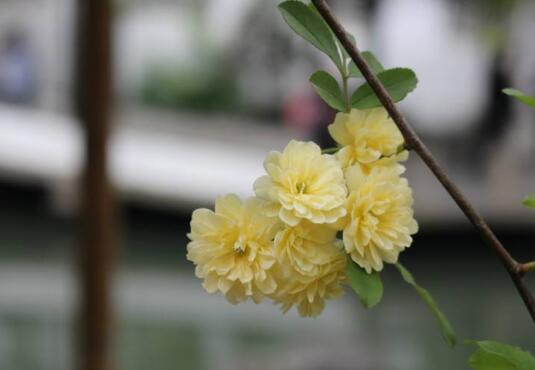
Regarding how to fertilize Rosa banksiae, the release of base fertilizer before planting is very important. Before planting Rosa banksiae, we need to apply an appropriate amount of base fertilizer into the soil, which can lay a good foundation for the growth of Rosa banksiae and also give it enough nutrients to get through the seedling stage.
2. Fertilizing before sprouting
Generally, after we plant Rosa banksiae, it will sprout in early spring. Before it sprouts, we need to fertilize it once. The concentration of the fertilizer released at this time can be relatively higher, but it must not be too strong. If the usual water-to-fertilizer ratio is 1:10, then at this time we can choose about 1:8.
3. Fertilizing during the growing season
After Rosa banksiae enters the growing season, its demand for nutrients is very high. Basically, we need to fertilize it once every half month so that it can grow more vigorously. However, when fertilizing, there is one thing we need to pay attention to: the fertilizer at this time should not be too strong, because if the fertilizer concentration is too high, it can easily burn the plant.
4. Fertilizing during the flowering period
Rosa banksiae does not need fertilizing during its flowering period, but before flowering we should apply enough fertilizer, because flowering consumes a lot of nutrients, so before flowering it must be applied sufficiently. Afterward, once all its flowers have withered, we can resume the normal fertilizing frequency.
II. How to water Rosa banksiae: avoid waterlogging
Rosa banksiae likes a moist environment, so during the process of growing Rosa banksiae, we should water frequently to keep the soil somewhat moist. However, we need to pay attention to controlling the amount of water, and remember not to cause waterlogging, otherwise it can easily lead to root rot. When summer temperatures are high, we can increase the watering frequency.
III. How to prune Rosa banksiae: light pruning
1. Pruning time
Rosa banksiae needs to be pruned multiple times every year. In winter each year, we need to prune once, cutting off dead branches and rotten leaves as well as branches that are growing too densely, which can increase its light penetration. Besides winter, after it finishes flowering we also need to prune once, cutting off the remaining flower stalks and some branches, which can promote the growth of new branches.
2. Pruning method
When pruning Rosa banksiae, we should grasp the degree well and not cut too heavily. Generally, light pruning is enough; we only need to cut off some unevenly growing branches and keep the better-growing branches and tender shoots, which can make the plant more beautiful and also help prolong the flowering period.
How to grow Rosa banksiae: how to cultivate and propagate Rosa banksiae
Rosa banksiae is also called Muxiang, Muxiang vine, or Jinpeng flower. Because its fragrance spreads far when it blooms, in some places it is also called Qilixiang or Shilixiang. The leaves of Rosa banksiae are ovate-elliptic or lanceolate, with pointed tips and fine serrations along the edges; the surface is green and glossy, while the underside is slightly paler. The umbel inflorescence is borne at the tip of short branches. How do you grow such a beautiful Rosa banksiae? Let's take a look below.
I. Basic information on Rosa banksiae
Muxiang is the general name for the Asteraceae plants Yunmuxiang and Chuanmuxiang. Yunmuxiang, also known as Guangmuxiang, Muxiang, Mixiang, Qingmuxiang, Wumuxiang, and Nanmuxiang, belongs to the genus Saussurea in the Asteraceae family. Chuanmuxiang is a plant of the genus Dolomiaea in the Asteraceae family, and both are plants endemic to China. Muxiang is distributed in places such as Sichuan, Yunnan, and Tibet in mainland China, mostly growing in alpine grasslands and shrublands as a wild plant, and has not yet been introduced and cultivated artificially. The rhizomes of these two plants are important Chinese herbal medicines. Muxiang is dug up in autumn and winter, with mud and sand and fibrous roots removed, cut into sections, and the larger ones further split lengthwise into pieces; after drying, the rough bark is knocked off.
Rosa banksiae is a climbing small shrub, up to 6 m tall; branchlets cylindrical, hairless, with short small prickles; leaflets 3-5, blades elliptic-ovate or oblong-lanceolate; flowers small, numerous in umbel inflorescences, sepals ovate, petals double to semi-double, white, obovate, flowering period April-May. It grows by streams, roadsides, or in hillside shrublands, at an altitude of 500-1300 m. It is distributed in Sichuan and Yunnan, China. It is cultivated throughout the country. The root of Muxiang can be used as Chinese medicine; it tastes bitter and can be combined with bitter orange, Sichuan chinaberry, Corydalis yanhusuo, etc., to regulate qi and soothe the liver, strengthen the spleen, and relieve stagnation.
II. How to grow Rosa banksiae
1. Site selection and land preparation
The root of Muxiang goes very deep into the soil and likes fertilizer. Apply 15,000-20,000 kg of fully decomposed barnyard manure per mu, crush it finely and spread it in the field, then deep plow 30-45 cm, rake finely and level, and make flat beds 90 cm wide or small raised beds 60 cm wide and 15 cm high, and dig drainage ditches well in preparation for drainage during the rainy season. If the land is dry, first irrigate thoroughly, and after the water seeps down and the soil is slightly dry and loose, sow.
2. Propagation method
Propagate by seed. Before sowing, soak the seeds in warm water at 30°C, stir, then let stand briefly, remove shriveled seeds and impurities, take out the plump seeds and let them dry slightly, and then sow. Sowing period: spring sowing around "Qingming", autumn sowing between "Liqiu" and "Chushu". After the new seeds of the current year mature, collect them, dry them slightly, remove all impurities and shriveled seeds, and then sow; soaking in water is not needed. Autumn sowing with new seeds of the current year is better than storing the seeds and sowing them in spring the following year. When sowing, in the prepared bed, open furrows about 3 cm deep at a row spacing of 30 cm, evenly scatter the seeds into the furrows, cover with soil, level with a rake, and press lightly. If the soil moisture for spring sowing is suitable, seedlings emerge in about 10 days; autumn-sown seeds emerge in 5-7 days. The seeding rate per mu is 1-1.5 kg.
3. Selecting and breeding good varieties
For biennial Muxiang, when it flowers, select robust plants, keep 1-2 large flower heads in the middle, and remove the excess flower heads so that nutrients are concentrated and the seeds produced are plump. When the seeds mature in July and August, pick them, break open the outer involucre skin of the capitulum, expose the seeds and dry them in the sun, preventing rain from wetting them. For autumn sowing, sow immediately after harvesting. For seeds kept for spring sowing, after collecting the seeds place them in a dry place and store them properly to prevent moisture and mildew.
III. Propagation methods of Rosa banksiae
Rosa banksiae is very easy to propagate by cuttings taken from hardwood before and after spring sprouting or from semi-hardwood before and after flowering, and layering mostly uses the air-layering method. In the growing season, select robust branches, cut a wound at the lower part of a node, wrap it into a bag shape with plastic film, fill the inside with soil, water it, then tie the bag opening tightly and keep the soil moist; the survival rate is very high.
During the dormant period, it can be transplanted bare-rooted, and when transplanting, the branches and vines should be heavily pruned. During the growing season, keep the soil moist and avoid waterlogging; after sprouting in spring, apply a compound fertilizer once or twice to promote large, fragrant flowers; after entering winter, open a trench at its root and apply decomposed organic fertilizer, and water thoroughly. In winter or early spring, prune the plant once, cutting off leggy branches, dead branches, diseased branches, and overly dense branches to enhance ventilation and light penetration inside the plant.
Rosa banksiae can be propagated by cuttings or layering. For cuttings, use hardwood before and after spring sprouting or semi-hardwood before and after flowering, and they root very easily; for layering, the air-layering method is mostly used. In the growing season, select robust branches, cut a wound at the lower part of a node, wrap it into a bag shape with plastic film, fill the inside with soil, water it, then tie the bag opening tightly and keep the soil moist; the survival rate is very high.
In addition, it can also be propagated by sowing. For some excellent varieties, use rose or single-petaled Muxiang as rootstock for grafting; both bud grafting and cleft grafting are suitable.
The flowers of Rosa banksiae are full of fragrance. Whether planted in a courtyard or indoors, it can very well adjust the indoor atmosphere. If you like Rosa banksiae, you can try growing a pot of it! The above is an introduction to how to grow Rosa banksiae.
How to grow Rosa banksiae in pots? How to prune Rosa banksiae?
Rosa banksiae is not only a good hedge material, but also an excellent vertical greening material. At the same time, in order to enjoy the beauty of Rosa banksiae, many friends also choose to grow a few pots of Rosa banksiae at home. So, how do you grow Rosa banksiae in pots? And how should it be pruned? The potted cultivation and maintenance methods and pruning methods of Rosa banksiae are introduced below.
Image: Rosa banksiae
I. How to grow Rosa banksiae in pots?
1. Potting soil:For nutrient soil, when preparing nutrient soil, attention should be paid to drainage, ventilation, and the combination of various nutrients. Its ratio is garden soil : leaf mold : rice husk ash = 5:3:2. Around overwintering each year, it is suitable to repot, trim roots, and change soil, gradually increasing the pot diameter year by year, with clay pots being best.
2. Watering:It varies with the season. During the winter dormant period, keep the soil moist; just do not let it dry out completely. In early spring, before the branches sprout and as the branches and leaves grow, appropriately increase the water volume, watering once each morning and evening. During the peak growing season and flowering period, increase the watering amount. In summer, with high temperatures, water evaporation increases, and the plant is in a weak semi-dormant state; dryness and dehydration are most taboo, so water once each morning and evening and avoid exposure to the scorching sun. When watering at high temperatures, each watering should have a small amount of water seeping from the bottom of the pot, indicating it has been watered thoroughly. When watering, do not splash water on the leaves to prevent disease.
3. Fertilizing:Rose likes fertilizer. Base fertilizer should mainly be slow-release organic fertilizer, such as decomposed cow manure, chicken manure, soybean cake, oil residue, etc. Add liquid fertilizer water once every half month, which can keep the leaves thick, dark green, and glossy. Before sprouting in early spring, apply a relatively strong liquid fertilizer once. Be careful not to fertilize during the flowering period. After the flowers fade in June, apply liquid fertilizer once again. In September, when the fourth or fifth axillary buds are about to sprout, apply a moderate liquid fertilizer once more. In December during the dormant period, apply decomposed organic fertilizer to overwinter.
Image: Rosa banksiae
II. How to prune Rosa banksiae?
The planting methods of Rosa banksiae can be divided into potted planting and ground planting, and the corresponding pruning methods also differ. Let's take a look below at the potted pruning method and ground planting pruning method for Rosa banksiae.
1. Potted pruning method:After each season's flowering period ends, comprehensive pruning must be carried out. Generally, light pruning is suitable. Promptly cut off spent flowers and thin, weak, crossing, and overlapping branches. Keep thick, young branches, leaving only 3-6 cm from the base, keep outward-facing buds, and prune into a natural open-center shape, making the plant shape beautiful and prolonging the flowering period. In addition, for potted rose, choose varieties that are dwarf, multi-flowered, and strongly fragrant.
2. Ground planting pruning method:Summer pruning of rose mainly involves cutting off the sprouting branches and flowers from the grafted rootstock, and after flowering, cutting off spent flowers with leaves and thinning out excess flower buds, reducing nutrient consumption to create good conditions for the next flowering period. To make the plant shape beautiful, long branches can be cut back by 1/3 or half, and medium branches by 1/3, cutting diagonally 1 cm above a leaf. If pruning is too light, the rose plant will grow taller and taller, the branches longer and thinner, and the flowers smaller and smaller. Winter pruning depends on the variety and cultivation purpose. When pruning, branches should be retained, and attention should be paid to the overall shape of the rose plant. For large-flowered varieties, it is suitable to retain 4-6 branches, 30-45 cm long, select a strong lateral bud, and cut off the branch above it. For trailing or climbing varieties, the main focus is thinning out old branches, cutting off weak branches and diseased branches, and cultivating the main trunk.
[Editor's concluding remarks]Although Rosa banksiae does not have strict requirements for the growing environment, it is not tolerant of waterlogging and avoids water accumulation, so extra attention should be paid during maintenance. The above introduced the potted maintenance methods and pruning methods of Rosa banksiae, hoping to be helpful to everyone!