What to do when anthurium leaves turn yellow? Shade them, apply light fertilizer frequently, and prevent pests and diseases
Anthurium is a highly ornamental flowering plant. It has a spadix inflorescence and leaf-shaped bracts, giving people a feeling of passionate fire, so it is loved by many people. However, even the most beautiful plant will have its overall beauty affected if its leaves turn yellow. So what should be done when anthurium leaves turn yellow? Below, the editor will take everyone through an introduction.
1. What to do when anthurium leaves turn yellow: find the cause
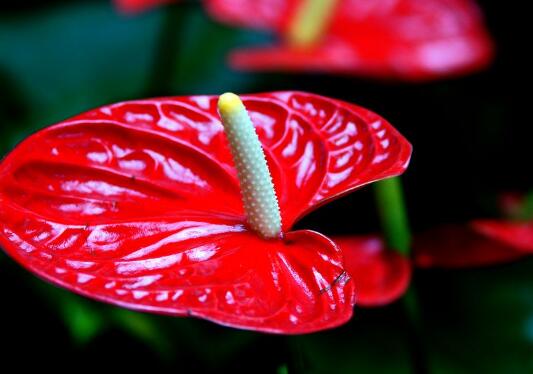
If you want to know what to do when anthurium leaves turn yellow, first we need to find the cause of this phenomenon, because the problem needs to be solved in a targeted way. Too much light, insufficient nutrients, improper fertilization, and so on are all causes of this phenomenon. As for how to solve it specifically? There is a detailed introduction below. Let us take a look.
2. Causes of yellowing anthurium leaves (with solutions)
1. Soil is too alkaline
In the northern regions of China, most soil is alkaline. This kind of soil is relatively lacking in nutrients, has a relatively simple structure, and is also prone to compaction, which weakens its ability to absorb nutrients and therefore also causes anthurium leaves to turn yellow.
Solution: If it is a soil problem, during usual care we can occasionally use a little diluted edible vinegar or lemon water to change the acidity and alkalinity of the soil. After the soil becomes acidic, the problem of yellowing leaves will gradually recover.
2. Too much or too concentrated fertilizer
In the process of growing anthurium, if we do not fertilize for a long time or apply concentrated fertilizer, both are causes of yellowing anthurium leaves. If it is not fertilized for a long time, it will dry up and turn yellow due to insufficient nutrients, while applying concentrated fertilizer can easily burn the plant.
Solution: During the growth process of anthurium, generally fertilizing once a month is enough, and when fertilizing, everyone should remember to first dilute the fertilizer with water and maintain the principle of light fertilizer applied frequently, so that it can absorb it better.
3. Temperature too low or too high
Anthurium is very particular about its growing temperature. It relatively prefers high temperatures, and only in an environment above 22°C can it grow well. If the temperature is too low, it can easily cause anthurium leaves to turn yellow. However, its growing temperature also cannot be too high. If it exceeds 30°C, it can also easily cause problems such as leaf rot.
Solution: During the growth process of anthurium, it is very important to let it grow under a comfortable environmental temperature. The suitable environmental temperature for its growth is 22°C-28°C. When growing it, we can appropriately do a good job of temperature control.
4. Too much light
Anthurium is a plant that prefers partial shade and is relatively afraid of direct sunlight. If it is placed in direct sunlight during cultivation, yellowing anthurium leaves are very likely to occur.
Solution: In the process of growing anthurium, it is best to place it in a spot with scattered sunlight. In summer, when the light is too strong, we also need to provide shading. It is best to move it indoors to a partially shaded place for cultivation, so as to avoid sunburning the plant.
5. Pest and disease infestation
During the growth process of anthurium, if we do not care for it properly, problems such as pests and diseases can easily appear. Such problems are extremely harmful to the plant. They not only affect its ornamental value, but in severe cases can also cause anthurium leaves to turn yellow and dry up.
Solution: When problems such as pests and diseases appear, we must deal with them in time. If the time is dragged out, the harm to the plant will be great, and handling it will also be more troublesome. For specific prevention and control methods, everyone can refer to the article on pest and disease control for anthurium. The editor will not repeat them here.
Conclusion: After reading the above content, I believe everyone has gained some understanding of the problem of yellowing anthurium leaves. In fact, this problem mainly occurs because we are not careful enough in our usual care. When you have time, you can read more about anthurium cultivation methods. I believe it can bring some help to your cultivation process.
Causes of yellowing anthurium leaves
① Too much watering. The growth habit of anthurium is that it likes moisture but cannot tolerate waterlogging. If watered too much, the root system of the anthurium will carry out anaerobic respiration and produce harmful substances, so the leaves turn yellow.
② Unsuitable light. Anthurium likes a shaded environment. Too much or too little sunlight will affect its growth and can also cause the leaves to yellow and wither.
③ Too much fertilizer. Flower-loving farmers may worry that the flowers will not grow well and give them too many nutrients, causing excessive nutrition, which then damages the pH of the soil and makes the soil too alkaline. This is also one of the causes of yellowing anthurium leaves. The solution is to irrigate the growing medium with ferrous sulfate solution.
④ Pests and viruses, such as yellow spot disease and leaf blight. Pests are mainly snails, moths, small aphids, and so on. For this, it is only necessary to spray some medicine for preventing and treating the corresponding disease.
⑤ Dry air. Growing flowers indoors in winter, with enclosed space and poor air circulation, can also cause leaves to turn yellow. The solution is to appropriately increase air humidity.
Anthurium that has had its yellow leaf problem solved also has a considerable role in feng shui. Below, let us learn about the feng shui role of keeping anthurium at home.
Pest and disease control for anthurium: 2 pests and 2 diseases / chemical control is the most effective
During the growth process of anthurium, the last thing we want to encounter is pests and diseases. Such problems are extremely harmful to the plant, and if not handled in time, they can easily cause the plant to wither and die. So what should be done when anthurium gets bugs? How should pest and disease control for anthurium be done? Below, the editor will take everyone through an introduction.
1. What to do when anthurium gets bugs: find the cause
If you want to know what to do when anthurium gets bugs, first we need to understand what kind of bugs they are, so that we can handle them in a targeted way, because the control methods for each pest and disease are different. Specific details are introduced below. Friends who are interested can take a look.
2. Pest and disease control for anthurium (pests)
Scale insects
Scale insects are extremely harmful pests, mainly threatening the leaves, branches, and fruits of anthurium. They gather on branches, leaves, and fruits, causing leaves to turn yellow, branch tips to wither, tree vigor to decline, and they can also trigger sooty mold.
Control method: When dealing with this pest and disease problem of anthurium, we can use a 750-1000 times dilution of Jiebizhi. After the medicinal liquid is absorbed by the tree body, the scale insects suck the toxic tree sap and die of poisoning. The insecticidal effect is good.
Thrips
Thrips are very small pests, mostly yellow in color. They mainly harm the peduncles, petioles, spathes, and other parts of anthurium. Plants infested by them show rough, uneven petioles and peduncles, and deformed flowers when the spathe unfolds.
Control method: Thrips are one of the economic pests. For this pest and disease problem of anthurium, we can use a 3000-5000 times dilution of 25% thiamethoxam water-dispersible granules to spray and kill them.
3. Pest and disease control for anthurium (diseases)
Leaf spot disease
Leaf spot disease is a disease that exists in many plants, and anthurium is no exception. When it occurs, many oval and elongated brown spots appear on its leaves, and over time they gradually spread, eventually causing the plant to gradually wither and die.
Control method: When dealing with this pest and disease problem of anthurium, we can use a 1000 times dilution of 20% silylazole · prochloraz to spray the diseased plant. Generally, spray once every 5-7 days, and after 2-3 times it can be cured.
Anthracnose
Anthracnose is a disease caused by fungi and is extremely harmful to anthurium. When it occurs, many round brown spots appear on the leaves of the anthurium, 2-8 mm in size. Over time they gradually spread and eventually gradually cause the plant to rot.
Control method: When controlling this pest and disease problem of anthurium, we can use a 600 times dilution of 70% anthracnose fumate to spray it. Generally, spray once every 7-10 days, and after 2-3 times it can be cured.