How to grow Cleome hassleriana? Cultivation methods and precautions such as ample sunlight
Cleome hassleriana is a plant native to the tropical regions of the Americas, later introduced to China, and today it is grown by people in many areas of China. However, there are many things to pay attention to if you want to grow it well. How to grow Cleome hassleriana? What are the cultivation methods and precautions for Cleome hassleriana? Below, the editor will walk you through it.
1. How to grow Cleome hassleriana: understand its habits
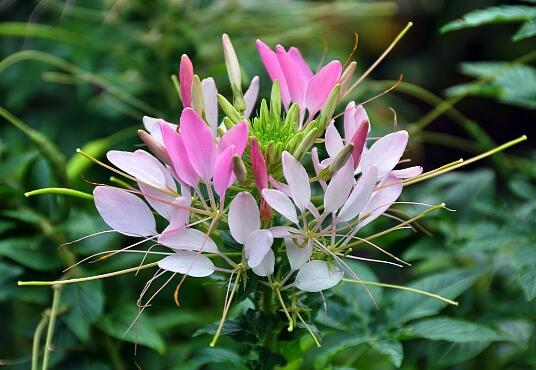
To know how to grow Cleome hassleriana, we first need to understand its growth habits. This plant is relatively light-loving, so during cultivation we should keep it in ample light so that it can grow better. In addition, daily watering and fertilizing are also points to note; the details are below, so let's take a look.
2. Cultivation methods and precautions for Cleome hassleriana
1. Soil: slightly acidic sandy loam
When growing Cleome hassleriana, we first need to choose the soil; this is the step of laying a good foundation and is very important. Generally, we can choose loose, fertile, slightly acidic sandy loam. This kind of soil has good drainage, can let it grow better, and is also less prone to waterlogging.
2. Fertilizing: apply dilute fertilizer frequently
Fertilizer is one of the main nutrients in the growth process of Cleome hassleriana. When fertilizing it, we should maintain the principle of "dilute fertilizer applied frequently, small amounts with more applications, complete nutrition," and after fertilizing, keep the leaves and flowers dry. There is one point to note when fertilizing it: the fertilizer must first be diluted with water so that it can be absorbed better. If the fertilizer is too concentrated, it is very easy to burn the plant.
3. Temperature: 20-32°C
During the growth of Cleome hassleriana, the ambient temperature is very important; only when it grows at a suitable temperature can it grow better. The suitable ambient temperature for Cleome hassleriana is between 20-32°C. This plant is relatively not cold-tolerant, so when growing it we should not let the ambient temperature be too low, otherwise it will affect its growth.
4. Water: maintain air humidity
Cleome hassleriana is relatively drought-tolerant, but during growth, having a certain amount of humidity in the surrounding environment is beneficial to its growth. Its most suitable air humidity is around 65-75%. If the air humidity is too low, it will speed up the withering of individual flowers. In midsummer, we basically need to water it every day to keep the potting soil at a certain humidity.
5. Light: pay attention to shading in summer
Cleome hassleriana is a relatively light-loving plant, so when growing it normally, we can place it in direct sunlight so it can carry out photosynthesis better and grow better. However, when the summer sunlight is too strong, it is best to pay attention to shading to avoid scorching the plant.
6. Pests and diseases: prevent and control promptly, do not delay
During the growth of Cleome hassleriana, if we are not careful enough with maintenance, pests and diseases can easily appear. Such problems are extremely harmful to the plant, not only affecting its ornamental value, but in severe cases also causing the plant to wither and die, so our prevention and control must be timely. For specific treatment methods, you can refer to the article on pest and disease control for Cleome hassleriana; the editor will not introduce them in too much detail here.
Compilation of basic knowledge on home flower cultivation
With the improvement of people's quality of life, home flower cultivation has become an indispensable lifestyle for people staying at home. But do you really understand home flowers? The editor of Huinong Network has compiled a treasure book of home flower cultivation; the issues you care about are below.
1. What are the categories of home flowers according to light intensity requirements?
According to flowers' requirements for light intensity, they can be divided into 3 categories: sun-loving flowers, shade-loving flowers, and neutral flowers.
1. Sun-loving flowers
Sun-loving flowers refer to flowers that can grow only in places with ample sunlight. Such flowers are suitable for full-light and strong-light environments; if the light is insufficient, their growth will be affected, and they may even fail to bloom. Many flowers belong to sun-loving flowers, such as spring peach blossoms and peonies, summer and autumn osmanthus and rose of Sharon, winter wintersweet and silver willow, fruit trees such as ginkgo, vines such as cypress vine, foliage plants such as black pine, and succulents such as aloe, all belong to sun-loving flowers.
2. Shade-loving flowers
Shade-loving flowers do not have a strong demand for sunlight and cannot tolerate direct sunlight. They are suitable for living in environments with insufficient light, such as azaleas and spider plants.
3. Neutral flowers
The growth of neutral flowers is unrelated to light, but according to the length of daylight they can be divided into long-day flowers, short-day flowers, and intermediate-day flowers.
(1) Long-day flowers
Refers to flowers that will not bloom unless the daily sunlight time is more than 12 h, such as hydrangea and cineraria.
(2) Short-day flowers
Refers to flowers that can bloom normally when the daily sunlight time is within 12 h, such as chrysanthemums and scarlet sage, but exceeding 12 h will also affect the growth of such flowers.
(3) Intermediate-day flowers
Refers to flowers that are not affected by sunlight time and will bloom normally regardless of the length of sunlight, such as geraniums and Chinese roses.
2. What are the categories of home flowers according to ornamental parts?
Different flowers have different characteristics. Here we classify flowers so that flower-growing enthusiasts can conveniently find the flowers they want.
According to the different ornamental parts of flowers, they can be divided into the following categories.
(1) Flower-viewing type
Among flower-viewing flowers, the focus of appreciation is flower color and flower shape. For example, Chinese roses, peonies, Cleome hassleriana, etc.; the vast majority of flowers belong to this category.
(2) Foliage-viewing type
Among foliage-viewing flowers, the focus of appreciation is leaf color and leaf shape. For example, Caladium bicolor, rubber tree, Norfolk Island pine, etc.
(3) Fruit-viewing type
Among fruit-viewing flowers, people mainly appreciate the fruit. For example, pomegranate, nandina, Chinese persimmon, etc.
(4) Stem-viewing type
Among stem-viewing flowers, the focus of appreciation is the branches and stems of the flowers. For example, Muehlenbeckia platyclada, silver willow, etc.
(5) Bud-viewing type
Among bud-viewing flowers, the focus of appreciation is the buds of the flowers. For example, silver willow, etc.
(6) Root-viewing type
Among root-viewing flowers, people mainly appreciate the form of their roots. For example, Ficus diversifolia, pandanus, etc.
(7) Plant-form-viewing type
Among plant-form-viewing flowers, the focus of appreciation is the form of the plant. For example, Sophora japonica 'Pendula', Chinese juniper, etc.
3. Why should the leaves of flowering bonsai be cleaned?
Healthy and beautiful flowers need careful maintenance, and among this, do not neglect cleaning the leaves. If the leaves of flowers are covered with dust, it not only reduces their ornamental value, but because dust blocks the leaf stomata, it will also obstruct the normal physiological activities of the flowers. Therefore, the leaves of flowers should be cleaned frequently or regularly.
There are many methods for cleaning leaves, such as wiping the leaves clean with a soft, clean damp cloth, brushing the leaf surface with a soft brush, or directly spraying and washing with a small manual sprayer, which is also very good. Of course, you can also use a sponge dipped in water and clean them one by one along the leaf veins.
Foliage plants that have lost their luster can be wiped with milk. Dip a cloth in some milk and gently wipe the surface of the leaves, and the leaves will become fresh and glossy. You can also wipe the leaves with beer. Dip absorbent cotton or a clean soft cloth in beer and gently wipe the leaves, because the leaves can directly absorb the nutrients in the beer; the leaves of the flowers will become greener and more glossy, and at the same time the texture of the leaves will also appear thicker.