How to propagate the hibiscus? The cutting method is simple, with a survival rate of 100%
Hibiscus, an ornamental plant, not only has large flowers, but also a fiery red flower color that is very lovable, and is grown in pots at home by many flower lovers. But is one pot of hibiscus too monotonous? It is time to propagate a few pots and grow them together, so how do you propagate hibiscus? According to research, there are mainly two propagation methods for hibiscus, cuttings and grafting. Because cuttings have a high survival rate, below we will cover the cutting method for hibiscus.
I. How to propagate hibiscus, cuttings/grafting
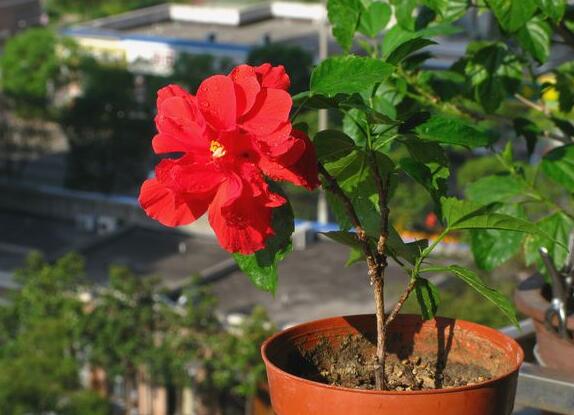
In the benefits and uses of hibiscus, we learned that hibiscus is not only beautiful but also has high medicinal value, so it is often propagated in large quantities. As for how to propagate hibiscus, the simplest, most practical, and highest-survival-rate method is still cuttings. Below, the editor will introduce the cutting method for hibiscus in detail from the aspects of time, substrate, and cuttings, as follows:
(1) The cutting method for hibiscus
① Cutting time
When hibiscus is propagated by cuttings, the survival rate is very high, but to achieve 100% survival, the choice of time must be correct. In the cultivation methods for hibiscus, we learned that hibiscus likes a warm environment, so it is best to take cuttings in spring and autumn, but in terms of survival rate, spring cuttings are higher than autumn cuttings.
② Cutting substrate
When propagating hibiscus by cuttings at home, the substrate must be chosen well. According to its growth habits, everyone should choose loose, breathable, well-drained sandy loam, vermiculite, river sand, etc. Spread about 15 cm of cutting substrate into the flowerpot, and note that considerable depth should be left in the substrate so that when the glass is covered it will not press down the cuttings.
③ Cutting selection
In the cutting method for hibiscus, the selection of cuttings is crucial; choose it well, and the whole propagation is half successful. Everyone can choose healthy one-year-old semi-lignified branches, about 10 cm long. After selecting the cuttings, cut off all the leaves on the lower section, keep 2 leaves on the upper section, and it is best to have a terminal bud.
④ Starting the cuttings
How to propagate hibiscus: after completing the above preparations, you can formally begin. When taking cuttings, first use a wooden chopstick to poke a hole in the sand surface, then insert the cutting, as shown in the picture above.
The spacing between cuttings is best about 4 cm, and the depth into the soil should be 2/5 of the cutting; it must not be deeper than 1/2, nor shallower than 3 cm. After inserting, spray thoroughly with water using a spray bottle so that the cuttings and sandy soil are tightly combined.
To retain moisture and warmth and improve the cutting survival rate, everyone should cover the pot soil with glass, then place it in a spot with direct sunlight, with appropriate shading.
⑤ Management after cutting
The cutting method for hibiscus is basically finished by this point, leaving only the final care and management. To encourage the cuttings to root faster, place the flowerpot in an environment of 20-25°C; generally, they will root in about 20 days.
When the weather is hot, everyone also needs to lift off the covering glass and spray water on the leaf surfaces 1—2 times to ensure the leaves do not wilt from lack of water.
Note: If a large number of water droplets are found on the glass, the glass should be slightly offset to allow air circulation. By meeting the above requirements, the cutting propagation of hibiscus is complete. With such a high survival rate and such a simple method, beginners can try it too~
(2) Grafting propagation of hibiscus
How to propagate hibiscus: besides cuttings, it can also be grafted, generally carried out in spring and autumn. This method is mostly used for hibiscus varieties that are difficult to root by cuttings or root slowly, especially double-petaled varieties with low cutting survival rates. Either branch grafting or bud grafting can be used. The rootstock can be single-petaled hibiscus. Grafted seedlings will grow branches and bloom in the same year.
How to propagate Chinese ixora: three propagation methods for Chinese ixora, with cuttings having the highest survival rate
Chinese ixora, an ornamental plant, not only has many flowers but also rich flower colors that are very lovable, and is grown in pots at home by many flower lovers. But besides ornamental value, Chinese ixora also has many benefits and uses, and because of this it is also propagated in large quantities. So how do you propagate Chinese ixora? Below are three propagation methods for Chinese ixora carefully compiled by the editor. Let's take a look together!
I. How to propagate Chinese ixora, cuttings/layering/sowing
Growing Chinese ixora in pots at home is the choice of many flower lovers, but is one pot of Chinese ixora too monotonous? Propagating a few pots and growing them together is what really gets you going! So how do you propagate Chinese ixora? According to research, there are mainly three propagation methods for Chinese ixora: cuttings, layering, and sowing. Because cuttings have a high survival rate, below we will cover the cutting method for Chinese ixora.
(1) The cutting method for Chinese ixora
The best time for cuttings is not spring, but June-July is preferable. When taking cuttings, choose semi-mature branches, 10~15 cm long, insert them into a sand bed, with a suitable temperature of 24~30°C; usually they will root in one and a half months (if you want to shorten the rooting period, you can soak the cuttings in 0.5% indolebutyric acid solution for 3~5 seconds).
① Cutting time, June-July
When Chinese ixora is propagated by cuttings, the survival rate is very high, but to achieve 100% survival, the choice of time is key. Chinese ixora cutting propagation can be carried out from March to October after the weather warms each year, and it is best to do it in June-July.
② Cutting soil, strong permeability
In the cutting method for Chinese ixora, the cutting soil is very important, and it has a great influence on the rooting rate of the cuttings. In the cultivation methods for Chinese ixora, the soil requirements are stated very clearly, and in cutting propagation, the soil requirements are even higher. The standards are: water retention, strong permeability, cleanliness, etc.
Substrate selection: In daily life, commonly used substrates for Chinese ixora include perlite, vermiculite, river sand, etc., and it is best to mix them. If used alone, they are suitable for intermittent mist propagation.
③ Cutting selection, 10-14 cm long
In the cutting method for hibiscus, the selection of cuttings is crucial; choose it well, and the whole propagation process is half successful. Everyone can cut tender branch cuttings in spring and summer. Specific requirements: branches with robust growth, no disease, and uniform size. Cutting size: 10-14 cm long, with a diameter of more than 3 mm.
Cutting treatment: After selecting the cuttings, generally no treatment is needed, but for large-leaved tall varieties, because rooting is more difficult, before cutting, everyone should treat the cuttings with growth hormone substances such as indolebutyric acid or naphthaleneacetic acid, which can significantly promote rooting.
④ Starting the cuttings
Insert the cuttings into the prepared pot soil; after inserting, water to keep the soil moist, and roots can emerge in about 50 days. After another ten days or so, they can be transplanted or potted up. At that time, place the Chinese ixora in a semi-shaded place for care, and after they root and survive, move them to a place with sufficient sunlight for normal care.
(2) Layering propagation of Chinese ixora
Besides cuttings, layering is also one of the propagation methods for Chinese ixora, and it is also carried out before the beginning of spring. Specific operation: choose a plant with many and dense branches, perform ring-barking 20 cm from the top, then wrap it with peat and plastic film; it can heal and root in more than 2 months.
(3) Seed propagation of Chinese ixora
Plants that can bear fruit can basically all be propagated by sowing, including Chinese ixora. In winter, collect Chinese ixora seeds and sow them the following spring. It is understood that the suitable germination temperature for Chinese ixora seeds is 22-24°C. The drainage holes in the bottom of the pot used for sowing should be enlarged, and a drainage layer should be made. After sowing, they germinate in 20-25 days, and when 3-4 pairs of true leaves have grown, the seedlings can be moved into 8 cm pots.
How to propagate Chinese hibiscus: propagation methods for Chinese hibiscus, mainly by cuttings
Chinese hibiscus is a relatively common flowering plant in people's lives, with high ornamental value, and people in all regions of our country are cultivating it. As more people cultivate it, questions about its propagation have also become a concern. Regarding how to propagate Chinese hibiscus? What are the propagation methods for Chinese hibiscus? Below, the editor will take everyone to learn about it.
I. How to propagate Chinese hibiscus, cuttings/grafting
When it comes to how to propagate Chinese hibiscus, it is actually mainly divided into two methods: cutting propagation and grafting propagation. Among them, cutting propagation is a relatively commonly used one, and the survival rate is also relatively high. However, although grafting propagation is used relatively less, as long as it is done properly, the survival rate is likewise very high. In the text below there are specific details of the two propagation methods, and friends who are interested can learn about them.
II. Propagation methods for Chinese hibiscus
Cutting propagation
1. Substrate selection, good drainage is required
Before carrying out cutting propagation of Chinese hibiscus, we must first choose soil. Generally, we should preferably choose loose, fertile humus soil rich in organic matter. This kind of soil has high nutritional value, and both drainage and breathability are relatively good, which can allow the plant to grow better.
2. Substrate disinfection, high-temperature disinfection
After choosing the substrate, we cannot plant immediately. It is best to disinfect it first, to avoid pests and diseases in it infecting the plant. When disinfecting, we can break it apart and spread it flat in the sun for exposure, or put it into a pot and stir-fry it over high heat. In this way, even if there are pests and diseases, they will be killed by the high temperature.
3. Cutting selection, choose robustly growing branches
After choosing the substrate, we also need to choose cuttings. Generally, it is best to choose branches that are relatively robust in growth and free from pest and disease infestation as cuttings, so the survival rate will be relatively high. If we choose branches that already look rather weak, then it is basically very difficult for them to survive, so everyone should not be too casual when choosing.
4. Cutting method, rooting in 20-25 days
Among the propagation methods for Chinese hibiscus, cutting propagation is relatively simple. First, we need to cut off the leaves on the lower part of the cutting and keep the leaves at the top, and use a chopstick to poke a hole in the substrate, then trim off the leaves at the bottom of the cutting, after which insert the cutting to 1/2. This operation can avoid damage to the cutting and is very practical. After that, water thoroughly and keep the room temperature between 18-21°C; rooting can occur in about 20-25 days.
Grafting propagation
When carrying out grafting propagation of Chinese hibiscus, it is best to choose spring and autumn. This method is generally used for Chinese hibiscus varieties that are difficult to root by cuttings or root slowly, especially double-petaled varieties with low cutting survival rates. Either branch grafting or bud grafting can be used. The rootstock uses single-petaled hibiscus. Grafted seedlings will grow branches and bloom in the same year.