What to do when bromeliads get pests? 3 pest and 3 disease control methods
80% of the beauty of a bromeliad lies in its flowers, after all, it only blooms once a year. But because some flower lovers care for them improperly, bromeliads can be attacked by insects, which reduces their ornamental value. So what should you do when bugs appear in a bromeliad? Actually, there is no need to panic, you just need to identify which pest it is and then deal with it accordingly. The following are common pest and disease control methods for bromeliads, let's take a look together.
I. What to do when bugs appear in a bromeliad, spray with pesticide to kill them
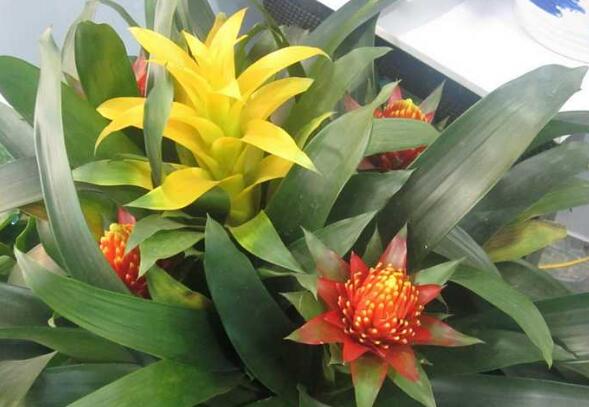
In the bromeliad cultivation methods, the points to note during its growth have already been introduced. If flower lovers do not pay attention, insects will come calling. What to do when bugs appear in a bromeliad, just identify which insect it is and then deal with it accordingly. The following are three common pests of bromeliads, as follows:
1. Scale insects
Scale insects harm all flowers and plants, so they are also one of the pests of bromeliads. According to observation, scale insects mainly harm the leaves of bromeliads, and in severe cases the leaves will turn yellow, wither, and even fall off. The solution to yellowing bromeliad leaves has been introduced earlier, let's now look at the method to deal with scale insects.
Solution: When scale insects are found causing harm, they should be dealt with immediately. When there are few scale insects, they can be scraped off directly. When there are many scale insects, 50% parathion can be used for spray killing.
2. Common cutworm
The common cutworm, also called the tobacco cutworm, is also one of the pests of bromeliads. It generally hides in dark places such as the potting soil and the bottom of the pot during the day, and comes out in the evening to feed on the petals, stamens and pistils of the bromeliad.
Solution: When this insect is found, pesticide should be sprayed immediately to kill it. As for which pesticide to use, any insecticide on the market will do.
3. Red spider mite
The red spider mite is one of the common pests of bromeliads. It mainly inhabits the underside of the leaves or the base of the leaf axils of the bromeliad, and pierces and sucks the sap of leaves, buds and flowers, affecting normal growth and development. When attacked by this insect, in mild cases it affects appearance, and in severe cases it can even cause the whole plant to wither and die.
Solution: Red spider mites are relatively small and difficult for us to spot with the naked eye, but once found they should be dealt with quickly. When there are few insects, they can be rinsed off with clean water; when there are many insects, spray a 1:1000 dilution of dimethoate solution, spraying once every 4 days, 2-3 times in a row is enough.
II. Diseases of bromeliads and their solutions
When bugs appear in a bromeliad, after reading the above content everyone should know what to do! However, besides being attacked by insects, diseases also constantly threaten bromeliads, and there are mainly 3 diseases of bromeliads: heart rot, root rot and leaf tip yellowing disease. The specific symptoms and solutions are as follows:
1. Heart rot
This disease is not common, but it is one of the common diseases of bromeliads. When suffering from this disease, the tissue at the base of the bromeliad's leaf cup becomes soft and rotten, with a foul odor. The leaves or leaf cup can be taken out with a light pull; if left alone, the leaf cup will collapse on its own after a while.
2. Root rot
After suffering from this disease, the root tips of the bromeliad will turn black-brown or rot, and no lateral roots will grow, thus affecting the plant's absorption of water and fertilizer, causing the bromeliad to grow slowly and become weak. It is understood that in hot and humid seasons, both heart rot and root rot can occur.
Solution for heart rot and root rot: After discovering the above symptoms, flower lovers can use a 400-fold dilution of 75% oxadixyl-mancozeb or a 400-fold dilution of 40% fosetyl-aluminum to irrigate the leaf cup, once a month, 3 times in a row is enough to cure it.
3. Leaf tip yellowing and withering
Another disease of bromeliads, it is generally related to water. Once watering is improper, or the air humidity is low, the salt content in the soil will become too high and cause salt damage. At this point leaf tip yellowing and withering will come calling, in mild cases causing leaves to turn yellow, and in severe cases the plant dies directly.
Control method: When watering, try to choose water with less salt content. If using household water, it should be used after being exposed to the sun.
What to do when calla lilies get pests, calla lily pest and disease control / 3 pests 3 diseases
Calla lily, a flower with a beautiful meaning and beautiful flower colors, is one of modern people's favorites. However, due to improper care, many people's calla lilies develop various problems, such as being attacked by insects. So what should you do when calla lilies get pests? It is actually very simple, identify which insect it is and then deal with it accordingly. The following is calla lily pest and disease control, follow the editor to take a look.
I. What to do when calla lilies get pests, spray with pesticide to kill them
Calla lilies have a long flowering period and are flowers with extremely high ornamental value, so once they are attacked by insects, it will seriously affect their beauty. As for what to do when calla lilies get pests, it is actually not difficult, you just need to carefully identify which insect it is and then deal with it.
(1) The three major pests of calla lilies
When calla lilies are kept at home, the most feared thing is pests. Beautiful fresh flowers turning into withered branches and fallen leaves is truly a headache. And it is understood that there are mainly three pests of calla lilies: scale insects, two-spotted spider mites and seed maggots. The specific symptoms and solutions are as follows:
1. Scale insects
Scale insects are one of the main pests of calla lilies. They mainly harm the leaves of bromeliads, and in severe cases the leaves will turn yellow, wither, and even fall off. How to deal with yellowing calla lily leaves has been introduced earlier, so I will not say more here.
Solution: When the above symptoms are found and scale insects are confirmed, flower lovers should deal with them immediately. When there are few scale insects, they can be scraped off directly. When there are many scale insects, 50% parathion can be used for spray killing.
2. Two-spotted spider mite
This insect is also called the cotton red spider mite. It is also one of the common pests of calla lilies. It generally sucks leaf sap on the underside of calla lily leaves. When attacked by two-spotted spider mites, in mild cases the leaves turn red, as if burned by fire, and in severe cases the leaves fall off.
Solution: When this pest is found, the diseased leaves should be removed and disposed of in a centralized manner; pesticide can also be used, spraying a 1000-fold dilution of 40% dicofol, or a 2000-fold dilution of 20% amitraz is enough to solve it.
3. Seed maggot
One of the most important pests of calla lilies, it is also a type of maggot. In its larval stage it erodes young seedlings, causing them to rot and then die. Once entangled with this insect, the consequences are very serious.
Solution: When this pest occurs, some insecticidal powder can be sprayed, or its soil and seeds can be treated with chemicals at the very beginning when preparing to plant.
(2) The four major diseases of calla lilies
What to do when calla lilies get pests, after reading the above content everyone should know what to do! However, besides being attacked by insects, diseases also constantly threaten calla lilies, and there are mainly 3 diseases of calla lilies: gray mold, soft rot and leaf spot. The specific symptoms and solutions are as follows:
1. Gray mold
This disease is one of the diseases of calla lilies. It mainly harms the leaves, pedicels and flowers of calla lilies. Symptoms: leaves produce yellow-green to dark-green water-soaked spots, which gradually expand, becoming soft and putrid when humid, and the affected parts produce gray, earthy-yellow mold layers.
Solution: When this disease is found, the diseased leaves should be promptly removed to avoid contact infection. If necessary, spray a 500-fold dilution of 50% carbendazim or a 500-fold dilution of 75% chlorothalonil, and after a few times it can basically be solved.
2. Soft rot
When suffering from this disease, the part of the calla lily near the soil surface will become soft and rotten and separate, the roots also rot, and the whole plant suddenly wilts and dies. If the leaves are diseased, they will become soft and wet-rotten; when the pedicel is attacked: the flower turns brown, and the pedicel becomes soft-rotten and falls off. It is a bacterial disease.
Solution: When this disease is found attacking, flower lovers should remove the diseased corms and disinfect the soil around the diseased plants with a 40-fold dilution of 40% formaldehyde.
3. Leaf spot
Leaf spot, one of the diseases of calla lilies, occurs frequently during the growth process. Symptoms: tiny lesions on the leaves, nearly round, gray, and gradually expanding and merging into irregular large rotten patches, sometimes also affecting flowers and pedicels.
Solution: When this disease is found, flower lovers should promptly remove residual diseased leaves to avoid excessive water. In severe cases, use a 1000-1500-fold dilution of emulsifiable concentrate, or a 500-fold dilution of 80% mancozeb, spraying 2-3 times every 7-15 days at 25%.
Why do cryptanthus leaves change color, what to do, and how to control its pests and diseases
The leaves of the cryptanthus are very beautiful, with clear veins and colored vertical and horizontal stripes. Its leaves are brilliantly colored and it is a very good houseplant grown for foliage. But it is also very fragile, susceptible to pest and disease attacks, and can also encounter leaf discoloration. Today I will take everyone to learn about the pests and diseases of cryptanthus and the reasons for leaf discoloration.Reasons for leaf discoloration
The leaves of cryptanthus are originally purple-red. Turning green is due to a lack of sunlight, so the plant cannot carry out photosynthesis, lacking carotene and chlorophyll, and thus the color gradually changes. If placed in a spot indoors that is too dark, the markings on the leaves will gradually disappear, and the leaf color will also become dull, losing its ornamental value. In addition, overly strong direct light will scorch the leaves, and mottled spots will appear on them. Cryptanthus is not cold-tolerant, so the lower the winter temperature, the duller the leaf color of the cryptanthus will be. Dry leaf tips are because in summer the air humidity is relatively low and evaporation is relatively large, so the leaves are very prone to water shortage, leading to dry leaf tips.
Solution
Cryptanthus likes a semi-shady environment and is suitable for growing at 20°C-25°C. Normally it should be placed near a sunny windowsill, and it can receive at most 3-4 hours of direct sunlight per day, but strong sunlight should be avoided. The placement of cryptanthus should be changed according to the seasons. The minimum winter room temperature should not be lower than 15°C; below 10°C cryptanthus is prone to cold damage. During the vigorous growth period of cryptanthus, apply an organic liquid fertilizer once every 7-10 days, and apply alum water once or twice a month, which can make the leaf color bright and vivid. Do not apply too much nitrogen fertilizer in daily care, as it will make the leaf patterns become dull. To prevent dry leaf tips, keep the potting soil moist, spray clean water on the leaf surface once or twice a day, and the cup-shaped part in the center of the leaf rosette can be filled with clean water.
Pest and disease control
The diseases of cryptanthus include anthracnose, gray mold, middle spot disease, stem rot and wilt disease, etc.
Control methods
For anthracnose, use a 500-fold dilution of 25% carbendazim wettable powder or a 600-fold dilution of 27% copper hydroxide suspension, or a 1:1:160 Bordeaux mixture for control. Apply once every half a month, 2-3 times in total.
For gray mold, reduce indoor humidity. Watering is best done on sunny mornings, and never water on cloudy or rainy days. At the same time, choose to ventilate a little later on sunny mornings to ensure indoor air circulation.
For stem rot, in the early stages of the disease from mid-May to July, spray cryptanthus with a 1000-fold dilution of 38% oxadixyl-cymoxanil-kresoxim-methyl, or a 800-fold dilution of 30% metalaxyl-hymexazol, or a 500-fold dilution of thiram.
Pests
The pests of cryptanthus are severely caused by mealybugs and scale insects. Mealybugs are small sap-sucking insects with a white sticky powder on their bodies, and they harm crops, fruit trees, gardens, forests and pastures. Scale insects suck the sap of plants, and in severe cases can cause the whole plant to die. Their secretions may also induce sooty mold, causing great harm.
Control methods
For mealybugs, if the infestation is not particularly severe, you can manually remove the mealybugs, or spray them off with a strong stream of water (be careful not to hurt the cryptanthus), or rinse the plant with a 1:1 solution of clean water and methylated spirits, which can not only wash off the insects but also kill the ones that cannot be washed off.
During the cultivation of cryptanthus, if scale insects are found on individual leaves, they can be gently brushed off with a soft brush, or combined with pruning, cutting off the infested branches and leaves. It is required to brush clean, cut clean, and burn them in a centralized manner. Never throw them away carelessly.
The above is my compilation of the reasons and methods for cryptanthus leaf discoloration, and pest and disease control. I hope it can be of help to the vast number of flower lovers, and please continue to follow Duorou Huapu to learn more about flower care knowledge.