Four Common Methods of Propagating Chrysanthemums, Cuttings and Division Are the Most Practical
The chrysanthemum, one of China's ten famous flowers, has a long blooming period, bright colors, and strong medicinal value, making it deeply loved by flower enthusiasts. Because the chrysanthemum has many effects and uses, it is propagated in large quantities. So how do you propagate chrysanthemums? Rather than buying them from a flower shop, it is better to do it yourself. There are many propagation methods for chrysanthemums, but the most practical and convenient is cuttings. Let's take a look together below.
I. How to Propagate Chrysanthemums, Cuttings Are the Most Practical
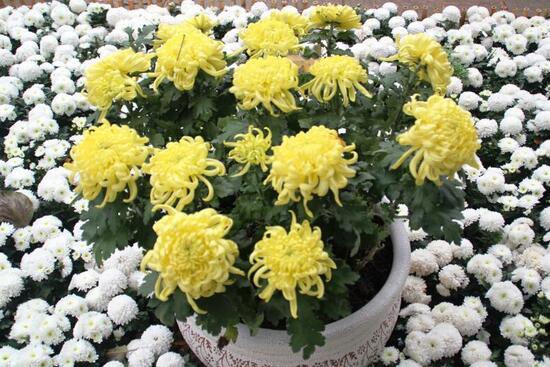
Growing flowers is about participation, so we should not only know how to care for chrysanthemums, but also understand how to propagate them. According to the author's research, there are mainly 5 propagation methods for chrysanthemums: cuttings, division, grafting, layering, and tissue culture, among which cuttings and division are the most practical. Let's continue reading for the specific operations.
II. Propagation Methods for Chrysanthemums
(1) Cutting Propagation Method for Chrysanthemums
Chrysanthemums are herbaceous flowers, so unlike the hard cuttings (stem cuttings) of woody flowers such as Chinese roses, roses, and gardenias, chrysanthemums use soft cuttings (the upper half of the branch, with the terminal bud). The cutting propagation method for chrysanthemums is as follows:
1. Selection of Cuttings
How to propagate chrysanthemums? If using cuttings, you first need to select good cuttings. Choose a healthy and vigorous chrysanthemum branch, then cut it in the middle, take the upper half, and leave about 20 cm.
Note: For chrysanthemum cuttings, each section should retain one leaf bud, and the top part should retain the terminal bud. After selecting the cuttings, soak them in a rooting powder solution for 2 hours.
2. Cutting Medium
According to the growth habits of chrysanthemums, we should choose soil rich in humus as the cutting medium. After selecting it, water it to moisten the soil.
3. Starting the Cuttings
Before cutting, use a wooden stick to make a slanted hole 6-8 cm deep in the soil, then place the treated cuttings into the hole, and press the soil firmly. After pressing the cuttings firmly, spray water again, spraying thoroughly and wetting completely, and place in a cool and ventilated place. In addition, you should also make a sunshade, cover it during the day, open it at night, and spray water with a spray bottle on time to keep the soil moist.
4. Post-Cutting Care
With the above steps, the cutting propagation of chrysanthemums is basically complete, and what remains is post-cutting management. After the upper leaf buds of the cuttings emerge, they can appropriately receive sunlight in the morning and afternoon, but must not be exposed to the scorching sun at noon. After the chrysanthemum cuttings survive, they can be transplanted and receive more sunlight, but at this time you need to control watering. Do not water too frequently, to avoid excessive growth.
(2) Division Propagation Method for Chrysanthemums
1. Time for Division
In China, division is often used for propagating chrysanthemums. This method is simple to operate and reliable for survival. As for the time for division, it is best to choose the third lunar month, and after surviving, pinching and care can be done in the fourth lunar month.
2. Division Method
The division method for chrysanthemums is also simple to describe. Dig out the mother chrysanthemum, then separate the branches with roots and plant them separately. After division, water thoroughly, then water appropriately afterward, and after two weeks you can apply fertilizer, then carry out normal care according to chrysanthemum cultivation methods.
Overall, chrysanthemums have relatively strong vitality. Propagation can be done by cuttings, division, grafting, layering, and tissue culture, but the ones most suitable for the vast number of flower enthusiasts are only cuttings and division, so everyone only needs to learn the two above; there is no need to master the rest. That is all for the propagation methods of chrysanthemums. I hope it can help everyone.
Methods and Steps for Cutting Propagation of Chrysanthemums
Chrysanthemums have been bred into a great many varieties. Chrysanthemums currently on the market have diverse colors, many petal forms, and bloom in multiple seasons, with a very wide range of applications, so they are deeply loved by people and are also one of the very important cut flower varieties today. Propagation methods for chrysanthemums include cuttings, division, sowing, grafting, and other approaches. However, in order to ensure the excellent characteristics of the mother chrysanthemum, chrysanthemums are often propagated by cuttings.
Chrysanthemum
Chrysanthemum cuttings generally include stem cuttings, bud cuttings, and leaf cuttings, but stem cuttings are the most common. The specific cutting steps are as follows:
1. Selection of cuttings: After flowering, choose robust plants free of pests and diseases, cut off the aboveground parts, and place them in a cold room or refrigerator, keeping them as mother plants.
2. Cutting time: Mid-April to early May is the suitable period for autumn chrysanthemum cuttings.
3. Preparation of cuttings: After new shoots sprout and grow in the spring of the second year, cut 7-8 cm terminal shoots as cuttings, use a sharp knife to trim the base into a horseshoe shape at 0.2 cm below the basal leaves, and remove the basal leaves, leaving only 2-3 upper leaves, and cut the large leaves in half. Place the medium in a cutting bed or pot and level it, water it, and once the water has seeped down, cuttings can be done.
4. Cutting: Before cutting, use a bamboo stick to poke small holes in the bed surface, insert the cuttings to a depth of 1/3-1/2 of the cutting, with a row spacing of 8-10 cm and a plant spacing of 2-3 cm.
5. Post-cutting management: Press the soil firm and water immediately, so that the medium and cuttings are closely combined. For bed cuttings, set up a shade shed; for pot cuttings, place them in a shaded place; always keep the soil moist, but not too wet; keep the temperature at 15-20°C; after one week the cuttings begin to take root. At this time, light needs to be increased, and generally after about 10 days they can be potted.
How Do Chrysanthemums Reproduce Asexually? Methods of Asexual Reproduction of Chrysanthemums
Chrysanthemum propagation methods are divided into two types: asexual reproduction and sexual reproduction. The greatest feature of asexual reproduction is that it can maintain the excellent characteristics of the mother plant and bring flowering earlier. Therefore, chrysanthemums mostly use asexual reproduction methods. Today I will introduce the asexual reproduction methods of chrysanthemums.
Methods of Asexual Reproduction of Chrysanthemums
1. Cutting Propagation
Cutting propagation is cutting off a part of the vegetative organs of the chrysanthemum mother plant and, using the plant's meristematic or regenerative capacity, under suitable conditions, causing it to take root and grow into a new plant. Cutting propagation methods include stem cuttings, bud cuttings, and leaf cuttings. Their advantages are wide application, simplicity, fast rooting, and a high survival rate, and they are the main propagation method for chrysanthemums.
(1) Stem Cuttings
Stem cuttings are a propagation method that uses young chrysanthemum branches for cuttings, including shaded film-covered cuttings and full-light mist cuttings. Shaded cuttings are generally used when the temperature is relatively low, and are mostly used for introduction and for raising large chrysanthemums and cliff chrysanthemums. Full-light mist cuttings root quickly and have a high survival rate, and are generally used during large-scale propagation in summer, mostly for raising single-stem chrysanthemums, multi-stem chrysanthemums, and desk chrysanthemums.
The seedbed should be chosen in a place with high and dry terrain, good drainage, ventilation and light, and convenient water sources, and can be made with bricks or wooden boards. The cultivation medium can use washed coarse river sand or vermiculite or perlite. The seedbed and medium must be disinfected. Use a 4000-fold potassium permanganate solution to soak the medium and seedbed for half an hour, then rinse once with clean water. Disinfection must be carried out before each cutting. Spray heads should be installed above the seedbed.
Cutting time: multi-head chrysanthemums in April-May, single-stem chrysanthemums in June-July, desk chrysanthemums in July-August, large chrysanthemums and cliff chrysanthemums in November-December.
Cuttings can be taken from the newly sprouted branches of chrysanthemum perennial roots retained from last year, or from the branch tips of small seedlings that survived winter cuttings last year. The cuttings are 5-7 cm long and have 3-4 internodes. The cut is located below a node. Use a sharp knife to smooth the wound, and cut off 1-2 lower leaves. Temporarily place the cut cuttings in water. On a pre-prepared clean and loose seedbed, first use bamboo chopsticks to make holes in the seedbed, with a plant spacing of 3 cm and a row spacing of 5 cm, then insert the cuttings about 1/3 deep. After inserting, gently press the base with your fingers so that the soil and cuttings are closely combined, and water thoroughly with a watering can.
After cutting, manage according to weather conditions. On sunny days, increase the number of sprays, keeping the leaves from drying out as the standard; you can spray intermittently. On cloudy and rainy days, spray less or stop spraying. In case of heavy rain, pay attention to covering to prevent rain. Seedlings cut in April-May take root in about 25 days, and seedlings cut in June-August take root in about 15 days. When the roots grow to 2-3 cm, they should be removed from the bed and potted in time.
(2) Bud Cuttings
There are two types of buds available for cuttings: foot buds and axillary buds. In autumn and winter, foot buds are used for cuttings. The foot buds that sprout at this time grow robustly and have strong vitality and are not prone to degeneration. Foot bud cuttings are generally used for introduction and cultivation of large chrysanthemums. After cutting, they root quickly and survive easily. To dig out foot buds, use a small knife to insert into the soil along one side of the foot bud to cut off the base, then take it out, peel off the leaves at the base of the bud, and cut immediately, burying about 2 cm deep. To cultivate large chrysanthemums and cliff chrysanthemums, foot bud cuttings can be used in November. Some chrysanthemum varieties lack foot buds or tender shoots when flowering, so axillary buds can also be used for cuttings. Axillary buds are buds growing from the leaf axils. They are short, small, and weak, with insufficient nutrients, and require meticulous management. After axillary bud cuttings, flower buds tend to form, so this method is not widely used.
(3) Leaf Cuttings
Pick healthy leaves, trim the base of the petiole flat, and bury the lower half of the leaf obliquely into the soil together with it, leaving the upper half of the leaf outside. Propagation by leaf cuttings has a low survival rate and slow growth. Except for use with precious varieties or when cuttings are extremely scarce, leaf cuttings are seldom used.
The management work for bud cuttings and leaf cuttings is the same as for stem cuttings.
2. Division Propagation
Division, also called root division, is a propagation method in which root tillers sprouting around the base of the mother plant are separated and cultivated into new plants. These root tiller seedlings themselves carry varying numbers of roots and stems. Once separated from the mother plant, they are independent plants, easy to survive, and can grow into robust seedlings.
After chrysanthemum perennial roots overwinter, many tiller buds sprout around the roots. Around Qingming, dig up the perennial roots of the mother plant, separate these rooted tiller buds for transplanting, water thoroughly, and provide appropriate shade. After the seedlings recover, let them receive light and fertilize, and afterward they grow into new plants. Chrysanthemum plants propagated by division are tall and have many branches, but the propagation quantity is not large, the flowers are relatively small, and the basal leaves fall early. They are generally used for cultivating early chrysanthemums, large chrysanthemums, and cliff chrysanthemums.
3. Layering Propagation
Layering propagation is a propagation method that uses the rooting ability of branches, pressing the branches or stems of the mother plant into the soil, and after rooting, cutting them off from the mother plant to become independent new plants. Methods such as girdling or wounding the branches buried in the soil can promote rooting. This method has an extremely high survival rate and can maintain the characteristics of the original variety. The disadvantages are small flower heads, shortened branches and stems, many branches, and inconvenient management. This method is rarely used, and can be used for excellent variations and ultra-dwarf plants.
4. Grafting Propagation
Grafting propagation is a propagation method in which the branch or bud of the plant planned for propagation is grafted onto another plant body, so that they heal and grow together to become a new individual. The branch or bud used for grafting is called the scion, and the plant receiving the scion is called the rootstock. Using a branch as the scion is called branch grafting, and using a bud as the scion is called bud grafting. Generally, the scion has excellent traits, and the rootstock grows robustly and has strong adaptability.
The purpose of grafting chrysanthemums is not simply propagation. Grafting is mainly used to make chrysanthemums have multiple colors on one plant, novel postures, fast growth, fast development, and many flowers. This method is mostly suitable for cultivating large chrysanthemums, tower chrysanthemums, and the like.
Chrysanthemums mostly use branch grafting, with Artemisia annua and Artemisia carvifolia used as rootstocks, because they have advantages such as strong adaptability, strong stress resistance, developed root systems, and vigorous growth, and can provide abundant nutrients for the scion.
The specific method is: according to the planned need, select tender shoots about 5 cm long, use a sharp knife to cut the base of the scion 2-3 cm into a wedge shape, then shorten the rootstock stem. The thickness of the stem at the cut part should be equivalent to the thickness of the scion stem. If the pith of the retained part is white, it indicates it has aged; if no pith has formed, it indicates it is too tender; neither is suitable for grafting. Pay attention to the selection of the grafting site. After removing the top of the rootstock stem, split it vertically 2-3 cm. Immediately after splitting, insert the prepared scion into the split of the rootstock, so that the cambium of the scion and rootstock align and fit closely. Bind the joint with plastic film strips, or use a "bark ring" made in advance from willow branches or elm branches to put on and tighten, then put on a plastic bag to prevent water evaporation and also prevent rainwater from entering the wound.
After 4 days, remove the plastic bag. After two or three weeks, remove the binding material, and remove the wormwood leaves from the rootstock below the joint.