How to propagate camellias? Four propagation methods, with cuttings achieving a 100% survival rate
Camellia, a very beautiful flowering plant, is loved by many for its beautiful flower shapes and rich flower colors. In daily life, keeping a few pots of camellias at home is a choice many people make, and many of them just buy them directly from stores. In fact, besides buying existing potted camellias, you can also propagate them yourself~ Below are four propagation methods for camellias. Follow along with the editor to learn more.
I. How to propagate camellias: cuttings / approach grafting / leaf cuttings / air layering
As one of China's top ten famous flowers, the camellia is a houseplant for many people. However, one pot of camellias looks rather monotonous; growing several pots together is what really feels satisfying. If you do not want to go out and buy them, then you need to propagate them yourself. As for how to propagate camellias, there are four methods: cuttings, approach grafting, leaf cuttings and air layering. Let's continue below to see exactly how to do it.
II. Four propagation methods for camellias
(1) Camellia cutting method
There are many propagation methods for camellias, and both sexual and asexual propagation can be used, but the most commonly used are still cuttings and approach grafting. Among these, the camellia cutting method is relatively simple, so let's introduce it in detail.
① Cutting time
For how to propagate camellias, the first thing is to choose the right time. For camellia cutting propagation, it is best to choose September, though mid-May in spring also works.
② Cutting selection
In the camellia cutting method, the selection of cuttings is especially important; if chosen well, it will directly affect the overall survival rate of propagation. On a sunny day in September, cut semi-lignified branches with sufficient nutrients and robust growth to use as cuttings.
Cutting treatment: cut them to a length of about 6-10 cm, preferably with 2/3 nodes. Then remove the basal leaves, keep the upper 3 leaves, and cut a slanted opening with a sharp knife. After that, disinfect the cuttings, apply some carbendazim to the wound, and place them in a cool, ventilated place to dry.
③ Starting the cuttings
After the cuttings dry, insert them into a sand pot or vermiculite pot, or you can also put them in a container filled with water. Be careful to keep them moist; generally they will root in 2 weeks. Overall, cuttings are extremely easy to root successfully. If done properly, the survival rate of camellia cutting propagation can reach 100%.
(2) Camellia approach grafting method
Approach grafting is one of the most common propagation methods for camellias, mainly used to propagate valuable camellias. Rootstock for approach grafting: generally choose oil tea; approach grafting time: between Qingming Festival and Mid-Autumn Festival.
Approach grafting method: plant the rootstock in a flower pot, use a knife to shave off about half at the parts to be joined, and note that the cuts should be smooth. Then, fit the cut surfaces of both sides tightly together, wrap with plastic film, and water the rootstock twice a day.
Care: after 60 days they will heal. At that time, cut them off and plant them, and place them under tree shade to avoid direct sunlight. In February of the second year, use a knife to cut off the tail of the rootstock, then plant it in place, and after that just care for it according to camellia cultivation methods.
(3) Camellia leaf cutting method
Considering the limited sources of branches for valuable camellias, using the leaf cutting method for propagation has become an option. The specific operation is as follows:
Cutting medium: mix mountain soil with 1/3 river sand to ensure good aeration and drainage. Then place the medium in a clay pot.
Cutting selection: take one-year-old leaves as leaf cuttings, and note that the leaves should not be too old or too tender; if too old they are not easy to root, and if too tender they rot easily.
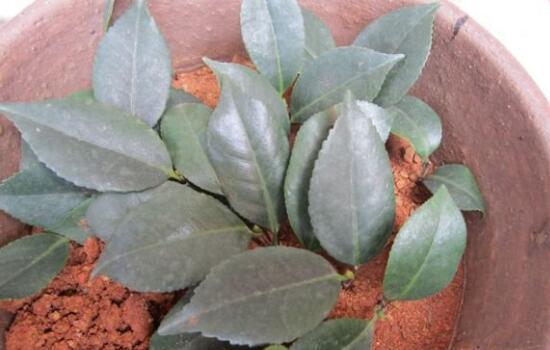
Starting the cuttings: insert the selected leaves about 2 cm deep into the soil, press the soil firm after inserting, water thoroughly, and then place in a cool, ventilated place. Generally they can develop roots in 3 months, and in the spring of the second year they can sprout and send out branches.
(4) Camellia air layering method
Besides the above three, the air layering method is also one of the camellia propagation methods. Its characteristic is that it can give new life to all the weak small branches on the camellia that would otherwise be pruned off. More importantly, this method has a high survival rate, quick rejuvenation and early flowering, making it very suitable for beginners to try. The specific operation is as follows:
On the weak branches that need to be pruned off, perform girdling at an appropriate position, with a girdling length of 5-8 mm, tie on a suitably sized plastic film, add sterilized and disinfected peat soil or leaf mold inside the film, and after 7-10 days, girdle another 5-8 mm below the plastic film, and after that a new life is born!
Overall, camellias have strong vitality, and all four propagation methods are easy to survive, but when it comes to convenience and survival rate, cuttings and approach grafting are still the best. Of course, methods are fixed while people are flexible; everyone can choose a method for propagation according to actual circumstances. That is all from the editor on camellia propagation methods. Hope it can be helpful to everyone.
How to propagate camellias? Key points to note in camellia cutting propagation techniques
Camellias are favored by flower lovers because of their graceful plant form and brilliant, colorful flowers. But some flower lovers do not know how to propagate camellias. In fact, camellias can be propagated by cuttings, layering, sowing and other methods, but for ordinary flower lovers, cuttings are the most practical propagation method. Next, let's learn about the key points to note in camellia cutting propagation techniques.
Image: Camellia
I. Cutting time
Taking the Fujian region as an example, most are inserted from June 10 to 30 into seedling beds in nursery soil, and clay pots or wooden boxes can also be used as containers for cuttings.
II. Cutting selection
Choose current-year young branches. It is better to use current-year semi-mature branches from the outer part of the crown with firm tissue, intact leaves and plump leaf buds as cuttings, 8-10 cm long, with 2 leaves kept at the tip.
III. Cutting the branch
When cutting, keep as much old branch as possible at the base; after insertion it easily forms callus tissue and roots quickly. Cut the cuttings in the early morning, and insert them as soon as they are cut.
Image: Camellia
IV. Cutting method
Insert about 3 cm into the seedbed medium. When inserting, the leaves are required to overlap each other, and after insertion press firm with your fingers. When inserting, use a 0.4%-0.5% indolebutyric acid solution to dip the base of the cuttings for 2-5 seconds, which has a clear effect of promoting rooting. Shallow insertion is better, as it allows air circulation, and healing and rooting are faster.
V. Management after insertion
The cutting seedbed needs shading, and the leaf surface should be sprayed with water every day to keep it moist, with the temperature maintained at 20-25°C. About three weeks after insertion, healing begins, and after six weeks they root. When the roots are 3-4 cm long, they can be transplanted into pots. When new roots grow from the base and new shoots and new leaves grow from the top of the branches, transplantation can be carried out.
VI. Survival and transplantation
For those that survive as cuttings, transplantation can generally be done from mid-September to early October of the same year. If not transplanted at this time, it is even better to wait until March of the following year for transplantation, because this allows more fibrous roots to grow in the original place, and the survival rate after transplantation will also be higher. At that time it also coincides with another growth period of camellias, which has many benefits for growth and development. One thing to note: if the cutting medium used is river sand or rice chaff ash, after rooting and leaf growth, they should be transplanted and divided as early as possible, because these media lack nutrients, and over time they will affect the growth of surviving seedlings in the nursery.
How to propagate camellias? Camellia propagation methods
Camellia is a common indoor potted plant, with emerald green leaves and rich flower colors, and has high ornamental value. In the process of caring for camellias, propagation is a very important step. There are many propagation methods for camellias, such as cuttings, approach grafting, leaf cuttings and so on. So, how to propagate camellias? Below we introduce camellia propagation methods. Let's learn about them together.
Image: Camellia
I. Cutting propagation
Camellia cutting propagation is the simplest. The most suitable time for cuttings is September, and spring also works. Choose well-grown, semi-lignified branches, remove the basal leaves, keep the upper 3 leaves, cut a slanted opening with a sharp knife, immediately dip the cut end into 200-500 ppm indolebutyric acid for 5-15 minutes, dry them, and insert into a sand pot or vermiculite pot. After insertion and watering, the wound heals in about 40 days and roots in about 60 days. Cuttings treated with hormones root 2-3 months earlier than those not treated with hormones. Using vermiculite as a cutting bed also roots much faster than a sand bed.
II. Approach grafting propagation
Choose an appropriate variety such as tea cup camellia or oil tea as the rootstock, and approach graft valuable camellias onto it. The time for approach grafting is generally between Qingming Festival and Mid-Autumn Festival. First plant the rootstock in a flower pot, use a knife to shave off about half at the parts to be joined, and the cuts should be smooth. Then fit the cut surfaces of both sides tightly together, wrap with plastic film, and water the rootstock twice a day. After 60 days they will heal. At that time they can be cut off and planted, and placed under tree shade to avoid direct sunlight. In February of the following year, use a knife to cut off the tail of the rootstock, then plant it in place.
Image: Camellia
III. Leaf cutting propagation
For camellia propagation by leaf cutting, branch cuttings are generally used, but some valuable varieties, due to limited sources of branches or because taking material would affect their tree shape, also use the leaf cutting method. Use mountain soil as the cutting medium, and mix in 1/3 river sand to facilitate aeration and drainage. Place the medium in a clay pot, then carry out pot insertion. Leaf cutting is best done during the rainy season. Take one-year-old leaves as leaf cutting material; if too old they are not easy to root, and if too tender they rot easily. Insert about 2 cm into the soil, press the soil firm after insertion, water thoroughly, and then place in a cool, ventilated place. Generally they can develop roots in 3 months, and in the spring of the second year they can sprout and send out branches.
IV. Air layering propagation
The greatest feature of the air layering method is that it can give new life to all the weak small branches on the camellia that would otherwise be pruned off. Moreover, this method has a high survival rate, quick rejuvenation and early flowering. The method is: on the weak branches that need to be pruned off, perform girdling at an appropriate position (generally 15-25 cm of branch can be kept at the upper part), with a girdling length of 5-8 mm, tie on a suitably sized plastic film, add sterilized and disinfected peat soil or leaf mold inside the film, and after 7-10 days, girdle another 5-8 mm below the plastic film. This is called the double-girdling air layering method.
Image: Camellia
V. Tree grafting propagation
Grafting camellias has many advantages: it can maintain the excellent traits of the variety, accelerate plant growth so it quickly takes shape and can be produced on a large scale, and save scion wood, especially for rare varieties with few sources of scion wood. The suitable time for grafting is June to July, when the leaves of the new shoots of camellia scions have already unfolded, and the temperature is relatively high, so grafting wounds heal quickly and the survival rate is high. The grafting method uses the cut grafting method among branch grafting methods. Because the grafting site is relatively high, it is often called “top grafting for head replacement”.
[Editor's conclusion]Camellia propagation can be divided into sexual propagation and asexual propagation, among which cutting propagation and approach grafting propagation are the most commonly used. Successfully mastering camellia propagation methods is of great significance to camellia cultivation. The above has introduced camellia propagation methods for everyone, and we hope it can be helpful to everyone!