How to grow Persian buttercup (Ranunculus asiaticus)? Growing methods and precautions, avoid strong light
Persian buttercup is a world-famous flowering plant with high ornamental value, and people all over the world grow it. However, to grow it well, there are still many points that need attention. Regarding how to care for Persian buttercup, what are the growing methods and precautions? Below, the editor will walk you through it.
1. How to care for Persian buttercup: understand its habits
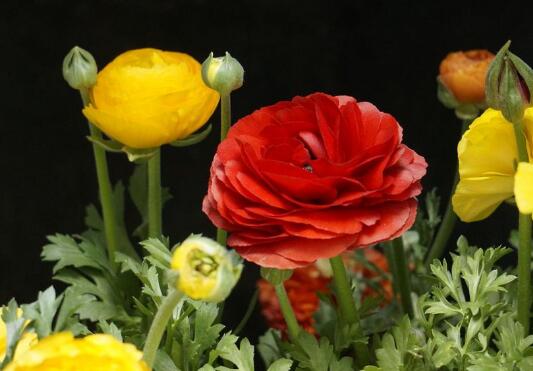
To know how to care for Persian buttercup, we first need to understand its growth habits. This plant prefers a cool and semi-shaded environment and is rather intolerant of heat, so in summer we need to pay attention to temperature control. In addition, daily watering and fertilizing are also points that need attention. The details are below, so let us take a look.
2. Growing methods and precautions for Persian buttercup
1. Soil: slightly alkaline soil
Before growing Persian buttercup, we first need to choose the soil, just like laying a good foundation when building a house; this is the step of laying a solid foundation. Generally, it is best to choose loose, fertile, well-drained neutral or slightly alkaline soil, in which it can grow better.
2. Fertilizing: once every 10 days during the growth period
Fertilizer is a relatively important nutrient in the growth process of Persian buttercup, especially after it enters the growth period, when its demand for fertilizer is very high, and it basically needs fertilizing once every 10 days. However, when fertilizing, there is one point we need to note: the fertilizer must first be diluted with water, because if the concentration is too high it can easily burn the plant.
3. Temperature: 20°C during the day / 7-10°C at night
When growing Persian buttercup, keeping it growing at a suitable temperature is very important. It is rather averse to heat and also afraid of cold. The suitable temperature during the day is around 20°C, while at night it can be kept between 7-10°C, so that it can grow better.
4. Water: avoid waterlogging
Throughout the entire growth period of Persian buttercup, it must not lack water. From sprouting to blooming, we need to keep it with sufficient moisture so that it can grow better. After it enters the flowering period, its demand for water becomes even higher, and we should often keep the soil moist to ensure its flowers are plump and vivid. But we need to control the amount of watering, and remember not to cause waterlogging, otherwise it can easily lead to root rot.
5. Light: avoid strong light
Persian buttercup prefers a cool and semi-shaded environment and is rather averse to strong light, so when growing it we should best place it in a spot with scattered sunlight. In summer, when the light is relatively strong, we should move it to a semi-shaded indoor spot to avoid scorching the plant.
6. Pests and diseases: deal with them promptly
In the process of growing Persian buttercup, if we are not careful enough, pests and diseases can easily take advantage of the opportunity. Such problems are extremely harmful to the plant, so when we discover them we must deal with them promptly, because the longer it drags on, the harder it is to handle. For specific treatment methods, you can refer to the article on pest and disease control for Persian buttercup, which has detailed introductions.
Persian buttercup: growing methods and precautions for Persian buttercup
Home propagation methods for Persian buttercup
Home propagation methods for Persian buttercup include: tuber propagation, division propagation, seed propagation and tissue culture propagation, etc. When growing Persian buttercup at home, we generally use tuber and division propagation.
Seed propagation has relatively high requirements and is more suitable for field planting and breeding, for mass propagation of Persian buttercup. Next, the editor will mainly introduce the tuber and division propagation methods for Persian buttercup.
Tuber division propagation
The tuber division propagation method for Persian buttercup can be said to be the most suitable method for home flower growing. Propagation by this method has the advantages of a short growth cycle, early flowering, large plants and many flowers, and the biggest advantage is that it is easy to cultivate.
The disadvantages are also very obvious: a relatively low division propagation coefficient and slightly slow propagation speed, etc. There is no way to produce it on a batch or large scale, so it is only suitable for home growers.
The best time for division propagation is September-October. Take out the Persian buttercup root tubers that went dormant and spent the summer, remove the soil, and then pull them apart along their natural growth direction. Each piece must have a section of fibrous roots, as well as several new buds and small root tubers.
Soak the root tubers in a 1% potassium permanganate solution for 3-5 minutes to disinfect and sterilize them, then plant them after drying slightly.
For Persian buttercup tuberous roots that have been lifted from the pot and gone dormant through the summer, in order to prevent the tuberous roots from rotting and to achieve uniform sprouting, they need to be treated for sprouting after disinfection: choose a shaded, ventilated, rain-sheltered place, spread a 5cm thick layer of clean wet river sand, insert the tuberous roots upside down in the wet sand, burying only the sprouting part, with the rest exposed.
Spray cold water frequently to keep the river sand neither dry nor waterlogged; at the same time, spray once a week with an 800-fold dilution of 50% carbendazim wettable powder for disinfection, to prevent the tuberous roots from rotting.
After the tuberous roots slowly absorb water and swell at low temperature, plant them when the buds begin to move, about the size of a grain of rice, and new roots appear, about 20 days later. Do not plant too deep; just bury the root crown.
Too deep is not good for leaf emergence; too shallow is not good for root development. Control watering before emergence and keep the soil moist; after the seedlings are all up, gradually increase the amount of watering.
Seed propagation
Raising seedlings:
The normal sowing period for Persian buttercup is from mid-October to mid-November. Put the Persian buttercup seeds in water for one day, then take them out, wrap them in gauze, and place them in an incubator to promote germination, at a suitable temperature of about 15°C. Take them out every morning and evening and rinse them once each time with clean water, then drain the water so the seeds remain moist.
About 7 days after germination promotion, some seeds begin to sprout, and at this point they can be sown immediately.
After the sprouted seeds are suitably dried, mix them evenly with an appropriate amount of yellow sand, then sow them in flower pots or a courtyard. For covering soil, mix peat and perlite at 1:1, with a thickness of 0.2-0.3cm being suitable.
For seed propagation of Persian buttercup, choose well-drained soil and carry it out in an environment with good ventilation and light transmittance. Strengthen protection of the sowing environment to avoid the threat of wind, rain and other weather disasters as well as pests and diseases.
After sowing, it usually takes one week for seedlings to emerge. At this time, keep the soil moist and replenish water in time to ensure smooth emergence of seedlings.
Planting out:
Plant out when the Persian buttercup seedlings grow to 3-4 true leaves, around mid-December to mid-January.
Persian buttercup prefers a slightly acidic environment, so it is advisable to choose loose, fertile sandy loam.
Usually mix garden soil, sandy soil and decomposed cake fertilizer (chicken manure) at a ratio of 5:3:1, or mix the same soil, leaf mold and decomposed organic fertilizer at a ratio of 4:2:1. For planting out, the plant and row spacing is about 10cm, and the depth should be such that the crown is not buried.
Care precautions for Persian buttercup
Persian buttercup is suitable for planting in well-drained, fertile, loose sandy soil, with a pH value of 6-7.5.
Persian buttercup likes moisture, fears waterlogging and is afraid of drought. During the growing period it must not lack water, but it should not be too wet either, and at the same time avoid pouring water on the leaf surface, otherwise it will cause disease.
Persian buttercup likes a sunny environment and a cool climate, but the temperature must not be lower than 10°C, nor higher than 25°C.
Persian buttercup likes fertilizer; pay attention to topdressing during the growth period. At the beginning, apply a light fertilizer once every 10 days, and later, as the seedlings grow, gradually increase the amount and concentration.
Persian buttercup avoids direct strong light. Potted plants should be placed in a lightly shaded, fresh environment, protected from drought, waterlogging and dust pollution, and the potting soil and surrounding environment should often be kept moist.
If the potting soil has a high organic matter content, only apply 1 to 2 times a thin liquid fertilizer mainly of phosphorus and potassium fertilizer around the bud stage.
After flowering, cut off the spent flowers at any time, then apply 1 to 2 times liquid fertilizer to nourish the roots, and control water appropriately so it safely enters summer dormancy.
If planting Persian buttercup in a courtyard, the plant and row spacing is 15cm-20cm. For potted plants, plant one tuber in a small pot and two tubers in a large pot. In warm regions it can overwinter outdoors, but in cold regions it needs to overwinter indoors.
The potting soil should be kept in a semi-dry state to prevent the tubers from rotting.
In the vigorous growth period in spring, it should often be kept moist, but during the flowering period the soil should be slightly dry, and apply 1-2 times liquid fertilizer. In summer it enters dormancy; after harvesting the tubers, they should be fully dried and placed in a ventilated, dry place, otherwise they rot very easily.
How to grow Persian buttercup? Growing methods and precautions for Persian buttercup
Persian buttercup is a perennial herbaceous plant of the genus Ranunculus in the family Ranunculaceae. It has a low, upright plant shape and beautiful, varied flowers, with high ornamental value, and is a famous ornamental flower. Nowadays, Persian buttercup has become an indispensable ornamental flower indoors and is deeply welcomed by consumers. So, how to grow Persian buttercup? The growing methods and precautions for Persian buttercup are introduced below.
Image: Persian buttercup
1. Growing methods for Persian buttercup
1. Soil:Persian buttercup likes well-drained, fertile, loose neutral or slightly alkaline soil, and sufficient base fertilizer should be applied when planting. For potted plants, a sandy culture soil rich in humus, loose and fertile, with strong permeability is required. You can use 2 parts garden soil, 1 part leaf mold and 1 part barnyard manure as the potting soil.
2. Light:Persian buttercup is not tolerant of strong light and likes a semi-shaded environment. In winter, light should be sufficient. In spring, as the temperature rises and the light intensifies, it should be moderately shaded and ventilation strengthened. In addition, Persian buttercup is a long-day plant, and its flowering period can be controlled according to this characteristic.
3. Watering:Persian buttercup likes moisture and fears waterlogging, and is relatively drought-tolerant, but should not be overly dry. After planting out, the first watering should be thorough, and afterward watering should be timely and balanced, and it must not be too dry or too wet. The degree of watering should be such that the soil surface is dry while the leaves do not show wilting.
Image: Persian buttercup
4. Fertilizer:Before planting out Persian buttercup, choose decomposed cake fertilizer or livestock manure and other organic fertilizers as base fertilizer, and spread them evenly. After transplanting, start topdressing when the plant has clearly grown or produced new leaves. In the early stage, mainly use urea, and in the later stage, mainly use compound fertilizer, applying once every 7 days.
5. Temperature:Persian buttercup likes a cool environment, with the optimum growth temperature during the day being 15-20°C, and 7-8°C at night. The temperature must not be too high or too low, and the day-night temperature difference must not be too large either, otherwise the growth and development of Persian buttercup will be affected, which in turn leads to a decline in the number and quality of its flowers.
6. Pests:During the growth period of Persian buttercup, if it is hot and humid, it easily causes the plant to grow leggy, develop yellow leaves and stem base rot. The main pests are root maggots and leaf miners, which can be killed by spraying with a 1000-fold dilution of 40% omethoate emulsifiable concentrate; for root rot, irrigate with a 1000-fold dilution of 50% benlate wettable powder.
7. Pruning:Persian buttercup is a flowering plant with a graceful plant shape and bright flower colors, and it grows relatively quickly. In the early bud stage, keep 3-5 robust buds per plant and remove the rest. At this time the potting soil should be slightly dry. After flowering, if seeds are not needed, promptly cut off the spent flowers.
Image: Persian buttercup
2. Precautions for growing Persian buttercup
Persian buttercup is suitable for planting in well-drained, fertile, loose sandy soil, with a pH value of 6-7.5; Persian buttercup likes moisture, fears waterlogging and is afraid of drought. During the growing period it must not lack water, but it should not be too wet either, and at the same time avoid pouring water on the leaf surface, otherwise it will cause disease; Persian buttercup likes a sunny environment and a cool climate, but the temperature must not be lower than 10°C, nor higher than 25°C; Persian buttercup likes fertilizer; pay attention to topdressing during the growth period. At the beginning, apply a light fertilizer once every 10 days, and later, as the seedlings grow, gradually increase the amount and concentration; Persian buttercup avoids direct strong light. Potted plants should be placed in a lightly shaded, fresh environment, protected from drought, waterlogging and dust pollution, and the potting soil and surrounding environment should often be kept moist; if the potting soil has a high organic matter content, only apply 1 to 2 times a thin liquid fertilizer mainly of phosphorus and potassium fertilizer around the bud stage; after flowering, cut off the spent flowers at any time, then apply 1 to 2 times liquid fertilizer to nourish the roots, and control water appropriately so it safely enters summer dormancy; if planting Persian buttercup in a courtyard, the plant and row spacing is 15cm-20cm. For potted plants, plant one tuber in a small pot and two tubers in a large pot. In warm regions it can overwinter outdoors, but in cold regions it needs to overwinter indoors; the potting soil should be kept in a semi-dry state to prevent the tubers from rotting. In the vigorous growth period in spring, it should often be kept moist, but during the flowering period the soil should be slightly dry, and apply 1-2 times liquid fertilizer. In summer it enters dormancy; after harvesting the tubers, they should be fully dried and placed in a ventilated, dry place, otherwise they rot very easily.
[Editor's concluding remarks]Persian buttercup likes moisture and fears waterlogging, and is not tolerant of strong light, so special attention is needed during care. The above has introduced the growing methods and precautions for Persian buttercup; have you all understood them?