How to train climbing roses to climb? A deep analysis from two aspects
Climbing roses are highly ornamental flowering plants, and many people across every region of our country grow them. However, as more and more people grow climbing roses, questions about how to train them to climb have also become a concern. So how do you train climbing roses to climb? Let's take a look below.
I. How to train climbing roses to climb
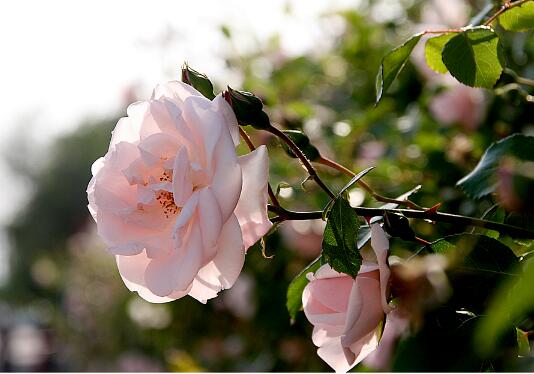
How to train climbing roses to climb really comes down to two main aspects: pruning and training the canes to climb. As long as you master the correct methods, it is actually quite easy to do. The specific steps are described in detail below, so let's take a look.
II. How to prune climbing roses
1. Pruning flowering canes
When pruning the canes of climbing roses, if you find that a cane has already bloomed, you need to be careful: cut back the vigorous flowering canes, leaving just 2-3 buds on them, which will also prepare the plant for blooming again.
2. Pruning non-flowering canes
When pruning canes of climbing roses that have not flowered, it is generally best to cut off the topmost section of the cane tip. If you see many flowering canes at the very top, then you should prune at the main stem, cutting away all of its flowering canes.
3. Pruning old canes
For old canes of climbing roses that have grown for more than 2 years, new canes will grow from them. So when pruning, apart from the growth points of the new canes, you need to cut away all those old canes. After such pruning, the new canes will replace the old ones and continue growing as the new main stems.
III. How to train climbing roses to climb
1. Choosing a support
If we want climbing roses to climb, then we must train them. Before training, we first need to choose a support, that is, a frame for creating the shape. Of course, if you want to train them onto a fence or a trellis net, then no support is needed; other ordinary locations generally do need one, and usually a simple support will do.
2. Planning the training direction
When planning the climbing direction, it is generally best to place the longer canes at the top and the shorter canes below, then keep the left and right canes balanced. When training, try to follow the direction of its growth, as this gives better results.
3. Adjusting the overall layout
Once the training direction is fixed, we need to observe its overall layout and the position of each cane, and check whether the distances between them are appropriate. If not, we need to loosen them and readjust. Don't worry about the trouble in this process; keep adjusting until you are satisfied, so that the climbing goes more smoothly.
The difference between climbing roses and Rosa multiflora, and how to train climbing roses to climb
Climbing roses are a profusion of blooms, with large, exceedingly beautiful flowers. But many people easily confuse climbing roses with Rosa multiflora. So what is the difference between climbing roses and Rosa multiflora? And how do you train climbing roses to climb? Let's find out below.
Climbing rose picture
I. The difference between climbing roses and Rosa multiflora
1. The main stem of a climbing rose is relatively thick and sturdy and can grow upright, while Rosa multiflora cannot; it must rely on external objects, which is what people mean by saying "Rosa multiflora lies down." But climbing roses can also lie down, so how do you tell them apart?
2. Most intuitively, the flowers of climbing roses are considerably larger than those of Rosa multiflora, as big as an adult's fist (there are also special small-flowered climbing rose varieties, such as Angela), while Rosa multiflora flowers are much smaller.
3. Climbing roses have another characteristic: each cane bears only one flower, whereas Rosa multiflora bears a cluster of flowers.
Rosa multiflora picture
II. How to train climbing roses to climb
1. Prepare a support for tying the canes
A support is any kind of frame of various shapes to which the climbing rose canes are tied and attached, allowing the climbing rose to form a flower wall, flower pillar or flower archway when it blooms in the future. The flower wall (fence) is the most commonly used shape and also the simplest to create. It suits large climbing roses whose canes are thicker and harder and not easy to bend into small curves, such as 'Parade' and 'Sweet Dream'. The following training uses the flower wall as an example. If you are training onto a fence or a trellis net, there is no need to prepare an additional support; if you need to train onto a building wall, then a support is needed, for example by installing a grid, driving long nails, or running wires. Climbing roses have strong covering ability, so a simple support is enough. It is recommended to run several sturdy iron wires on the wall in a tic-tac-toe pattern to secure the few main canes, and the remaining canes can then be fixed to the canes already secured to the iron wires.
2. Plan the direction of the canes
When pruning, you should already understand the number, length and growth direction of the canes, and plan the approximate training positions of the canes: generally the long canes are trained at the top and the short canes below, keeping the left and right canes balanced, and training as much as possible along the growth direction of the canes.
After the first round of training and tying, step back to a farther position and observe the overall layout after training, the position of each cane, and whether the distances between them still need adjustment. If not suitable, loosen and adjust again; sometimes all the trained canes are loosened for a second or even a third round of training and tying.
Climbing rose picture
The above isthe difference between climbing roses and Rosa multifloraandtraining climbing roses to climb, and we hope after reading you can share it about climbing roses and Rosa multiflora.
How to grow climbing roses? Climbing rose cultivation techniques
Climbing roses are also called climbing rose, vine rose, and so on. Their flower language is dangerous beauty, the flowering period is May to September, and the fruiting period is August to October. The place of origin is China, and they are now cultivated in many places. Climbing roses have varied flower forms, brilliant colors and a long flowering period, with excellent ornamental value. In gardens they are often used to climb various flower stands and corridors, and can form landscapes such as flower pillars, flower walls, flower seas and arches.
Climbing roses can reach 3-4 m in height. They have no climbing organs themselves, so they need artificial trellising or tying to train them upward. The fruit is red-yellow, and the seeds are achene-like and dark brown. Climbing roses like sunlight, are cold-resistant and drought-resistant, and grow well in fertile, loose, moist soil with good drainage. Below, we will tell you about the cultivation techniques for climbing roses.
Climbing rose cultivation techniques
(1) Propagation technique: Climbing roses are mostly propagated by grafting. Select well-growing wild Rosa multiflora as rootstock and store it in sand, then in February to March of the following year cut branches of excellent varieties as cuttings, graft them using the U-shaped graft method, and strengthen management after grafting, keeping the relative air humidity at 75-80%.
(2) Planting technique: In early spring or late autumn, choose fertile, loose soil with good drainage for bare-root planting. At a row spacing of 1.5 x 2 m, dig planting holes 50 cm in diameter and 30 cm deep. After planting, fill in soil and firm it, then water thoroughly. In summer, appropriate shading is needed, and during the growing period apply fertilizer once every 10 days. Set up a support in time, and manually train and tie the canes onto the support. After flowering or before flower bud differentiation, cut off diseased, pest-damaged, overlapping and aging canes to favor the growth of new canes.