Water the Variegated Spider Plant (Chlorophytum comosum 'Vittatum') once every 2-3 days, and fertilize once every 10-15 days.
The Variegated Spider Plant, a very beautiful foliage plant, has leaves that stay green all year round, drooping gently like weeping willows on both sides, with yellow-white longitudinal stripes in the center, looking both attractive and elegant. In everyday life, many households grow a Variegated Spider Plant, which shows how beautiful it can be when well cared for; special attention must be paid to water and fertilizer. So how do you water and fertilize a Variegated Spider Plant? Today the editor will solve this problem for everyone.
I. How to water and fertilize a Variegated Spider Plant, timing/frequency
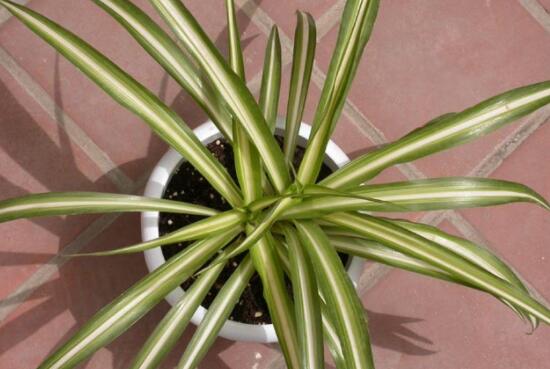
As a premium variety among spider plants, the Variegated Spider Plant is not easy to grow, especially regarding water and fertilizer, where the amount must be carefully controlled. As for how to water and fertilize a Variegated Spider Plant, since watering and fertilizing are skilled tasks, watering and fertilizing at the right time and in the right amount is crucial. For specific requirements, let's read on.
(1) How to water a Variegated Spider Plant
The Variegated Spider Plant likes a moist environment and can grow better when the potting soil stays moist for a long time. So to keep the potting soil moist, growers must water frequently; however, the Variegated Spider Plant dislikes waterlogging, so the soil must have good drainage. Next, let's take a look at the watering schedule for the Variegated Spider Plant.
1. Watering in spring and autumn, once every 2-3 days
The Variegated Spider Plant likes a warm environment, so spring and autumn, when the temperature is suitable, are its growing seasons, and watering is generally done once every 2-3 days.
2. Watering in summer, once a day
Summer temperatures are high and water evaporates quickly, so the watering interval for the Variegated Spider Plant should be shortened, ideally once a day. However, when watering in summer, note that watering should be sufficient, and around noon and in the evening you should also spray water on the branches and leaves to prevent the leaves from drying out.
3. Watering in winter, reduce watering
Winter temperatures are low and water evaporates slowly, so the watering interval for the Variegated Spider Plant should be extended, with watering once a week being sufficient. However, the specifics still depend on the condition of the potting soil; in general, keep the potting soil moist.
(2) How to fertilize a Variegated Spider Plant
It is understood that the Variegated Spider Plant is a foliage plant that tolerates fertilizer relatively well. When first planted, fertilizer and water must be sufficient; during the growing season, apply a compound fertilizer once every 10—15 days; if grown outdoors, you can apply diluted, well-rotted cake fertilizer water, human urine and manure, etc.
Note: Once fertilizer is lacking, it easily scorches at the tips and ages, leading to symptoms of yellowing leaves in the Variegated Spider Plant; but too much fertilizer is also not good, as it can cause symptoms such as root rot in the Variegated Spider Plant and withered leaves.
Overall, the Variegated Spider Plant has strong benefits, but to bring out its greatest effect, you must pay attention to watering and fertilizing, and it is best to follow the requirements above. That is all the editor has to share about the watering and fertilizing methods for the Variegated Spider Plant, and I hope it helps everyone.
Variegated Spider Plant Chlorophytum comosum Variegated Spider Plant guide: how to grow a Variegated Spider Plant / how to propagate a Variegated Spider Plant
Variegated Spider Plant profileVariegated Spider Plant Chlorophytum comosum
Aliases:
Classification: herbaceous flower
Family and genus: Plantae, Angiosperms, Monocotyledons, Asparagales, Asparagaceae, Chlorophytum
Full bloom period: spring and summer
The Variegated Spider Plant, Latin scientific name: Chlorophytum comosum, is a perennial evergreen herb of the genus Chlorophytum in the family Asparagaceae, a common ornamental flower that is now widely cultivated. An evergreen perennial herbaceous plant with rhizomes underground, slender leaves that are linear-lanceolate, with yellow-white longitudinal stripes in the center, clasping at the base, bright green. Stolons emerge from the leaf axils, extend out of the clump, curve outward, and bear small plantlets with aerial roots at the tips. Flowers are white, with 6 tepals, blooming in spring and summer. Flower meaning: "Helpless yet giving hope." It is a common green plant for office and home bonsai.
How to grow and care for a Variegated Spider Plant, precautions, and an introduction to the Variegated Spider Plant
The Variegated Spider Plant, Latin scientific name: Chlorophytum comosum, is a perennial evergreen herb of the genus Chlorophytum in the family Asparagaceae, a common ornamental flower that is now widely cultivated. An evergreen perennial herbaceous plant with rhizomes underground, slender leaves that are linear-lanceolate, with yellow-white longitudinal stripes in the center, clasping at the base, bright green. Stolons emerge from the leaf axils, extend out of the clump, curve outward, and bear small plantlets with aerial roots at the tips. Flowers are white, with 6 tepals, blooming in spring and summer. Flower meaning: "Helpless yet giving hope." It is a common green plant for office and home bonsai.
Morphological characteristics of the Variegated Spider Plant
The Variegated Spider Plant is an evergreen perennial herb with rhizomes underground that are fleshy and short, creeping horizontally or growing obliquely; leaves are slender, linear-lanceolate, with yellow-white longitudinal stripes in the center, clasping at the base, bright green. Stolons emerge from the leaf axils, extend out of the clump, curve outward, and bear small plantlets with aerial roots at the tips. Flowers are white, with 6 petals.
The flowering period of the Variegated Spider Plant is spring and summer.
Ecological habits of the Variegated Spider Plant
The Variegated Spider Plant likes warmth and humidity, likes partial shade, and avoids blazing sun in summer; it has relatively high requirements for soil and prefers loose, fertile, sandy soil. At a room temperature of 20°C, the stems and leaves grow rapidly, and the winter temperature must not be lower than 5°C. The flowering period is between spring and summer. Spider plants like a warm, shady, and humid climate and are suited to long-term growth in a moist, semi-shaded environment. Spider plants have poor cold resistance and also dislike a hot growing environment, so shade must be provided in summer and warmth must be maintained in winter.
Cultivation techniques for the Variegated Spider Plant, key cultivation points
The Variegated Spider Plant likes warm, humid, and semi-shaded environments. It is not very strict about light intensity. Its vigorous growth period is roughly from March to September, and as long as the winter temperature is not below 7°C, it can grow normally. It grows relatively well under constantly moist conditions. Because it has fleshy roots, it can endure a period of dryness, so watering should alternate between dry and moist; in spring and autumn, water generally once every two to three days, in summer generally once a day, and in winter when the plant grows slowly, reduce the amount of water appropriately. A dry environment with air humidity that is too low often causes the leaf tips to dry out, affecting growth and ornamental effect, so regular spraying to raise air humidity is more beneficial for growth. During the vigorous growth period, the Variegated Spider Plant can be fertilized once every half month; for outdoor cultivation, you can apply diluted, well-rotted cake fertilizer water or human urine and manure; for those placed indoors, you can apply some compound fertilizer. Generally, repot once every one to two years, and the potting soil can be loose, fertile, well-drained sandy soil.
Changing soil and repotting
In the management of potted spider plants, to achieve lush stems and leaves, the soil should be changed and the pot replaced once every year in March. If the pot is relatively deep and the base fertilizer is sufficient, repotting once every two years is fine. When repotting, knock the plant out of the pot, cut off dead and rotten roots and excess roots, replace with new culture soil rich in humus, and then apply livestock hoof and horn pieces or well-rotted cake fertilizer as base fertilizer. After planting, place it in a semi-shaded, warm place to recover. The most suitable growth temperature for spider plants is about 25°C. After the plant recovers robust growth, hang the pot under a corridor eave or in a suitable indoor position. Generally, the height should be such that it does not bump your head, and attention should be paid to ventilation.
Appropriate light
The Variegated Spider Plant likes a semi-shaded environment. In spring and autumn, avoid direct strong sunlight; in summer, when sunlight is especially strong, it can only receive some slanting light in the morning and evening, and during the day 50%-70% of the sunlight needs to be blocked, otherwise the leaf tips will dry out. Variegated varieties are especially afraid of strong sunlight; the Golden-edged Spider Plant grows even more beautifully in weak light, with the yellow edges more obvious and the leaves more glossy. But in winter it should receive more sunlight to keep the leaves tender and fresh green. Household potted spider plants should be placed in front of a south-facing window, otherwise the leaves will lose their luster or even wither.
Moderate fertilization
The Variegated Spider Plant is a foliage plant that tolerates fertilizer relatively well. If fertilizer and water are insufficient, it easily scorches at the tips and ages, the leaves turn yellow, and it loses ornamental value. From late spring to early autumn, apply organic fertilizer liquid once every 7-10 days, but for variegated varieties such as Golden-edged and Variegated Spider Plants, less nitrogen fertilizer should be applied to avoid the variegation fading or even disappearing, which affects appearance. You can appropriately apply organic fertilizer made by composting bone meal, eggshells, etc.; after full fermentation, take an appropriate amount of diluted liquid and apply it once every 10-15 days, which can make the variegated leaves bright and vivid.
Appropriate watering
The Variegated Spider Plant likes a moist environment, and the potting soil should be kept moist regularly. In summer, watering should be sufficient, and around noon and in the evening you should also spray water on the branches and leaves to prevent the leaves from drying out. Indoors there is often a lot of dust; if a spider plant accumulates too much dust, it not only affects its growth but also damages the fresh, bright appearance of the branches and leaves, so the branches and leaves should be sprayed and washed frequently to keep them bright and beautiful. Dead leaves and yellow leaves at the lower part should be removed at any time, and normal humidity should be maintained at ordinary times; it should not be too dry or too wet.
Propagation methods for the Variegated Spider Plant: division propagation
The Variegated Spider Plant is commonly propagated by division. In March of spring, that is, before leaving the greenhouse, separate the clustered old plants and replant them; or cut off the small plantlets on the stolons and cultivate them, and they can also quickly grow into large plants.
The Variegated Spider Plant likes fertilizer very much, so during cultivation, fertilizer and water must be sufficient. During the growing season, apply a top dressing once every 10 days. If fertilizer and water are insufficient, the leaves easily turn yellow, the leaf tips turn yellow and dry, and growth is poor. Except in winter, it can grow outdoors and can also be cultivated in ordinary rooms. Pay attention to cleaning the plant and keeping it neat. It likes partial shade in spring and autumn, avoids the midday blazing sun in summer, and needs more sunlight in winter; if there is insufficient sunlight in winter, the leaves will turn yellow and dry.
Disease and pest control for the Variegated Spider Plant
The Variegated Spider Plant has relatively few pests and diseases, mainly physiological disorders, with yellowing at the front ends of the leaves, so fertilizer and water management should be strengthened. Check frequently and promptly remove scale insects, whiteflies, etc. on the leaves. Spider plants are not prone to pests and diseases, but if the potting soil is waterlogged and ventilation is poor, besides causing root rot, root rot disease may also occur. You can irrigate the roots with a 500-800 times dilution of carbendazim wettable powder once a week, and using it 2-3 times in a row is sufficient.
The Variegated Spider Plant likes warm, humid, and semi-shaded environments and is not cold-tolerant; its cold tolerance is somewhat poorer than that of ordinary green spider plants. It fears high temperatures and strong sunlight exposure, and is also not tolerant of drought, saline-alkali soil, or waterlogging. The suitable growth temperature is 13-28°C, and the winter ambient temperature should not be below 7°C. After Frost's Descent, the lowest morning temperature may already be close to 4°C; such temperature conditions will bring obvious cold damage to Variegated Spider Plant plants. Although it may not show immediately at the time, after being moved indoors, due to insufficient light, dry air, relatively high room temperature, poor ventilation, and other reasons, Variegated Spider Plant plants that have already suffered cold damage will inevitably show features such as green stripes turning yellow and leaf edges turning brown. However, as long as the fleshy root system has not rotted and died due to cold damage, move it to a brightly lit place, control watering of the potting soil, increase foliar spraying, and before taking it outdoors the following spring, repot and change the soil, while pruning away leaves that have withered and died; by strengthening fertilizer and water management, the plant can quickly recover vigorous growth. Household potted spider plants, under ordinary circumstances, also often tend to show phenomena such as dry leaf tips and leaves gradually losing their luster.
Distribution area of the Variegated Spider Plant
The Variegated Spider Plant is native to South Africa, is a common ornamental flower, and is widely propagated by division and planted.
Dietary or medicinal value of the Variegated Spider Plant
The medical information and health dietary information on Huahu.com is for reference only and cannot be used as a basis for diagnosis or medical treatment. Any health issues should be consulted with professional medical staff, and treatment for any disease should follow a doctor's advice.
Ultimate flower care mission: love yourself, start from reality, and strictly follow a doctor's advice. For illness, do not be careless, do not delay, do not give up hope, face it bravely, use love to warm the silent world, and use your heart to care for the flower field within.
The Variegated Spider Plant has high medicinal value, and the whole plant can be used as medicine. It has the effects of nourishing yin and moistening the lungs, clearing heat and resolving phlegm, relieving cough and expelling phlegm, and activating blood circulation. It can be used to treat fever and respiratory infections, lung heat or lung yin deficiency, cough, hematemesis and hemoptysis, and other conditions. In addition, it can also be decocted and taken to treat oral conditions such as pharyngitis.
Garden uses and landscape uses of the Variegated Spider Plant
The Variegated Spider Plant is an excellent indoor hanging foliage plant. It can be planted in crevices along roadside stones, or used to accent water-and-stone or tree-stump bonsai, all with distinctive charm.
Comparison: Variegated Spider Plant: yellow-white longitudinal stripes in the center of the leaf. Silver-edged Spider Plant: leaf margins green-white. Golden-edged Spider Plant: leaf margins yellow-white.
Functions and uses of the Variegated Spider Plant: environmental value
The Variegated Spider Plant has a very good air-purifying effect. It can absorb harmful gases in the air such as carbon monoxide, carbon dioxide, formaldehyde, and benzene; in addition, the scent emitted by spider plants can also kill pathogens in the air.
Flower meaning of the Variegated Spider Plant
Helpless, yet still hopeful.
Origin of the flower meaning
"Helpless yet giving hope" comes from a legend. Once upon a time there was a chief examiner who was jealous of talent and resented able people. He always paid special attention to anyone talented, and when the examination came, he made things especially difficult for them.
One year, he learned that an examinee named Lin Dexiang was very talented. After the examination ended, he collected all the papers with the surname Lin, and sure enough there was one named Lin Dexiang whose essay was very well written; compared with his own godson's paper, the difference was like heaven and earth. He thought it over and over, and resolved to suppress the one surnamed Lin and let his godson come out on top.
So he began to mark Lin Dexiang's paper. At that moment, someone came to report that the emperor was visiting incognito. In his panic, the chief examiner hid the paper among the lush orchids in the pot on his desk. The emperor was welcomed in, and after finishing official business, he saw the orchid on the desk, with luxuriant branches and leaves and blossoms competing in beauty, and wanted it. The chief examiner had no choice but to give it to the emperor. When the emperor returned to the palace and was about to carefully admire the orchid, unexpectedly the orchid's stems and leaves all bent down and spread apart, revealing that paper. After reading the paper, the emperor thought this examinee was an outstanding talent of exceptional ability beyond the crowd, and after thinking it over carefully, he understood the mystery within.
He then sent someone to summon the chief examiner before the hall, not only dismissed him from office, but also "bestowed" that potted flower on him. The chief examiner was both ashamed and furious, and died not long after. From then on, the stems and leaves of this kind of orchid never stood upright again, and gradually evolved into today's spider plant; and its flower meaning, "Helpless, yet still hopeful," is also derived from this meaning.
Variegated Spider Plant pictures
What to do if the leaves of the Variegated Spider Plant wither: suitable light / moderate watering / reasonable fertilization
As the most outstanding among spider plants, the Variegated Spider Plant has powerful benefits, but what leaves the deepest impression is still its beautiful leaves, like a green waterfall pouring down, just like a fairy descending to earth, extremely beautiful. So when the leaves of the Variegated Spider Plant wither, growers must be very anxious! To solve this problem, the editor summarized 4 causes; let's take a look together.
I. When the leaves of the Variegated Spider Plant wither, find the cause
As a common potted plant, the Variegated Spider Plant is not simple to grow, and with the slightest negligence it will show various problems, such as yellowing leaves in the Variegated Spider Plant and withering leaves in the Variegated Spider Plant, seriously affecting the plant's ornamental quality. As for what to do when the leaves of the Variegated Spider Plant wither? Overall, it is reflected in light, watering, fertilization, and humidity. Let's look at the specifics below.
II. Causes of withering leaves in the Variegated Spider Plant and solutions
1. Improper light
① Insufficient light: The Variegated Spider Plant likes a semi-shaded environment, and during growth it cannot lack light. Once it is in a dark environment for a long time, the Variegated Spider Plant will, due to insufficient photosynthesis, fail to get enough nutrients, causing the leaves to wither. Solution: Very simple, just supplement light, but the light cannot be too strong; diffused light is sufficient.
② Light too strong: The Variegated Spider Plant avoids direct strong light. In summer, once it is placed under the strong sun, its leaves will wither due to sunscald. Solution: Move it to a spot with diffused light (a shading rate of around 50% is best), let it recover for a while, then water moderately, and after a period the leaves will return to health.
2. Improper watering
① Insufficient watering: The growth of the Variegated Spider Plant cannot do without water. Once watering is too little, the leaves cannot absorb enough water for a long time, and they will slowly wither. Solution: Very simple, just supplement water, but not too much; keeping the potting soil moist is sufficient.
② Excessive watering: Although the Variegated Spider Plant likes a moist environment, watering too much causes the potting soil to become too wet, which leads to root rot in the Variegated Spider Plant, and its external manifestation may be withering leaves. Solution: Stop watering, remove it from the pot, cut off the rotten roots, change the potting soil, and replant.
3. Improper fertilization
① Insufficient fertilization: The growth of the Variegated Spider Plant needs sufficient nutrients. Once fertilization is too little and nutrients are insufficient, its leaves will wither from lack of nutrients. Solution: Very simple, just fertilize moderately. During the growing season, apply a compound fertilizer once every 20 days; mainly, do not let the fertilizer splash onto the leaves.
② Excessive fertilization: During the growth of the Variegated Spider Plant, sufficient fertilizer can make the leaves greener and more attractive, but once fertilization is excessive, it will cause root burn, and the result is that the leaves cannot absorb water and nutrients and wither. Solution: Irrigate with water to dilute the fertilizer; in severe cases, remove it from the pot, cut off the rotten roots, and then replant.
4. Improper humidity
Besides the above points, withering leaves in the Variegated Spider Plant may also be caused by humidity. It is understood that the Variegated Spider Plant is very sensitive to air humidity; once indoor humidity is too high or too low, it will affect plant growth and lead to leaf withering.
Solution: In summer and autumn, indoor air is relatively dry, so at this time spray water on the plant's leaves and surroundings to increase air humidity, so that the plant grows vigorously.