Is clematis prone to pests? Prevent and control 2 pests and 2 diseases this way
Clematis is a highly ornamental flowering plant and is fairly common in people's lives today. However, even a plant with great ornamental value will wilt if pests and diseases appear. Regarding whether clematis is prone to pests, and how to prevent and control clematis pests and diseases, the editor below will walk you through it.
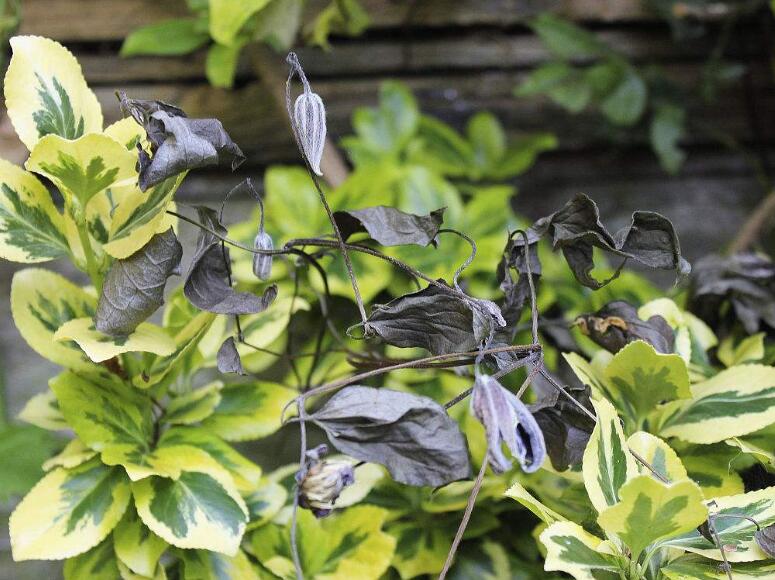
I. Is clematis prone to pests? / Improper care makes it prone to pests
As for the question of whether clematis is prone to pests, it actually still depends on the care process. If cared for properly, it is generally not prone to pests; on the contrary, if the care method is wrong, it is very prone to pests and diseases. As for how to care for it, there is a detailed explanation in the article on clematis cultivation methods, so the editor will not go into too much detail here.
II. Prevention and control of clematis pests and diseases
1. Red spider mite pest
In the prevention and control of clematis pests and diseases, the red spider mite is a relatively common pest. This pest is very small and difficult to spot with the naked eye, so it can only be judged through certain symptoms. It mainly harms the leaves of the plant. When this pest appears, the leaves will show a withered, yellow, and whitish appearance, and over time it will gradually spread to the whole plant.
Control method: The most direct way to prevent this pest is to use a 1000-fold dilution of 10% fenbutatin oxide emulsifiable concentrate for spraying and killing, generally once every 7-10 days, and about 2 times is basically enough to completely eliminate this pest.
2. Slug moth pest
The season when the slug moth pest appears most is summer, so everyone must pay attention at this time. The slug moth mainly harms the branches and leaves of the plant. It will slowly gnaw on the plant, and over time it will turn the plant into a bare stem, so it can be said to be extremely harmful.
Control method: When this pest appears, it must be discovered and dealt with early, otherwise prolonged delay will cause the plant to lose nutrients and die. To deal with it, we can use a 1000-fold dilution of 50% malathion emulsifiable concentrate to spray and control the plant.
3. Southern blight disease
Southern blight mainly harms the root and stem parts of the plant. When the disease occurs, many white hyphae appear at the root and stem, and then gradually spread, finally causing clematis to show dehydration, thus heading down the path of withering and death.
Control method: For this disease, we need to carry out root drenching treatment. Generally, a 1000-fold dilution of quintozene can be used. If discovered in time, it can basically be cured.
4. Powdery mildew disease
Powdery mildew is one of the relatively major diseases of clematis. It can generally appear when the temperature is above 20°C, so care must be done well at this time. This disease mainly harms the branches and stems of the plant. When it occurs, many white powders will appear on the branches and stems.
Control method: To prevent and control this disease, we can choose to use thiophanate-methyl to spray the plant, generally once every 7-10 days, and after 2-3 times this disease can basically be eliminated.
As for the question of whether clematis is prone to pests, friends who have read the above should already understand. In fact, if you want the plant to avoid pests and diseases, you must be careful during the care process. The editor's introduction to the prevention and control of clematis pests and diseases ends here, and I hope it can help everyone.
Key cultivation points and pest and disease control of clematis
There are many varieties of clematis, and many new clematis varieties are successfully bred every year, but some classic, highly adaptable varieties are still respected and loved by many clematis enthusiasts. Below, we will introduce the key cultivation points, pest and disease control, and application forms of clematis.
1. Key cultivation points
1.1 Planting
The roots of clematis fear waterlogging but like a cool environment, so whether clematis is planted in the ground or in a pot, the root area must be kept cool and dry. If you choose ground planting and the garden soil is relatively sticky and heavy, it is recommended to improve the soil, and media such as leaf mold, peat, perlite, and coarse sand can be used to improve soil drainage. In addition, remember to lay a layer of gravel at the bottom of the planting hole to prevent the bottom of the root system from being soaked in water for a long time. For potted clematis, you only need to buy ready-mixed planting soil with good drainage from the market for planting. To make clematis grow robustly and bloom abundantly in the future, an appropriate amount of slow-release fertilizer can be applied at planting time to ensure nutrient supply.
1.2 Watering
For ground-planted clematis, apart from the high-temperature and low-rainfall period in summer when it needs to be watered in the morning and evening, no additional watering is needed in other seasons. Potted clematis should follow the watering principle of "water when dry, and water thoroughly when watering," that is, water only after the potting soil has dried out, and when watering, make the potting soil fully moist, so that the clematis root system can grow healthily.
1.3 Fertilizing
In order for clematis to have a lush flowering season, fertilizing is an indispensable step. There are three important fertilizing stages for growing clematis. First is at the initial planting time, mix some slow-release fertilizer into the medium to provide nutrients needed for later growth and quickly grow into a robust plant. Second, after winter begins each year, apply a thin layer of organic fertilizer at the roots of clematis; seaweed fertilizer or vermicompost can be chosen to prepare for the coming year's abundant flowers. The third-stage fertilizer can be called "gift fertilizer." After the flowering period ends, scatter slow-release fertilizer on the soil surface to promptly replenish the large amount of nutrients consumed by flowering.
1.4 Pruning
Pruning of clematis is indispensable for shaping the plant and promoting flowering. The main pruning methods for clematis can be divided into three types. Type one is the no-pruning type, that is, letting it grow freely, and each year after flowering just cleaning up diseased branches and weak branches. This pruning method is mainly aimed at a large group of clematis that blooms around March in early spring. Type two is the light-pruning type, that is, in late winter and early spring, cutting clematis back to within 1 m to 1.5 m from the ground. This pruning method is mainly aimed at early-flowering varieties that bloom in April to May. Type three pruning is the heavy-pruning type. In late spring and early winter, cut all clematis branches to a height of 0.3 m to 0.4 m from the ground. In this way, clematis will send out many robust branches during the growing season, and at the same time the flowers can be kept within the best line of sight. This pruning type is suitable for late-flowering clematis varieties that bloom in May to June.
In addition, note that pruning clematis is not absolute. Certain branches can be retained or pruned according to the desired shape, ultimately creating a clematis with a unique form.
2. Pest and disease control
2.1 Leaf miner
Clematis is naturally robust and rarely suffers large-scale severe pest and disease problems. Leaf miner is a type of pest that often occurs on clematis leaves. The main symptom is gray irregular curves appearing on the leaf surface. This is because the leaf miner larvae gnaw on the mesophyll tissue inside the leaf, forming empty channels. Leaf miner does not cause great harm to the growth of clematis, but it does affect the ornamental value of clematis leaves to a certain extent. Once this symptom appears, promptly cut off the affected leaves and burn them. If the pest is relatively severe, spraying insecticide can be considered.
2.2 Wilt disease
It occurs occasionally on clematis plants. Once it occurs, the harm to clematis growth is extremely great and needs to be dealt with promptly to avoid the spread of the disease. The symptom of wilt disease is drooping leaves and branches, much like the wilting of a plant caused by lack of water, but the difference is that it cannot return to normal after watering. Once it is confirmed as wilt disease, measures must be taken promptly. Follow the affected branch toward the root and stem to find the lesion. The lesion appears as ring-shaped constriction and necrosis of the branch. Promptly cut off the branch below the lesion until the pith of the branch is seen to be green, and burn the diseased branch. For potted clematis, it is recommended to repot and replace the soil and replant. For ground-planted clematis, all soil within 15 cm around the root and stem point must be replaced and a fungicide sprayed.
3. Application forms
Clematis is extremely suitable whether for potted ornamental viewing on a balcony or for direct open-ground planting, but because it climbs by twining with stems or leaves, no matter where it is planted, it must be provided with a trellis it can climb.
3.1 Pillar type
This is the most common form of clematis trellis. You can buy ready-made trellises, including iron ones and plastic ones, or use sturdy branches pruned from the garden and make one yourself. However, note that as the seedling age increases, the branches grow relatively quickly, so when buying or making a trellis yourself, it is best to choose a sturdy one with strong load-bearing capacity, to avoid the trouble of the trellis collapsing later.
3.2 Fence and wall type
If you want to use clematis to decorate a wall, a wall-mounted trellis is a relatively good choice. Use a rectangular flower box as a container, insert a flat trellis, and then place it by the wall. For some tall courtyard walls, if you want to achieve the effect of clematis covering the wall surface, you can plant directly in the ground and fix sturdy metal mesh or metal wire on the wall to help clematis climb. With careful care, after 2 to 3 years you can have a flower wall covered with clematis.
3.3 Hanging type
This planting method is relatively suitable for evergreen clematis groups, such as 'Joe' (C. cartmanii 'Joe') and 'Pixie' (C. Pixie). Because this type of clematis plant is relatively compact and grows slowly, it can bloom well even if the branches hang down completely, making it very suitable for planting in hanging pots and arranging on a balcony. Other large-flowered clematis varieties can also be made into hanging potted ornamental plants, but because the branches will grow too long and become tangled, affecting the flowering effect and ornamental value, they are not suitable for long-term planting.
3.4 Screen type
In public landscaping, you can try combining the hanging planting method to form a flower screen covered with clematis. If this landscaping method is adopted, try to avoid using small-flowered clematis such as 'Bell Clematis.' Large-flowered clematis has better ornamental value because the flowers are eye-catching.
3.5 Ground cover
The most common ornamental method for clematis is to build a support and view it as a climber, but it also has a certain creeping habit and can also be viewed as a ground cover plant. Planting clematis in the ground on sites with slopes and undulating terrain, without any support and letting it spread and grow, is also a creative and highly ornamental planting form, relatively suitable for use in private gardens or refined public landscaping. Except for bell-type clematis and long-sepaled clematis, other types of clematis are suitable for this application form.
3.6 Corridor frame
Clematis is a type of plant that grows very vigorously and has relatively strong climbing ability. In landscaping or in conditional private courtyards, it can be planted beside a corridor frame or archway and allowed to climb. In about 2 to 3 years, with proper pruning, it can basically cover the corridor frame and form a relatively good landscape effect.
The above is all the content about clematis. If you are relatively interested in clematis, come to Huinong Network to learn more.
Clematis knowledge Pest and disease control of clematis
It is said that clematis is a plant that is easy to grow. It is said to be easy to grow because clematis can grow very well with almost no need for much care. Many flower enthusiasts have reported that clematis is difficult to grow and care for, and a large part of this is pests and diseases. So our succulent flower nursery will introduce to everyone the prevention and control of clematis pests and diseases.
Pest and disease control
Clematis has relatively strong resistance to pests and diseases. Severe pest and disease damage rarely occurs. Diseases include wilt disease, which is especially likely to occur in summer when the rain clears and the temperature rises sharply, with branches suddenly withering, and new shoots often sprouting in autumn or the following spring. Others include powdery mildew (harming leaves or flowers), viral disease (yellow spots on leaves, deformed flowers), etc., sprayed with a 1000-fold dilution of 10% antibacterial agent 401 acetic acid solution. Pests include red spider mites and slug moths, sprayed and killed with a 1000-fold dilution of 50% fenitrothion emulsifiable concentrate.
Clematis southern blight
1. Symptoms: Clematis southern blight occurs at the roots and stem base of the plant. It generally begins near the ground at the root and stem, then spreads upward and underground, and finally the entire root system of the plant is surrounded by white hyphae and the root base rots. The diseased part first appears brown and water-soaked, then the cortex rots, the plant shows dehydration symptoms, and then slowly becomes scorched and withered, as if burned by fire.
2. Control methods:
(1) Treatment and control of diseased plants
In the early stage of disease, the mycelium surrounds the outside of the root crown cortex and has not yet invaded. Dig out the plant. Some plants' roots may already be entangled by hyphae, and some fleshy roots may begin to rot. At this time, the plant can be heavily pruned leaving 1 or 2 nodes, then the roots can be cleaned in clean water, dried slightly, soaked in a 1000-1500-fold chlorothalonil solution for 1-2 min, replanted in new clean cultivation medium, and then root-drenched with a 1000-fold quintozene solution. The general control rate can reach 80%.
(2) Agricultural measure control
① Do a good job of disinfecting and sterilizing the medium. Organic fertilizer used in cultivation must be fully decomposed before use, to avoid bringing pathogenic bacteria into the cultivation medium due to the use of organic fertilizer. When new seedlings are potted, the cultivation medium should be disinfected with a 1000-fold thiophanate-methyl or chlorothalonil solution.
② Do a good job of clearing weeds at the cultivation site, arrange cultivation density reasonably, improve the ventilation and light transmission rate of the cultivation environment, and create a good field microclimate. Drain promptly when there is a lot of rain to reduce humidity, which can effectively control the probability of disease occurrence.
③ Do a good job of fertilizer and water management measures, use fertilizer reasonably, pay attention to the combined use of NPK, cultivate strong seedlings, and improve the disease resistance of the plants; clematis is mainly potted, and the cultivation medium should have good air and water permeability. A mixed medium of perlite, peat soil, and pine bark can be used, and its ratio can be prepared at 1:3:1.
3. Chemical control
The control of clematis southern blight should focus on prevention. Usually by the time it is discovered it is already very serious. In hot and humid seasons, combined with fertilizer and water management, root drenching can be carried out about every 10 d with a 1000-fold solution of thiophanate-methyl, quintozene, or tolclofos-methyl emulsifiable concentrate. If disease occurs, it can be sprayed continuously for 2-3 d, and the liquid medicine can be used to sterilize the ground surface near the diseased plant.
Wilt disease
Wilt disease is the main disease of clematis. It occurs suddenly and can cause the entire plant to shrink. Although the plant still has a good root system, spraying with carbendazim or thiophanate every 2 weeks, repeated 2-3 times, can effectively inhibit the occurrence of this disease.
Powdery mildew
Powdery mildew is another disease that harms clematis relatively often. It is prone to occur when the temperature exceeds 20°C and humidity is high. When it occurs, carbendazim and thiophanate-methyl can be used alternately every 1 week, repeated 3-4 times.