What to Do When Ixora Gets Pests? Pest and Disease Control plus Aphid and Ash Kill Methods
Ixora, a very beautiful ornamental plant, not only has a long flowering period, but also has beautiful flower shapes and rich flower colors, and is deeply loved by flower enthusiasts. Many flower enthusiasts grow Ixora in pots at home, but for certain reasons, pests often appear, which is very distressing. So what should you do when Ixora gets pests? The following is a very comprehensive guide to pest and disease control for Ixora. If you love flowers, you must take a look.
I. When Ixora Gets Pests, Spray with Pesticide
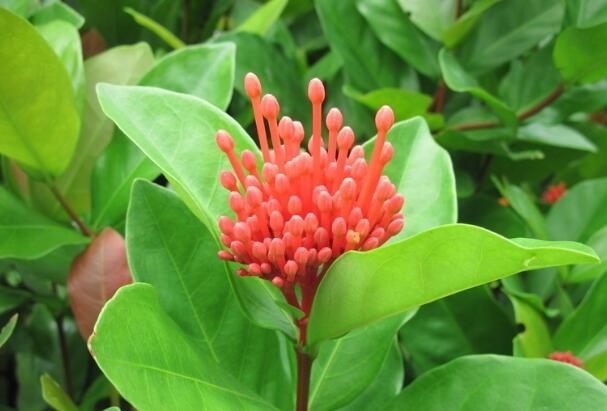
As a beautiful plant, Ixora is grown in many flower enthusiasts' homes, but if everyone does not follow the cultivation methods for Ixora, or operates improperly, it will get pests and diseases. Flower enthusiasts must be very anxious! As for what to do when Ixora gets pests, it is actually very simple. We first determine which kind of pest it is, and then solve it accordingly. Regarding pest and disease control for Ixora, the editor will discuss insect pests and diseases separately.
(1) Pests and Diseases of Ixora, 3 Insect Pests
Scale insects, red spiders, aphids
1. Scale insects
Damaged parts: This insect is one of the main pests of Ixora. It mainly harms tender leaves and sucks the sap of the flowers.
Symptoms of infestation: Ixora leaves change from green to grayish green, and finally to yellow. In severe cases, the branches and leaves are covered with scale insects, causing the entire plant to wither and die.
Solution: When there are few scale insects, they can be directly scraped off or picked off with a toothpick; if the density of scale insects is high, use 550% malathion, 40% dimethoate 0.1% solution, etc. for spraying and killing. Once scale insects occur, the harm is very great, so in daily life everyone mainly focuses on prevention.
2. Red spiders
Damaged parts: One of the main pests of Ixora. It mainly harms the underside of leaves and survives by sucking the sap of Ixora leaves.
Symptoms of infestation: The plant will become nutritionally imbalanced, and symptoms such as yellowing and even falling off of Ixora leaves may appear.
Control method: After confirming this pest, rinse the whole plant thoroughly with a large amount of water, then spray a specialized pesticide, such as 20% dicofol emulsifiable concentrate 2000 times solution, and spray several times.
3. Aphids
Damaged parts: Indoors, aphids are the main pest of Ixora. They mainly harm leaves and pierce and suck the sap of newly sprouted branches and leaves.
Symptoms of infestation: Leaves become stiff, which affects the normal growth of the plant after early spring. After flowering, the flowers are very small, or flowering is abnormal.
Control method: When there are few aphids, tobacco powder and plant ash can be sprinkled on the insects and leaves, and after about 1-2 hours, rinse clean with water; when there are many aphids, use 2.5% derris emulsifiable concentrate 1200 times solution for spraying and killing.
(2) Pests and Diseases of Ixora, 3 Diseases
Leaf spot disease, anthracnose, sooty mold
Regarding pests on Ixora leaves, after reading the above content, I believe everyone knows how to deal with it! However, in addition to being damaged by insects, diseases also constantly harm Ixora. It is understood that there are mainly 3 kinds of diseases of Ixora: leaf spot disease, anthracnose and sooty mold. The specific symptoms and control methods are as follows:
1. Leaf spot disease
Damaged parts: Leaf spot disease is a fungal disease. It mostly occurs in late autumn when the weather turns cold. It is one of the main diseases of Ixora and harms the plant's leaves.
Symptoms: Pale yellow and red-yellow spots appear on the leaves, and after expansion they become round or oval; if the environment is relatively humid, black granular matter may appear on the lesions, and in the later stage the leaves dry up and fall off.
Control method: After discovering this disease, everyone should promptly remove diseased leaves and residual water to avoid excessive water. In severe cases, use emulsifiable concentrate 1000-1500 times solution for control, or 50% carbendazim wettable powder 500 times solution, spraying 2-3 times every 7-15 days, and results can be seen after several applications.
2. Anthracnose
Damaged parts: This disease is one of the main diseases of Ixora. It mainly harms leaves. The pathogen overwinters on diseased parts or diseased leaf residues.
Symptoms: Nearly round or irregular round lesions appear on the leaf edges. As the disease worsens, the color of the lesions turns dark brown and spreads around. At this time, the center of the lesion is grayish white and the edge is dark red, which is easy to identify.
Control method: When diseased leaves are found, remove them immediately to reduce the source of disease; before onset, spray 25% carbendazim wettable powder 500 times solution, about once every 10 days, and after 3-4 sprays it is basically improved.
3. Sooty mold
Damaged parts: Another disease of Ixora. The parts it harms are branches and leaves.
Symptoms: Dark brown dirty spots appear on branches and leaves, then gradually expand, forming a large area of black soot-like fungal layer, affecting the plant's photosynthesis and thereby causing Ixora to be unable to grow normally.
Control method: When diseased branches and leaves are found, everyone can wash them with 1000 times carbendazim solution or burn them. This disease focuses on prevention. Usually everyone should strengthen indoor ventilation to reduce the air humidity in the greenhouse so as not to cause the disease to spread.
Regarding pest and disease control of Ixora, the editor has introduced it here. I believe everyone will know what to do when encountering pests or diseases in the future! Overall, during the growth process of Ixora, pests and diseases are unavoidable, so to avoid unnecessary trouble, flower enthusiasts should keep in mind the above symptoms and control methods.
Pest and Disease Control of Ixora
Leaf spot disease and anthracnose often occur, and can be sprayed with 10% antibacterial agent 401 acetic acid solution 1000 times solution. Insect pests include scale insectsHarm, and can be sprayed and killed with rosin mixture 10 times solution.
Cultivation and Pest and Disease Control of Ixora
Ixora is also known as Yingdan flower and is native to southern China. It likes high temperature, high humidity and a sunny environment. It is not cold-tolerant and tolerates partial shade. It requires acidic soil rich in humus, loose and fertile. In winter, the temperature should not be lower than 0 degrees Celsius.
Propagation: Mainly by sowing and cuttings. For sowing, collect seeds in winter, sow in spring the next year, germinate 20-25 days after sowing, and transplant when 3-4 pairs of leaves have grown. For cuttings, they can be carried out from May to October, with June to July being the best. Select semi-lignified branches, 10-15 cm long, insert them in a sand bed, and they can take root after 40-50 days.
Cultivation: Ixora should be planted in places with deep soil and sufficient sunlight. Potted plants should be repotted once every two years, and shaped and pruned, cutting off diseased branches and weak branches. Fertilize once a month during the growing season. For seedling planting, when the seedlings are 30 cm tall, pinch off the tips to encourage more side branches. In winter, pay attention to cold protection.
Pests and diseases: Leaf spot disease and anthracnose often occur, and can be sprayed with 10% antibacterial agent 401 acetic acid solution 1000 times solution. Insect pests include scale insects, and can be sprayed and killed with rosin mixture 10 times solution.
Application: Ixora has a beautiful plant shape, dense flowering, rich flower colors and a long flowering period. When planted in the open ground in the south, it is suitable for courtyards, hotels and scenic areas. As a potted plant, it is especially suitable for windowsills, balconies and living rooms.