What to Do When Mint Gets Bugs? 2 Pests and 2 Diseases and How to Control Them
When growing mint, the situation people fear most is pests and diseases, because many people do not understand these conditions well, so when they appear they are often at a loss. As for what to do when mint gets bugs and how to control mint pests and diseases, there is a detailed introduction below. Let me walk you through it.
I. What to Do When Mint Gets Bugs
To know what to do when mint gets bugs, we first need to understand which pest or disease has appeared. Just like treating an illness, only by understanding the cause can the right remedy be applied. Below are the symptoms of various pests and diseases when they appear, as well as methods for controlling mint pests and diseases. You can take a look.
II. Pest and Disease Control for Mint
1. Black cutworm pest
Symptoms: The black cutworm, also called the soil silkworm, is a type of silkworm-class insect with a black body surface. It appears more easily in moist environments, so special attention must be paid at such times. This pest mainly harms mint seedlings. It gradually damages the tender leaves of the seedlings, ultimately causing the mint to lose nutrients, wither, and die.
Control method: Because seedlings are relatively fragile, control must be carried out as early as possible. To deal with this pest, we can choose a 40% fenvalerate-killing emulsifiable concentrate at 2000-3000 times dilution for direct spray-killing.
2. Silver-marked noctuid pest
Symptoms: In mint pest and disease control, the silver-marked noctuid is a relatively common pest. It mainly harms mint leaves, gradually sucking out the sap within, which causes the leaves to turn yellow and fall off. It is an extremely harmful pest.
Control method: To deal with this pest, we can use a 10% imidacloprid wettable powder at 2500 times dilution for spray-killing. Generally, spray once about every 20 days, and after 1-2 times this pest can basically be eliminated.
3. Rust disease
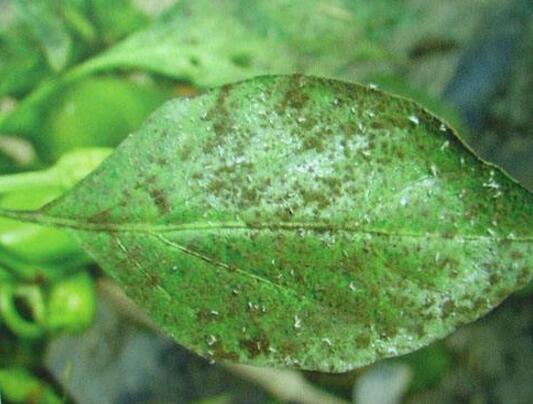
Symptoms: Rust is a plant disease caused by fungi. It mainly harms the leaves, stems, and fruits of mint. In the early stage of the disease, many small blister spots of different colors appear on the leaves, and over time they gradually spread, causing the mint to gradually wither and die.
Control method: This disease spreads very quickly, so it must be treated as early as possible. If it is late, it becomes very difficult to cure. For this disease, we can choose a 25% triadimefon at 1000-1500 times dilution to spray the plants for control.
4. Leaf spot disease
Symptoms: Leaf spot is a relatively common disease in mint pest and disease control. Its peak period is from July to September, so special attention must be paid during this period. When this disease occurs, many brown spots appear on the leaves. Over time the spots gradually spread, and the color gradually turns black, ultimately causing the mint to wither and die.
Control method: For this disease, it is best to carry out control in the early and middle stages. If it reaches the late stage, it basically cannot be controlled. In the early and middle stages, we can choose a 65% zineb at 400-500 times dilution to spray the diseased plants. Generally, spray once every 10-15 days, and after 2-3 times they can basically recover.
What Is the Flower Language of Mint? The Legend of Mint / Everlasting Love
Mint is a flower that looks rather elegant and refined, and precisely because of its elegant temperament, it is also loved by many people. Like many flowers and plants, mint has its own flower language. As for what the flower language of mint is and what legends about mint exist, let me walk you through it below.
I. What Is the Flower Language of Mint?
1. Everlasting love
As for what the flower language of mint is, it is actually related to love. Its flower language is “everlasting love,” representing that true love is eternal and will never fade. Precisely because of this flower language, mint is also loved by many couples deeply in love.
2. May I meet you again
Besides everlasting love, mint has another flower language: may I meet you again, foretelling that love becomes a destined arrangement only because of a fated encounter.
II. The Legend of Mint
The myth and legend of mint originated earliest in the region of Greece. It is said that long ago, the god of the underworld, Pluto, fell in love with the sea spirit Minthe, but Pluto already had a wife, and his wife also found out about this matter. Out of jealousy, his wife turned Minthe into a flower. After the transformation, Minthe gave off a fresh fragrance for a long time, also representing everlasting love.
III. Flower Language of Mint in Different Colors
1. White mint: everlasting love
2. Red mint: love me once more
3. Pink mint: may I meet you again
4. Purple mint: symbolizes virtue
An Introduction to Mint Propagation Methods and a Summary of Its Disease Prevention
How much do you know about mint? Mint flowers are petite and lovely, giving off a faint delicate fragrance, and are deeply loved by people. But many friends are troubled by disease control for the mint they grow at home. Today, let me walk you through mint propagation methods and a summary of its disease prevention.
Mint Propagation Methods
In production, rhizome propagation is mainly used, and seedling propagation can also be used. Mint is mainly propagated by division and cuttings.4In the middle and first ten days of the month, cut the stolons of the mother plant into sections at the nodes and plant them separately. Mint can also be propagated by digging up thick, white rhizomes and cutting them into6-10cm lengths, then covering with soil after planting3cm or so, about15-20days to sprout. Sowing is carried out in spring or autumn. Peppermint takes from germination to flowering about80-100days. After germination, initial growth is relatively slow,2-3weeks later growth speeds up. To maintain good growth, it is best to renew it every year. During the growth period it needs more nitrogen fertilizer, properly combined with phosphorus and potassium fertilizer, and also needs a large amount of water. If there is black cutworm damage, it should be controlled promptly.
Mint is mostly cultivated in open fields. In northern regions, protected cultivation can be used, or a combination of open-field and protected cultivation. The cultivation season depends on the climate of each place; generally it can be cultivated in seasons without frost. Protected cultivation can produce year-round; in northern regions, open-field cultivation can be done in4--10month.
Rhizome propagation: from lateOctober to11early month, dig up rhizomes from the seed-growing plot, select those that are white, thick, and have short internodes, cut them into10cmsmall sections, and immediately plant them into pre-dug10cmdeep furrows, with row spacing25--30cmand plant spacing15cm. After planting, cover with fine soil, rake level, and compact.
Seedling propagation
Select a field with strong plants, uniform growth, and no pests or diseases as the seed-growing plot. After the autumn harvest, immediately carry out cultivation, weeding, and topdressing1times. In early4of the following year, when the seedlings are15cmtall, pull the seedlings and transplant them. In the transplanting plot, dig holes at row spacing20cmand plant spacing15cm, planting 2 seedlings per hole. After planting, cover with soil and compact, then water with dilute manure water.
Mint Disease Control
Rust
Harms leaves and stems, and occurs frequently in rainy seasons. In addition to strengthening field management and improving ventilation and light conditions, control methods include using25%triadimefon1000--1500times dilution for leaf spraying.
Leaf spot disease (also called white star disease)
Harms the leaves,5--10occurs in month. In the early stage of the disease, promptly remove and burn them, or use75%chlorothalonil500--700times dilution for spraying.
The main pests are black cutworm and silver-marked noctuid. For black cutworm, you can use40%fenvalerate emulsifiable concentrate, fenvalerate-killing emulsifiable concentrate2000--3000times dilution to spray the root zone, or use40%isofenphos-methyl1000times dilution to drench the roots. For silver-marked noctuid, you can use50%chlorfluazuron emulsifiable concentrate per mu30--60ml mixed with water and spray, or use50%fenitrothion1000times dilution for spraying control.
The above is the introduction to mint propagation methods and a summary of its disease prevention that I have compiled. I hope it can help the many flower lovers, and please continue to follow Duorou Huapu to learn more about flower care knowledge.