What to do when magnolia liliiflora gets pests? Fertilizing is the key to pest and disease control
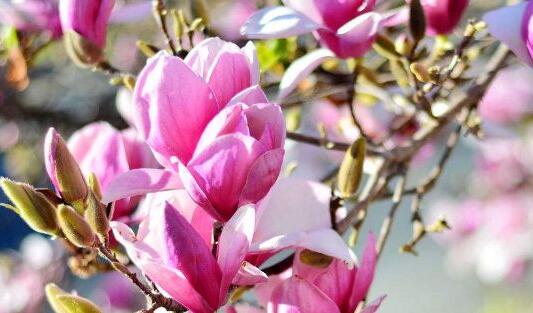
Magnolia liliiflora (purple magnolia) has very good cold resistance, so it rarely suffers from pests and diseases. However, if it is cultivated completely incorrectly, or if the environment is too harsh, pests and disease spots will often harm the purple magnolia. So what should you do when purple magnolia gets pests? Let's take a look at pest and disease control for purple magnolia.
Pest and disease control for Magnolia liliiflora (purple magnolia)
I. Diseases of Magnolia liliiflora
1. Chlorosis of Magnolia liliiflora
Main symptoms: The leaves of Magnolia liliiflora gradually turn from green to yellow. Chlorophyll gradually decreases due to the disease, and the leaves first turn yellow and then gradually turn white. The plant grows slowly, and in severe cases the plant may die. This is one of the most damaging diseases in pest and disease control for Magnolia liliiflora.
Cause: Chlorosis is generally caused by bacteria, viruses, nematodes, and so on, and can also be caused by severe nutrient deficiency, such as nitrogen deficiency, sulfur deficiency, drought, and so on.
Control measures: Strengthen cultivation management, pay attention to rational fertilization, timely watering, and so on; check the soil before planting, and if the quality is too poor, improve it through measures such as fertilization. In addition, a 0.1% ferrous sulfate solution can be sprayed on the leaves for prevention.
2. Anthracnose of Magnolia liliiflora
Main symptoms: Nearly round or irregular disease spots appear on the leaves of Magnolia liliiflora, often on the leaf margins, with a diameter of 10-20 mm. The spots are first grayish white with dark brown edges, and then dense small black dots appear.
Cause: Excessive temperature, poor ventilation, insufficient fertilization and watering, and leaves infected by Gloeosporium fungi; the small black dots are fungal masses.
Control measures: 1) Pay attention to rational care, such as scientific fertilization, watering, maintaining ventilation in the environment, and avoiding excessively high environmental temperatures; 2) When diseased plants are found, promptly spray 50% thiophanate wettable powder at 500-600 times dilution, or 50% carbendazim at 500-600 times dilution, or Bordeaux mixture at 1:2:150-200 times dilution, or 50% Tuzet at 800 times dilution.
II. Pests of Magnolia liliiflora
1. Red spider mite
In pest and disease control for Magnolia liliiflora, the red spider mite is one of the most damaging pests. After Magnolia liliiflora unfurls its leaves, it moves onto the leaves and begins damaging them from both sides of the main vein on the underside, using the leaves as its main food source.
Control measures: 1) When the leaf color looks wrong, carefully check the underside of the leaves, and if only a small number of pests are present, remove the diseased leaves as early as possible; 2) Use 40% dicofol emulsifiable concentrate at 1000-1500 times dilution or 20% clofentezine wettable powder at 2000 times dilution for spraying to eliminate the pests.
2. Psilogramma increta (privet hawk moth)
Psilogramma increta usually forages in the early morning and hides in dark places during the day. It feeds on the epidermis of Magnolia liliiflora leaves, and then the entire leaf may be eaten bare. Not only that, the plant's growth is also inhibited and flowering is reduced.
Control measures: 1) Turn the soil regularly to kill overwintering pupae; 2) When Psilogramma increta appears in serious numbers, spray 20% diflubenzuron suspension concentrate at 1500 to 2000 times dilution, 50% phoxim at 2500 times dilution, or 80% dichlorvos emulsifiable concentrate at 800 to 1000 times dilution for control.
What to do when hoya gets pests? Pest and disease control for hoya / 2 pests, 2 diseases
In the process of growing hoya, the last thing people want to encounter is certainly problems like pests and diseases. The appearance of such problems not only greatly affects the ornamental value, but also poses a great threat to the plant itself. So what should you do when hoya gets pests? And what needs to be done for pest and disease control in hoya? Below, the editor will walk everyone through it.
I. What to do when hoya gets pests
II. Pest and disease control for hoya
Pests
1. Scale insects
Scale insects are a relatively common pest among the pests and diseases of hoya. They mainly feed on the sap in hoya leaves, inserting their mouthparts deep into the leaves and gradually sucking it out, which causes hoya to wilt due to nutrient deficiency.
Control method: When controlling this pest, we can use 3% pyrethrin at 1000 times dilution for spraying and killing.
2. Aphids
Aphids are a major pest that appears on many plants, and hoya is no exception. They mainly threaten hoya seedlings, gradually sucking the sap from the seedlings, which prevents the seedlings from growing and causes them to wither and die. It can be seen that among the pests and diseases of hoya, the harm from aphids is still very great.
Control method: The harmful period of aphids is during the transition between spring and summer each year, so everyone must pay special attention during this period. When dealing with this pest, we can use trichlorfon at 1000 times dilution for spraying and killing. Generally, three consecutive sprays can completely eliminate this pest.
Diseases
1. Anthracnose
Among the pests and diseases of hoya, anthracnose is a relatively common disease. In the early stages of the disease, many black spots appear on the leaves of hoya, and as time goes on they gradually spread, eventually causing the plant to wither and die.
Control method: When controlling this disease, we can use 70% thiophanate-methyl at 1000 times dilution to spray hoya. Generally, spraying once every 7-10 days, and after 2-3 times it can basically be cured.
2. Soft rot
The peak period of soft rot is every summer, so everyone must pay extra attention during this period. When the disease occurs, many water-soaked spots appear on the leaves of hoya, and they spread extremely quickly, eventually causing the plant to rot and die.
Control method: When controlling this disease, it must be done promptly; if it drags on too long, it will be very difficult to cure. For treatment, we can use methyl parathion at 1000 times dilution for spraying to control hoya.
What to do when dragon's beard orchid gets pests? Pest and disease control for dragon's beard orchid / 2 pests, 3 diseases, pesticide spraying
As a beautiful foliage plant, dragon's beard orchid is grown in the homes of many flower lovers. Its leaves are like dragon whiskers, and the leaf color is pure, giving it excellent ornamental value. However, when grown indoors, due to improper care and other reasons, dragon's beard orchid will inevitably get pests and diseases. So what should you do when dragon's beard orchid gets pests? The following are several pest and disease control methods for dragon's beard orchid. Let's take a look together.
I. What to do when dragon's beard orchid gets pests
When grown indoors, due to factors such as improper care and poor ventilation, dragon's beard orchid will get pests and diseases. It is understood that the main pests and diseases of dragon's beard orchid are: scale insects, red spider mites, anthracnose, black spot, and southern blight. Their appearance will harm the health of the plant. In response, once discovered, everyone should immediately spray pesticides for control.
II. Pest and disease control for dragon's beard orchid
1. Scale insects
Although dragon's beard orchid is not prone to pests, under conditions of high temperature, high humidity, and poor air circulation, it can still get scale insects. This pest occurs mostly in May, inserting its mouthparts into the leaves to suck sap, causing the leaves of dragon's beard orchid to turn yellow, and in severe cases the plant will die.
Control method: When there are few scale insects, promptly wash them off with water, or wipe the diseased plant with rice vinegar, alcohol, laundry detergent, and so on, with good results; when there are many scale insects, promptly spray 40% omethoate at 1000 times dilution or 50% dichlorvos at 1000 times dilution for control, spraying once every 7—10 days, and results can be seen after 2—3 consecutive sprays.
2. Red spider mite
When growing dragon's beard orchid indoors, if the ventilation conditions are poor, dragon's beard orchid may also be harmed by red spider mites. Although this pest is small, it can use its sharp mouthparts to suck nutrients from the leaves, thereby affecting the normal growth of the croton.
Control method: After discovering red spider mites, the whole plant should be thoroughly washed with a strong stream of water, and then spray 20% dicofol emulsifiable concentrate at 2000 times dilution. Results can be seen after several consecutive applications. If no pesticide is available, everyone can also use chili water, tobacco water spraying, and other methods to repel the pests.
3. Anthracnose
Among the pests and diseases of dragon's beard orchid, anthracnose is also one. It is generally caused by bacteria and easily occurs in hot, humid summers. This disease causes brown small spots to appear on the leaves of dragon's beard orchid, which later expand into round or oval shapes, and in severe cases the entire plant is damaged.
Control method: When diseased leaves are found, remove them immediately to reduce the source of infection; in the early stage of the disease, first spray 50% thiophanate-methyl wettable powder at 800-1500 times dilution for treatment, once every 7-10 days, and then supplement with 1% equal-strength Bordeaux mixture, once every half month. After doing this, the disease can basically be cured.
4. Black spot
In addition to anthracnose, dragon's beard orchid may also suffer from black spot. When the disease first appears, round dark brown spots about 2-3 mm in diameter appear on the diseased leaves, and then they slowly expand and increase in number. In severe cases they harm the entire tissue, causing poor plant growth.
Control method: This disease occurs mostly in June. Everyone should observe more often. When the above symptoms are found, cut off all severely affected leaves and burn them, and promptly spray 40% carbendazim at 800 times dilution or 65% zineb at 400-500 times dilution for control.
5. Southern blight
Among the common pests and diseases of dragon's beard orchid, southern blight is also one that must be guarded against. This disease occurs mostly during the plum rain season and mainly harms the stem base and roots of dragon's beard orchid, causing purple-brown spots to appear on the leaves, followed by an obvious white layer of mycelium. In severe cases the plant withers and eventually dies.
Control method: After discovering the above symptoms, promptly spray fungicides such as carbendazim, Bordeaux mixture, and lime sulfur mixture on the stem base of the plant and on the substrate; or, after the disease occurs, directly remove the infected potting soil and sprinkle pentachloronitrobenzene powder or lime on it.