How to propagate amaryllis? Bulb division is the most suitable, and it flowers quickly
In terms of growth rate, the amaryllis is a relatively fast grower. Amaryllis plants that are 1-2 years old need to be considered for propagation. Because its root characteristics are distinctive, the propagation methods are also slightly different. So how do you propagate amaryllis? Let's take a look at amaryllis propagation methods.
How to propagate amaryllis
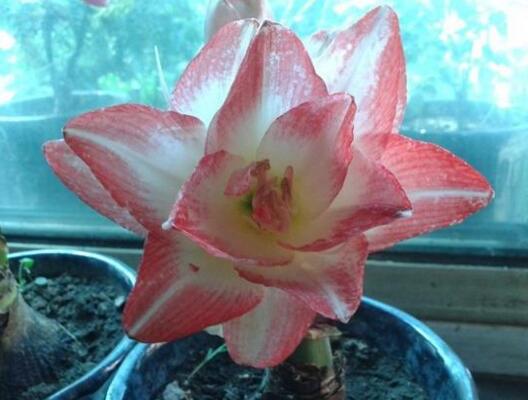
The most commonly used propagation method for amaryllis is bulb division. Besides that, seed sowing and cuttings are also fairly practical. In seed propagation, it often takes a relatively long time from sowing to flowering, so for most flower enthusiasts, choosing bulb division and cuttings is more suitable. Combined with proper amaryllis cultivation methods, you can see the bright red flowers relatively quickly.
I. Amaryllis seed propagation
1. Time
Amaryllis blooms in spring and summer. If the climate conditions are suitable, it will also bloom in winter. Therefore, when using the seed sowing propagation method for amaryllis, it is more suitable to choose spring, and you can also sow immediately after harvesting.
2. How to sow amaryllis seeds
Select seeds from mature fruits, soak them in warm water for 5 minutes and take them out. Mix 2 parts peat soil and 1 part river sand to make the substrate. Sow the seeds in the sand bed by dibbling at a spacing of 2-3 cm.
3. Management
Keep the ambient temperature at 15-20°C and keep the sand bed slightly moist. Generally, seedlings will emerge in 10-15 days. After 2 true leaves grow, the seedlings can be separated. Generally, it takes 2-3 years from sowing to flowering, so it is a test of the grower's patience.
II. Bulb division propagation
1. Time
Bulb division is the most commonly used amaryllis propagation method. The time is generally chosen to be March-April.
2. Remove the mother bulb
Remove the mother bulb, then cut it longitudinally into several portions, then divide it in half from the middle, ensuring that the lower end of each portion has part of the basal plate, so that roots can develop smoothly after propagation.
3. How to propagate amaryllis by bulb division
Insert each divided portion of the mother bulb into a sand bed. The sand bed is made by mixing peat soil and sandy soil. After inserting, water appropriately to ensure that both the upper and lower parts of the sand bed are moist. Be careful to control the temperature at around 18°C. After 6 weeks, small bulbs will form, and roots will grow from the lower part.
III. Tissue culture
Use MS medium, select the stem disc, tissues of dormant bulbs, or flower stalks as explants, then carry out tissue culture through the embryo bud method to produce callus tissue. Generally, adventitious roots can form after 30 days, and adventitious buds will form in 3-4 months. However, this method is generally suitable for breeding new varieties and is not recommended for beginners.
How to propagate amaryllis? 6 amaryllis propagation methods
How to propagate amaryllis? Amaryllis is an indoor flowering plant used to decorate and beautify the home. Because amaryllis has rich and colorful flower colors, many varieties, large flowers, and high ornamental value. The most common propagation methods for amaryllis are seed sowing, bulb division, and cuttings. Sowing is a sexual propagation method, while division is an asexual propagation method.
How to propagate amaryllis 1. Amaryllis seed propagation methodSow immediately after harvesting, with a high germination rate. The sowing soil is a mix of 2 parts peat soil and 1 part river sand. The seeds are relatively large, so dibbling is suitable, with a spacing of 2-3 cm. The suitable germination temperature is 15-20°C. Seedlings emerge in 10-15 days, and seedlings are separated when there are 2 true leaves. It takes 2-3 years from sowing to flowering.
2. Amaryllis bulb division propagation methoda. The old bulb can produce 2-3 small daughter bulbs each year. Remove them and plant them separately. Be careful not to damage the roots of the small bulbs, and let their tops emerge above the soil surface. The small bulbs take about 2 years to flower.
b. Artificial bulb cutting is mostly used to propagate daughter bulbs in large quantities, that is, cut the mother bulb longitudinally into several portions, then divide it into two halves in the middle, so that the lower end of each has part of the basal plate as the root-forming part, then insert them into a cutting bed mixed with peat soil and sand. Water appropriately. After 6 weeks, 1—2 small bulbs can form between the scales and roots will grow at the lower part. In this way, one mother bulb can produce nearly a hundred daughter bulbs.
c. Amaryllis sets seed easily. Artificial pollination can be carried out during the flowering period. The seeds mature after 2 months, and each capsule contains about 100 seeds. Sow immediately after harvesting, with a high germination rate. After sowing, place in partial shade, keep moist, and maintain a temperature of 15-18°C. It will germinate in half a month. If the temperature reaches 18-20°C, it will germinate in 10 days. Seed propagation takes 3-4 years to flower. Bulb division propagation is carried out in March-April. Remove the small bulbs around the mother bulb and plant them. When planting, the top of the small bulb should be exposed above the soil surface.
3. Amaryllis cutting propagation methodCut the mother bulb longitudinally into several portions, then further divide its scales, and insert them obliquely in vermiculite or sand. Plant in place when 2 true leaves have grown. When planting the false bulb, if the potting soil is too loose, flowering may be delayed or the number of flowers reduced. You can use a mixed soil of 5 parts sandy loam, 2 parts peat soil, and 1 part sand. The planting depth is best when 1/3 of the bulb is exposed above the soil surface.
4. Amaryllis bulb division propagation methodBulb division propagation is generally carried out in July-August. First cut the bulb longitudinally into several pieces, then divide them further by scales. The outer layer uses 2 scales as a unit, and the inner layer uses 3 scales as a unit. Each unit must carry part of the basal plate. In this propagation method, if the diameter of the divided bulb is more than 6 cm, each bulb can be divided into more than 20 double-scale and triple-scale cuttings.
Insert the cuttings obliquely into the substrate (pH value is best around 8), maintain 25-28°C and appropriate air humidity. After 30-40 days, 1-2 small bulbs can form between the scales of each cutting, and roots grow at the base. The small bulbs propagated by this method need to be cultivated for about 3 years before they can flower.
5. Amaryllis tissue culture propagation methodMS medium is commonly used, with stem disc, dormant bulb tissue, flower stalk, and ovary as explants. After tissue culture, callus tissue first forms, adventitious roots form after 30 days, and adventitious buds form after 3-4 months.
Complete collection of amaryllis propagation methods
Amaryllis growth habits
The growing environment for amaryllis needs to be warm and humid. It does not like extreme heat, so sunlight should not be too strong. It is best to keep it under a greenhouse for care. During the winter dormant period of amaryllis, when the climate is cold and humid, keep the temperature at 10-12°C, and it must not be lower than 5°C.
Amaryllis propagation methods
Sowing method
Because amaryllis seeds are relatively large, dibbling is suitable. The dibbling spacing is about 2-3 cm. During germination, keep the temperature within the range of 15-20°C, and seedlings will emerge in about 10-15 days. From sowing to flowering, it takes 2-3 years.
Bulb division method
The old bulb of amaryllis can produce 2-3 small daughter bulbs each year. At this time, you only need to remove the small daughter bulbs and plant them. So how should the daughter bulbs be propagated? The method is artificial bulb cutting. Cut the mother bulb longitudinally and divide it into several portions, then divide the middle part into two halves, so that the lower half of each has part of the basal plate as the root-forming part. Then insert them into a cutting bed, water, and after about 6 weeks, the bulb can produce 1-2 small bulbs and roots will grow at the lower part. After that, one mother bulb can produce nearly a hundred daughter bulbs.
Cutting method
Cut the mother bulb of amaryllis longitudinally into many portions, then further divide its scales, and insert them obliquely in vermiculite or sand. Plant in place when 2 true leaves have grown. If the potting soil is too loose when planting the false bulb, flowering will be delayed or the number of flowers will decrease. At this time, you can use a mixed soil of sandy soil, peat soil, and sand for care.
The above is the complete collection of amaryllis propagation methods!