How to propagate the desert rose? Cuttings are the most practical method
Because of the desert rose's drought-tolerant and heat-loving characteristics, it is grown in Guangdong and Inner Mongolia in China, and once it has grown for 1-2 years, the question of propagation arises. So how do you propagate the desert rose? Here I will introduce several common propagation methods for the desert rose.
How to propagate the desert rose
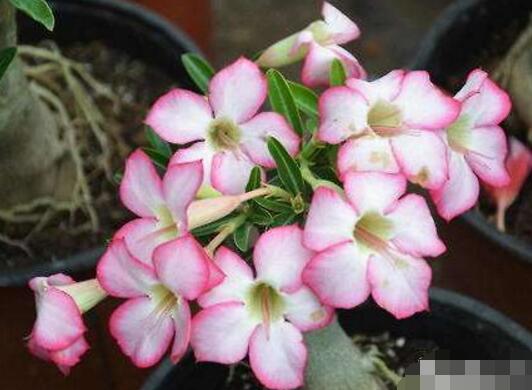
The desert rose has a relatively short and small plant form and belongs to the succulent shrubs or small trees, so its propagation methods mainly include cuttings, grafting, layering and sowing. Division propagation, which is used for most plants, is not commonly used when growing the desert rose.
Propagation methods for the desert rose
1. Cuttings
1. Time
It is best to choose summer, when the temperature is higher and suitable for the desert rose to root quickly after cuttings.
2. Method
From vigorous growing branches, choose 1-2 year old tip branches, cut them into several short sections 10 cm long. Because the sap is somewhat toxic, they need to be washed and left to dry before inserting into the prepared substrate. The substrate can be river sand or leaf mold.
3. Management
Just keep the substrate from drying out completely, do not expose it to direct sun, keep the temperature above 25 degrees, and place it in a ventilated spot. After 3-4 weeks it will root, after which it can be transplanted and then given normal care according to desert rose cultivation methods.
2. Desert rose grafting method
1. Time. Generally, grafting should avoid the plum rain season, when the air humidity is high, which is unfavorable for post-grafting care. Generally, March-April in spring is the best.
2. Method. Choose a superior variety to make a 7-10 cm long scion. After shortening the main yellow branch, graft the scion onto the plant. Then place it in a shady spot for care, taking care to keep the environment ventilated. Generally after 10 days the cut wound will heal, after which it can be placed in sunlight for care.
3. Layering
1. Time. Layering time is generally chosen in spring or summer, for example late April or early May are both fine.
2. Method. On the desert rose plant, choose 2-3 year old vigorous branches, perform ring barking on the middle-lower part of the branch, taking care that the position should be 0.5 cm below the node, then wrap the cut part with plastic film and soil, tie it tightly and place it in a bright spot for care.
4. Sowing
1. Time. Sowing time is generally chosen in summer, for example April-May, because the temperature at this time is suitable for germination.
2. Method. The desert rose does not easily set fruit, so artificial pollination is needed. Collect the seeds before the fruit naturally splits open. You can choose to store them in sand and sow them the following summer. When sowing, evenly dibble them on a sand bed and keep the temperature above 21 degrees. After 3-4 weeks they will germinate.
[Notes]: Because the sap of the desert rose contains certain toxins, no matter which propagation method is used, care should be taken not to contact the sap, and necessary protective measures should be taken to avoid poisoning symptoms. If there is any adverse reaction, seek medical attention promptly.
How to propagate the desert rose: propagation methods for the desert rose
Desert rose flowers look like small trumpets and have the brilliant beauty of roses. They are very appealing. How do you propagate the desert rose? Let's take a look together at the propagation methods for the desert rose.
Desert rose propagation method 1: Cuttings
Cuttings are usually taken in spring and summer. Select 1-2 year old branches, preferably tip branches, and cut them into lengths of about 10 cm. The stem of the desert rose is fleshy and has transparent milky sap (note that the sap is toxic). Wash off the sap with clean water, then place in a cool, ventilated spot and insert only after the cut has healed.
The substrate can be clean river sand or soil, taking care that it drains and breathes well. During cutting, pay attention to controlling the frequency of watering, keep the soil slightly moist, and provide appropriate shade. After 3-4 weeks of insertion, it will root.
Desert rose propagation method 2: Layering
Desert roses propagated by air layering have a relatively high survival rate and the operation is relatively simple. Generally, layering can be done during the plant's growing season, with spring and summer being best. When layering, first make a cut or ring bark at the part where roots are to form using a sharp knife, then wrap the wound with sphagnum moss or soil, then cover the substrate with transparent film, tying both ends tightly. Once you see roots growing to the film, it can be cut off and planted.
Desert rose propagation method 3: Grafting
Grafting should avoid the plum rain season. After grafting in spring, you can soon enjoy the flowers. The scion length is generally 7-10 cm. After grafting, place the potted plant in a shaded spot for care. If successful, the wound will heal in about 10 days, then place it in a spot with ample sunlight. After about 2 months, remove the film binding, as leaving it too long can easily cause constriction marks and affect subsequent growth.
Grafting can combine different varieties onto the same plant, increasing its ornamental value.
Desert rose propagation method 4: Sowing
The desert rose does not easily set fruit and requires artificial assisted pollination. Its fruit will naturally split open some time after ripening, and the seeds scatter easily, so they must be harvested before splitting. After harvesting, the seeds should be sown as soon as possible. If they need to be stored, they should be placed in a cool, dry place, otherwise they easily lose their ability to grow.
Desert rose Adenium obesum desert rose illustrated guide: how to grow the desert rose / how to propagate the desert rose
Desert rose profileDesert rose Adenium obesum
Aliases: Tianbao flower, small oleander, wealth flower, Shahongji flower, Adam flower, dwarf frangipani
Classification: succulent and pulpy plants
Family and genus: Plantae, Angiosperms, Dicotyledoneae, Gentianales, Apocynaceae, Adenium
Full bloom period: spring and autumn
The desert rose (scientific name: Adenium obesum) is a perennial succulent plant with a plant height of up to 2 m. It has multiple aliases, such as: Tianbao flower, wealth flower, Shahongji flower, Adam flower, dwarf frangipani, small oleander, and in Europe and America it is often called desert rose or desert azalea. It belongs to the small trees and can grow up to 2 m tall in its place of origin. The base of the desert rose is swollen, the fleshy stem is short and thick, and needle-shaped or obovate leaves grow alternately at the tips of the stem branches. The upper side of the leaves is dark green, and the underside is light green and relatively rough. The flowering period is from late spring to autumn, the flowers are pink to red, in umbel-like inflorescences, 2-10...
Desert rose cultivation methods and precautions: introduction to the desert rose
The desert rose (scientific name: Adenium obesum) is a perennial succulent plant with a plant height of up to 2 m. It has multiple aliases, such as: Tianbao flower, wealth flower, Shahongji flower, Adam flower, dwarf frangipani, small oleander, and in Europe and America it is often called desert rose or desert azalea. It belongs to the small trees and can grow up to 2 m tall in its place of origin. The base of the desert rose is swollen, the fleshy stem is short and thick, and needle-shaped or obovate leaves grow alternately at the tips of the stem branches. The upper side of the leaves is dark green, and the underside is light green and relatively rough. The flowering period is from late spring to autumn, the flowers are pink to red, in umbel-like inflorescences, with 2-10 flowers in a five-pointed funnel shape clustered at the branch tips.
The whole plant is toxic. If livestock or young children accidentally eat the stems, leaves or sap, it can cause heart conditions such as accelerated heartbeat and arrhythmia.
The desert rose is a crystalline form of gypsum that grows in low-lying desert areas. Its shape closely resembles a rose, and it grows in the desert. Its root is swollen into a fleshy root, the stem is thick and sturdy, with many branches and emerald green leaves. Because its place of origin is close to the desert and it is red like a rose, it is named the desert rose. Hence it is called the desert rose. According to its growth form, it can be divided into single, connected, branching and clustered forms. In size, single forms generally have a diameter of 1.5-10 cm, and connected forms are 10-50 cm or larger. It is one of the few flower-like minerals among natural stones and has high ornamental value. Because of the unique climatic conditions in the Inner Mongolia desert, this unique desert flower, the desert rose, grows there. Its shape closely resembles a blooming bouquet of roses. It not only has unique ornamental qualities, but also represents love that never fades. There are also places of origin in China, such as in the Gobi Desert of the Alxa League in Inner Mongolia.
Botanically, the desert rose is also known as Tianbao flower. It is a succulent plant of the genus Adenium in the family Apocynaceae, native to Kenya and Tanzania in Africa. It likes high temperatures, dry conditions and a sunny environment, tolerates extreme heat but not cold, and is named the desert rose because its place of origin is close to the desert and it is red like a rose. Mineralogically, the desert rose is a gypsum-type crystal born in the desert, shaped like a blooming rose, in countless forms, magnificent and magical. Its main component is limestone, and because its geological formation conditions are special, its output is scarce, making it a purely natural wondrous stone. The desert rose is also the name of a popular pop song sung by Hong Wei, with lyrics by He Houhua and music by He Qiaoli.
Morphological characteristics of the desert rose
Desert rose flowers are shaped like small trumpets, rose-red, and very beautiful. The umbel-like inflorescences cluster in groups of three or five, brilliant as brocade, blooming continuously through the four seasons. It is named the desert rose because its place of origin is close to the desert and it is red like a rose.
The desert rose has alternate simple leaves, obovate, with an acute tip, 8 cm-10 cm long and 2 cm-4 cm wide, leathery, glossy, dark green on the upper side, gray-green on the underside, with entire margins. Racemose inflorescences, terminal, bearing more than 10 flowers, trumpet-shaped, 6 cm-8 cm long; the corolla has 5 lobes, in rose red, pink, white and compound colors. May to December is the flowering period of the desert rose, and the flowers come in red, rose red, pink, white and other colors. Greenhouse cultivation in the south more easily sets seed. The seeds have white soft hairs that help them fly and disperse.
Tianbao flower is commonly known as the "desert rose", with the scientific name Adenium Obesum, and its place of origin is northeastern Africa. "Flower of White Horse City" is in the same family but a different genus. Its flowers are bright red, and the multi-flowered variety is red outside and white inside, both shaped like small trumpets; the flower diameter is about 4 cm, and the flower color is very delicate and beautiful. Its stem sap is slightly toxic, so when keeping it as a houseplant, care should be taken not to let children and pets swallow it. Its growth habit is similar to the commonly grown "bottle palm". The leaves are like long teaspoons, whorled near the top, just like a small umbrella shape; the leaves below its stem fall off, leaving marks one by one. Tianbao flower belongs to the succulent plants of the family Apocynaceae, and all have curved tubers or tuberous roots, which are swollen and fleshy and store a large amount of water and nutrients, so they are drought-tolerant and barren-tolerant. Tianbao flower likes heat and fears cold, and sometimes sheds its leaves in winter to reduce water evaporation, which helps it resist the cold; it itself enters a "hibernation" state, so it should not be watered or fertilized much.
Ecological habits and growing environment of the desert rose
In the south, the flowering period is from May to August on the Gregorian calendar. It loves light and warmth; so during the warm and humid growing period, sunlight is essential to promote photosynthesis. Long-term excessive shade easily makes the branches and leaves soft and drooping, and it is then very difficult for it to bud flowers again. Sufficient sunlight allows normal flower bud differentiation. It likes a high-temperature, dry and sunny environment. It tolerates extreme heat but not cold, tolerates drought and avoids waterlogging. A calcareous, well-draining sandy loam is suitable. In winter the temperature should not be lower than 10°C.
Perennial succulent plant, plant height up to 2 m. It likes a dry, high-temperature, ventilated and sunny environment, tolerates extreme heat but not cold. It tolerates drought but not waterlogging. Do not water too much each time; if there is more moisture, it easily causes root rot, and the branches also grow leggy. A good sunlight environment instead helps the desert rose bloom. The root is swollen into a fleshy root. The stem is thick and sturdy, and the leaves are emerald green.
Fern plants
The desert rose is a fern plant called "Selaginella", very drought-tolerant. In the dry season it becomes withered and yellow, wilting, just like clumps of dry grass. When the water supply is sufficient, the branches and leaves stretch out and turn green again, so it is also called the "resurrection plant", but in reality it cannot bloom. This fern was first named in Long Yingtai's literary collection "Desert Rose", in which it is introduced: "Yes, in his eyes, it is not a rose, just a kind of lichen! However beautiful a lichen may be, how beautiful can it be? What he sees is an ugly, musty-smelling lower plant, placed in a large bowl." In fact, this name is taken from its resemblance, rather than its actually being able to bloom flowers similar to roses.
Cultivation techniques for the desert rose
In cultivation, desert rose branches easily grow leggy, affecting the beauty of the plant shape, and grafting can be used to change its plant shape. You can cut all the branches off at a certain height of the plant according to a certain shape, then take the upper ends of the cut branches and graft them using the cleft grafting method. Plants treated by grafting have a beautiful plant shape, and after flowering the flowering branches are compact and highly ornamental.
The desert rose is relatively drought-tolerant. Do not water too much each time; if there is more moisture, it easily causes root rot, and the branches also grow leggy, making pruning rather troublesome. In summer, when temperatures are high, water according to the soil condition. Generally water once every two or three days, and there must be no standing water in the pot. In winter, when the temperature drops, the desert rose also enters a semi-dormant period, at which time watering should be properly controlled, taking care to keep the soil dry. Watering once a week is enough. Appropriate drought is very beneficial to the growth of the desert rose. (When the desert rose enters the dormant period in winter, the leaves gradually fall off. This is normal leaf drop, and there is no need to be nervous about it.)
The desert rose relatively likes phosphorus and potassium fertilizer, and it is generally supplemented about once a month. During the vigorous summer growth period, sufficient fertilizer and water are needed, so that the flowers it produces can be lush and vivid. In addition, in combination with repotting once a year, some slow-release base fertilizer can also be appropriately applied in the pot, such as decomposed bean cake, bone meal, etc.
The art of pruning
Pruning the desert rose is also very important. If you do not pay attention to regular pruning and let it grow leggy, it easily loses its ornamental value. After the flowering period is the best time to prune, and you can make choices according to personal preference. Note: more branches mean more flowers. If you want more flowers, you must find ways to keep more divisions.
Cultivation points
Pot cultivation requires ample sunlight and good drainage. A fertile, loose mixed soil of sand and leaf mold is best. During the growing period it should be dry rather than wet. In summer, when temperatures are high, water once a day; at other times water once every 2-3 days. Fertilize 2-3 times a year. In the winter drought dormant period, it normally sheds its leaves. Plant in spring or repot. In the south it can be planted in the ground and overwinter outdoors. In the north it should be potted and overwinter indoors. The potting soil can use equal parts leaf mold and coarse sand mixed, plus a small amount of decomposed dry bone meal. Before planting, put some broken tile pieces at the bottom of the pot to facilitate drainage. Repot every spring and replace with new culture soil. Newly planted and newly repotted plants can be placed indoors or in a shaded spot for care, watered less, and enter normal management after recovering.
Light and temperature
During the growing period it should be placed outdoors in a sunny spot, and can also be grown in a greenhouse, requiring ample light. In winter it needs to be brought indoors and placed in a sunny spot; it is even better if grown in a greenhouse. In winter keep the indoor temperature above 12°C. If the potting soil is dry, it can also overwinter safely at a temperature of 7-8°C.
Watering and fertilizing
Spring and autumn are the vigorous growing periods, and it should be watered fully to keep the potting soil moist, but not overly wet. Water according to the principle of watering when dry and stopping when wet, and watering thoroughly when completely dry. In early spring and late autumn, when temperatures are lower, watering should be moderated. In winter reduce watering and keep the potting soil dry, but water if it becomes too dry. It does not need much fertilizer. During the growing period, apply dilute liquid fertilizer 1-2 times a month, and stop fertilizing in winter.
The desert rose relatively likes phosphorus and potassium fertilizer, and it is generally supplemented about once a month. During the vigorous summer growth period, sufficient fertilizer and water are needed, so that the flowers it produces can be lush and vivid. In addition, in combination with repotting once a year, some slow-release base fertilizer can also be appropriately applied in the pot, such as decomposed bean cake, bone meal, etc.
Potting soil and repotting
The desert rose, like other succulent plants, likes well-draining sandy soil. Therefore, when repotting, it is best to add more river sand or small gravel to ordinary soil, which can improve the drainage of the potting soil. Generally this is only needed when the plant has already grown quite luxuriant. Desert roses at the seedling stage should be repotted every year. The repotting method is very simple. First, stop watering before repotting, then after the potting soil is completely dry, take the plant out, clear away the old potting soil and prune the root system, then replant.
Desert rose cultivation methods and care points
The desert rose likes a dry, sunny environment, tolerates drought but not waterlogging, and tolerates heat but not cold. The suitable growing temperature is 20-30°C. When grown at home, it should be placed in a spot with ample sunlight or bright indirect light, and it is suitable to use fertile, loose, well-draining calcareous sandy loam. May to December is its flowering period, and the flowers come in red, rose red, pink, white and other colors. Greenhouse cultivation in the south more easily sets seed.
Sunlight
Do not think that the seemingly delicate desert rose cannot accept strong sunlight. In fact, a good sunlight environment instead helps the desert rose bloom. Apart from the vigorous growing period, even during the dormant period, the desert rose still needs ample sunlight to overwinter.
Temperature
The desert rose likes to grow in a high-temperature, ventilated environment. In the summer in the south, which is also the growing period of the desert rose, the average temperature is around 30°C, making it very suitable for growing in the south. In winter, because the desert rose has poor cold tolerance, it should be moved indoors for cultivation and kept dry. Only in this way can the desert rose bloom those beautiful flowers again in spring and summer.
Watering
The growth of the desert rose should avoid a humid environment. Even during the growing period, water should not be excessive. Before each watering, you must confirm that the surface of the potting soil is completely dry. Never water during the plant's dormant period, as this will only make the plant more susceptible to cold damage and withering.
During the growing period it should be dry rather than wet. In the high-temperature summer period, water once the surface soil is dry according to the soil condition. Generally water once every 3 days, and there must be no standing water in the pot, otherwise the roots easily rot. In the vigorous spring growing season each year, apply nitrogen fertilizer 2-3 times, and before flowering apply a compound fertilizer containing calcium and phosphorus 2 times. In the dry winter season, the plant enters the dormant period. If the temperature is below 10°C, it sheds its leaves. At this time watering should be controlled and the soil kept dry.
Fertilizing
The rainy season in spring and summer each year is the growing period of the desert rose. Therefore, at this time a little fertilizer should be added to supplement the nutrients consumed during its growth. However, because the growth rate of the desert rose varies, it is best to use slow-release fertilizer, such as decomposed compost. As for autumn and winter, these are the dormant period of the desert rose, when its growth is very slow or even stops, so do not fertilize during this period.
Indoor pot cultivation
In summer the potting soil should be kept moist, otherwise the leaves easily dry and curl. In the other seasons, it is better to keep it dry rather than wet; in winter, watering thoroughly once a week or once every ten days is enough.
In cultivation, desert rose branches easily grow leggy, affecting the beauty of the plant shape, and grafting can be used to change its plant shape. You can cut all the branches off at a certain height of the plant according to a certain shape, then take the upper ends of the cut branches and graft them using the cleft grafting method. Plants treated by grafting have a beautiful plant shape, and after flowering the flowering branches are compact and highly ornamental. More branches mean more flowers. If you want more flowers, you must find ways to keep more divisions.
Propagation methods for the desert rose
The desert rose is commonly propagated by cuttings, grafting and layering, and can also be sown. The desert rose is mainly propagated by sowing and cuttings.
Cuttings
Summer is best. Select 1-2 year old branches, preferably tip branches, cut them into 10 cm lengths, and after the cut has dried, insert them into a sand bed. After insertion they root in about 3-4 weeks. Grafting: use oleander as the rootstock, and in summer use the cleft grafting method. After surviving, the plant grows vigorously and flowers easily. Layering: often in summer use the air layering method, cutting away 2/3 of a vigorous branch, first filling it with moss and then wrapping it with plastic film. It roots in about 25 days, and after 45 days it is cut off and potted. Sow in summer, with a germination temperature of 21°C.
Whether the flowers, leaves, stems, or its shape, all are elegant and distinctive, natural and generous, uniquely styled, and especially suitable for home indoor and balcony decoration. When in full bloom, most of the leaves fall off, and the flowers fill the branches, with a graceful posture. In cultivation, desert rose branches easily grow leggy, affecting the beauty of the plant shape, and grafting can be used to change its plant shape. You can cut all the branches off at a certain height of the plant according to a certain shape, then take the upper ends of the cut branches and graft them using the cleft grafting method. Plants treated by grafting have a beautiful plant shape, and after flowering the flowering branches are compact and highly ornamental. More branches mean more flowers. If you want more flowers, you must find ways to keep more divisions.
Sowing
Spring is best. Use the dibbling method to make management after emergence easier. Before sowing, the substrate must be disinfected. After emergence, be careful that the substrate in the sowing tray is not too wet, otherwise the roots may rot and cause the death of large numbers of seedlings. Cuttings are best taken in the vigorous growing season. Cut the branch sections to about 10 cm, soak the lower ends in water, and dilute the mucus at the cut to prevent it from gumming up and affecting root formation. They can be inserted into a sand bed or directly into disinfected cultivation substrate, and root in about 15-30 days. When propagating, it is recommended to use the sowing method, so that the plant's root and stem can naturally swell to form a good plant shape. Cutting seedlings cannot do this, and it also greatly reduces ornamental value.
Desert rose disease control and pest control
Sometimes there is damage from leaf spot disease, which can be sprayed with 500 times diluted 50% thiophanate-methyl wettable powder. Pests include scale insects and leaf-rolling worms, which can be killed by spraying with 1000 times diluted 50% sumithion emulsifiable concentrate. The main pest is scale insects. When the infestation is severe, it causes all the leaves to fall off, the plant's growing point to die, and even the plant to die. When growing at home, pay attention to observation, and once discovered, immediately wipe them off with a cotton swab dipped in water. You can also spray 1-2 times during the egg-laying and hatching periods with 1000-2000 times diluted 40% omethoate emulsifiable concentrate, or 1000 times diluted 50% sumithion emulsifiable concentrate. When carrying out disease and pest control, pay attention to the safety of pesticide use.
Control techniques for soft rot
Desert rose soft rot is a major disease harming the desert rose. The desert rose has gorgeous flowers, luxuriant blooming and a short sturdy plant, especially the root and stem part with an old, vigorous and ancient posture, making it an excellent succulent plant for tropical regions. It has been introduced into China for more than 10 years and grows well, but the occurrence and damage of its soft rot often causes the death of the whole plant.
1. Symptoms: Soft rot is a major disease of the desert rose. The desert rose develops water-soaked softening near the soil surface, initially white or light yellow, and finally turning dark brown. Under humid conditions it ruptures and rots and has a foul odor, the internal tissue is black, and it is sticky and soft to the touch.
2. Cause: Desert rose soft rot is mainly caused by high summer temperatures and stuffiness, poor ventilation, or standing water in the pot.
① High summer temperatures, stuffiness and poor ventilation, or being rained on, are the key factors causing the occurrence of this disease.
② Too much watering during the growing period leaves the tubers and roots in a suffocated state, and root absorption capacity declines.
③ When potting or transplanting seedlings, planting too deep or piling too much soil around the root and stem favors disease development. High humidity at the stem base favors the reproduction and invasion of pathogens, promoting the occurrence of the disease
3. Control methods:
① When cultivating, choose well-draining, medium-fertility sandy loam. You can use 3 parts coarse sand, 1 part leaf mold plus a small amount of plant ash. Do not use garden soil as seedling soil.
② In order to prevent soft rot early, you should start from the seedling planting stage. First, disinfect the potting soil for planting flowers. The soil must be disinfected with 0.5%-1% formalin solution, and each square meter should be disinfected to prevent mutual infection. As for depth, generally it is suitable for the neck of young seedlings to be slightly exposed above the surface, for mature plants the stem neck to be exposed about 1/3 above the surface, and for old tubers to be exposed 1/2 above the surface.
③ Watering: usually do not water too much, so as to avoid the potting soil being too wet. Especially in the early potting stage, pay attention to watering less. In hot weather, slightly moist is best. From early September, you can appropriately water a bit more.
④ Chemical control: about once a month, spray 1000 times diluted agricultural streptomycin solution or 150-200 times diluted Bordeaux mixture.
Distribution area of the desert rose
The desert rose is native to Kenya and Tanzania in Africa. It is now distributed in North African countries such as Tunisia, Algeria and Morocco.
Uses and purposes of the desert rose: ornamental value
Whether the flowers, leaves, stems, or its shape, all are elegant and distinctive, natural and generous, uniquely styled, and especially suitable for home indoor and balcony decoration. When in full bloom, most of the leaves fall off, and the flowers fill the branches, with a graceful posture.
Whether the flowers, leaves, stems, or its shape, the desert rose is elegant and distinctive, natural and generous, uniquely styled, especially suitable for home indoor and balcony decoration, and is an excellent choice for indoor cultivation.
In the south, the desert rose can bloom twice, in spring and autumn. If cared for properly, flowers can be seen in all three seasons of spring, summer and autumn. When in full bloom, most of the leaves fall off, and the flowers fill the branches. Its posture is graceful, its tree shape is old, vigorous and ancient, elegant and distinctive. The roots, stems, leaves and flowers all have relatively high ornamental value, and it is currently a popular high-end choice for indoor cultivation.
Landscape uses and garden design of the desert rose
The desert rose plant is short and small, with an old, vigorous and ancient tree shape, and swollen roots and stems like a wine bottle. It blooms twice a year, in April-May and September-October, bright red and beautiful, shaped like a trumpet, extremely distinctive, and deeply loved by people. Planted in the ground in the south to arrange small courtyards, it is old, dignified, natural and generous. As a potted ornamental, decorating indoors and balconies, it is uniquely styled.
Cultural background and beautiful legend of the desert rose
According to legend, in the vast Gobi Desert there is a kind of stone that has grown for tens of millions of years. It is the crystalline form of a plant. The seeds of this plant are naturally paired. After flowering, the root and stem are connected, and the flowers are like roses; if one of them dies, the other no longer blooms either and slowly withers... After countless years, their bodies and the sand crystallize into a peculiar flower, without life but never fading, becoming the "desert rose" symbolizing everlasting love.
Legend has it that in desert regions, roses are not easy to survive, so local young people mostly give desert rose stones instead on Valentine's Day.
Mineral species and genus overview
The desert rose is also called "Gobi stone", "wind-carved stone" and "wind-polished stone". It is mainly produced in the vast Gobi. The desert rose is born in the riverbed of ancient Ruoshui. Most are formed after volcanic magma cooled and then underwent long-term natural changes and sun and wind erosion, or are formed by quartz sand condensing over tens of millions of years. Because of the special geological conditions, it forms a flower among stones in countless forms, magnificent and magical. The geographical conditions for the formation of the desert rose are special, so its output is scarce, and among them those whose flower shape closely resembles a rose and completely display floral characteristics are even rarer. The formation of the desert rose bears witness to history. It can not only be treasured for a lifetime, but can also be passed down to later generations. It becomes a witness to the happiness of a family for generations. Those petal after petal of rose stone petals open vividly. It is a masterpiece formed by fine sand weathering through thousands of years of wind and rain sculpting. There are also scattered fine grains of sand embedded in the middle of the petals. It has no rose leaves or thorns, only flowers, silently blooming in the Gobi Desert. The shape of this rock is similar to a rose, so it is called the "desert rose". Desert rose: with aesthetic feelings, it strengthens the appreciation of beauty, promotes association and imagination, benefits artistic creators, and can also be used as a gift for young men and women to express affection and convey love.
Desert rose is a rare gemstone and commemorative stone, born in the desert. Its main components are calcium carbonate and quartz, a type of gypsum crystal, a flower within stone. Because its formation requires special geographical conditions, it is produced in scarce quantities. Desert rose is shaped like a blooming rose, in a myriad of forms, magnificent and wondrous. It is a purely natural wonder stone that can purify water and air, and holds extremely high collectible and ornamental value.
Main components
Desert rose is a symbiont of calcite, quartz, and hard translucent gypsum.
Origin and distribution
Countries near the Sahara Desert, including Algeria, Libya, and others. It is also produced in desert regions of the United States, Mexico, Morocco, Canada, and other countries. There are also producing areas in China, such as in the Gobi Desert of Alxa League in Inner Mongolia.
Development and utilization
Because desert rose is difficult to mine, scarce in output, and peculiar in shape, it occupies a special position in the natural wonder stone market and has extremely precious research and collectible value. It has petal upon petal of rose-like stone petals, blooming in a lifelike way. It is formed by fine sand weathering through tens of millions or even hundreds of millions of years of wind and rain sculpting. There are also scattered grains of fine sand embedded in the middle of the petals. It has no rose leaves or thorns, only flowers silently blooming in the Gobi Desert, but it will never wither, nor will it fade.
Desert rose images