Does the flame vine get pests? Control methods for 2 pests and 2 diseases
During the growth of the flame vine, the problem people fear most is pests and diseases. Such problems are extremely harmful to the plant, not only greatly affecting its ornamental value, but if not dealt with in time, they can also cause the plant to wither. Does the flame vine get pests? How do you control pests and diseases on the flame vine? Below, the editor will walk you through it.
I. Does the flame vine get pests? Yes, it does
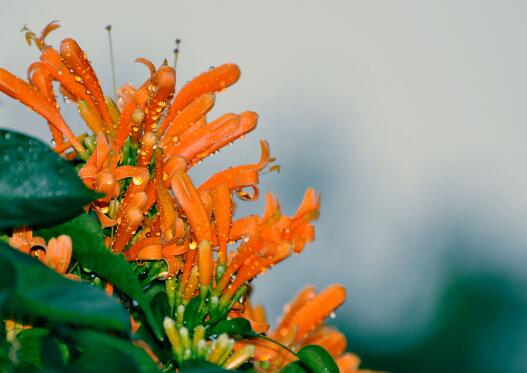
As for the question of whether the flame vine gets pests, the answer is yes. During the growth of the flame vine, if it is not cared for properly, it is prone to two pests, whiteflies and scale insects. In addition, there are also some diseases. As for how to solve such problems, there is a detailed introduction below. Let us take a look.
II. Pest and disease control on the flame vine
Pests
1. Scale insects
Among the pests and diseases of the flame vine, scale insects are one of the most harmful. They mainly damage the leaves, branches and fruits of the flame vine, causing its leaves to gradually turn yellow and drop, and finally causing the plant to wither and die.
Control method: When controlling this pest, we can use a 1000-fold dilution of 255 phosmet to spray and kill it directly.
2. Whiteflies
Whiteflies are a very small pest, with the largest ones not exceeding 3mm. This pest mainly feeds on the sap in the flame vine, gradually sucking it out, causing the plant to lose a large amount of nutrients and finally wither. Among the pests and diseases of the flame vine, it is considered one of the most harmful.
Control method: This pest has an extremely strong reproductive capacity, so it must be dealt with as early as possible. When controlling it, we can use a 1200-fold dilution of 40% omethoate emulsifiable concentrate to spray and kill it.
Diseases
1. Leaf spot disease
Leaf spot disease is one of the more frequently occurring pests and diseases of the flame vine. Its peak period is in spring and autumn each year, so everyone must pay special attention during this time. When leaf spot disease occurs, many brown spots appear on the leaves of the flame vine, and over time they gradually spread, eventually causing the plant to gradually wither and die.
Control method: When controlling leaf spot disease, we can use a 400-600 fold dilution of 80% mancozeb to spray the diseased plant, generally once every 7-10 days, and after 2-3 times it can basically be cured.
2. Powdery mildew
Among the pests and diseases of the flame vine, powdery mildew is a relatively common disease. When it occurs, many powdery spots appear on the leaves of the flame vine, and over time they gradually cover the leaf surface, causing it to be unable to carry out photosynthesis and gradually wither.
Control method: When controlling powdery mildew, we can use a 1500-fold dilution of 50% carbendazim wettable powder to spray the flame vine, generally once every 12-15 days, and after 2-3 times it can be cured.
What are the common pests and diseases of Rangoon creeper? Pest and disease control for Rangoon creeper / 2 pests, 3 diseases
During the growth of the Rangoon creeper, what we least want to encounter is pests and diseases. Such problems are extremely harmful to the plant, and if not dealt with in time, the harm to the plant is extremely great. So what are the common pests and diseases of the Rangoon creeper? What needs to be done for pest and disease control of the Rangoon creeper? Below, the editor will walk you through it.
I. What are the common pests and diseases of Rangoon creeper? Aphids / leaf spot disease
When it comes to the common pests and diseases of Rangoon creeper, there are mainly five: aphids, scale insects, anthracnose, leaf spot disease and powdery mildew. All five of these pests and diseases are extremely harmful to the plant, so they must be dealt with in time when discovered. The specific treatment methods are below. Let us take a look.
II. Pest and disease control for Rangoon creeper (pests)
1. Aphids
Aphids are a pest found on many plants, and the Rangoon creeper is no exception. They are a phytophagous insect that mainly harms the leaves and stems of the Rangoon creeper. They gradually absorb the sap within, causing the plant to lose a large amount of nutrients, and over time they also cause the plant to gradually wither and die.
Control method: When dealing with this pest and disease of the Rangoon creeper, if the number of pests is relatively small, we can prune off the affected branch tips and then disinfect the plant. If the number is relatively large, we can directly use a 3000-fold dilution of 50% pirimicarb wettable powder to spray and kill them directly.
2. Scale insects
Scale insects are an extremely harmful pest, mainly threatening the leaves, branches and fruits of the Rangoon creeper. They gather on the branches, leaves and fruits, causing leaves to turn yellow, branch tips to wither, tree vigor to decline, and they can also trigger sooty mold.
Control method: For this pest and disease of the Rangoon creeper, we can use an insecticide made by mixing 40.7% chlorpyrifos emulsifiable concentrate and 80% dichlorvos emulsifiable concentrate in a 1:1 ratio, diluted 1000-1500 fold, to spray and kill them.
III. Pest and disease control for Rangoon creeper (diseases)
1. Anthracnose
Anthracnose mainly threatens the leaves of the Rangoon creeper. In the early stage of the disease, many brown spots appear on the leaves, and over time the spots gradually expand and occupy half the area of the leaflets, making the plant unable to carry out photosynthesis and gradually turn yellow, and the leaves gradually fall off.
Control method: When controlling this pest and disease of the Rangoon creeper, we can use a 1000-fold dilution of 75% thiophanate-methyl wettable powder to spray the diseased plant, generally once every 7-10 days, and after 2-3 times it can be cured.
2. Leaf spot disease
Leaf spot disease is a disease caused by fungi. Its peak period is in spring and autumn each year, so everyone must pay special attention during this time. When the Rangoon creeper develops this disease, many brown round spots appear on the leaves, and over time they gradually spread to the petioles and stems, eventually causing the plant to gradually wither and die.
Control method: When dealing with this pest and disease of the Rangoon creeper, we can use a 1000-fold dilution of 20% simeconazole · prochloraz to spray and control it, generally once a week or so, and after 1-2 times it can be cured.
3. Powdery mildew
Among the pests and diseases of the Rangoon creeper, powdery mildew is a relatively common disease. When it occurs, many powdery spots appear on the leaves of the Rangoon creeper, and over time they gradually cover the leaf surface, causing it to be unable to carry out photosynthesis and gradually wither.
Control method: For this pest and disease of the Rangoon creeper, we can use a 1500-fold dilution of 50% carbendazim wettable powder to spray the flame vine, generally once every 12-15 days, and after 2-3 times it can be cured.
Control of common pests and diseases of the flame vine
Flame vine, alias:Huangshan vine; Latin name: Pyrostegia venusta (Ker-Gawl.) Miers, Bignoniaceae, a vine of the genus Pyrostegia, with 3-forked filamentous tendrils. Leaves opposite; stamens inserted at the middle of the corolla tube, filaments filamentous, anthers divergent. Ovary cylindrical, densely covered with fine soft hairs, style slender, stigma ligulate and flat, both style and filaments extending beyond the corolla tube. Capsule valves leathery, boat-shaped, with multiple rows of seeds inside, seeds winged, membranous. Long flowering period, native to Brazil in South America, and has been widely cultivated in tropical Asia as a garden ornamental trellis plant. It is mostly planted around garden buildings and climbs on arbors. In early summer, the red-orange flowers hang in clusters like firecrackers, hence the name flame vine.
Flame vine, a vine, with 3-forked filamentous tendrils. Leaves opposite; leaflets 2-3, ovate, apex acuminate, base subrounded, 4-10 cm long, 3-5 cm wide, glabrous on both surfaces, with extremely small scattered glandular pits beneath, margin entire; rachis about 2 cm long; petiolules 5-20 mm long.
The panicle is borne at the apex of lateral branches, about 10-12 cm long. Calyx campanulate, with 5 small teeth. Corolla tubular, with a ring of hairs in the middle inside, constricted at the base, orange-red, lobes 5, oblong, valvate in bud, reflexed after the flower opens, margins covered with white short pubescence. Stamens inserted at the middle of the corolla tube, filaments filamentous, anthers divergent. Ovary cylindrical, densely covered with fine soft hairs, style slender, stigma ligulate and flat, both style and filaments extending beyond the corolla tube.
Capsule valves leathery, boat-shaped, with multiple rows of seeds inside, seeds winged, membranous. Long flowering period, in the Xishuangbanna Tropical Botanical Garden in Yunnan it can last as long as half a year, usually from January to June.
The flame vine rarely gets leaf spot disease and powdery mildew; spray with a 1500-fold dilution of 50% carbendazim wettable powder.
The pests of the flame vine include whiteflies and scale insects, which can be sprayed and killed with a 1200-fold dilution of 40% omethoate emulsifiable concentrate.