Daylily: 3 pests and 3 diseases and their control, environmental hygiene is the key to prevention
Daylilies are easy to grow, but they can also be threatened by pests and diseases, especially when the cultivation methods are improper, some pathogens and pests may appear on the daylily, causing the leaves to turn yellow and fall off. Today we will learn about the pest and disease control methods for daylilies.
Pest and disease control for daylilies
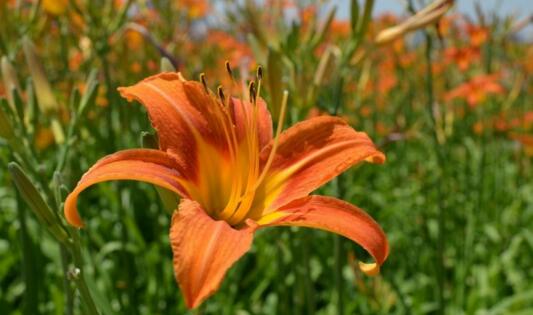
Statistics show that the most common pests of daylilies include red spider mites, aphids, leaf miners and so on; while the more common diseases include leaf spot, leaf blight, rust and so on. So when carrying out control, let us mainly look at the symptoms and control methods of these few pests and diseases.
Common pests
1. Red spider mite
Red spider mites feed on the sap of the leaves and are very destructive to the chlorophyll in daylily leaves. They are only 0.4 mm long, so they are relatively difficult to spot with the naked eye in the early stages. When the leaves turn yellow and fall off, the front and back of the leaves should be carefully checked.
Control method: Avoid excessively high environmental temperatures and overly dry air, because red spider mites prefer hot, dry environments; spray with a solution made by diluting 40% dicofol emulsifiable concentrate to 1000 times.
2. Aphids
Aphids feed on tender leaves, tender stems and flowers, causing slow growth of the daylily, along with symptoms of deformed and discolored leaves. In daylily pest and disease control, aphids are one of the more common and extremely harmful pests.
Control method: Remove the deformed and discolored leaves; and spray with a solution made by diluting 50% malathion emulsion to 1000 times. Maintain good environmental hygiene to prevent eggs from overwintering.
3. Leaf miner
The larvae cause the leaves to turn white and rot, and white streaks also appear on the leaves. The adults leave translucent blister-like marks on the leaf surface, which can easily cause daylily leaves to wither.
Control method: Adult leaf miners usually gather on the upper part of the leaves. Fallen leaves should be removed in a timely manner to reduce overwintering or oversummering sources of the pest; spray with 40% dimethoate emulsifiable concentrate at 1000 times.
Common diseases
1. Leaf spot
Oval, elongated lesions appear on daylily leaves. The lesions are light reddish-brown in color, and afterward a chlorotic ring forms around them, which gradually expands, and then black spots also appear on the lesions.
Control method: Remove diseased leaves and burn them in a centralized manner; alternately spray 70% mancozeb at 500 times, 50% captan at 500 times, and 80% mancozeb at 400-600 times to reduce the pathogen's resistance to the fungicides.
2. Leaf blight
Irregularly shaped lesions appear at the leaf tips or edges of the daylily. The lesions are reddish-brown in color, later turning grayish-brown. The lesions gradually join together into a single patch, and then small black dots also form on the lesions.
Control method: Pay attention to maintaining ventilation and light transmittance in the environment, and avoid excessively high temperatures; at the same time, spray the plants with 50% carbendazim wettable powder at 500-600 times.
3. Rust
Rust causes leaf drop and poor growth in daylilies. In daylily pest and disease control, it is uncommon but extremely harmful. In severe cases, it can cause the daylily to wither and die in a short time due to massive evaporation of internal water, so it must be dealt with promptly.
Control method: Rust can spread over long distances via airflow, so the environment needs to be kept ventilated, and the temperature should not be too low; in the early stage of the disease, spray 15% triadimefon wettable powder at 1000-1500 times, generally once every 10 days, 2-3 times is enough.
Common pest and disease control for daylilies
Rust
Rust and leaf blight are diseases that daylilies are extremely prone to. Rust is a fungal disease and is the main disease in the middle and late stages of daylily growth. It begins to occur in early May, is most severe from June to July, and gradually stops only after October. It damages leaves and flower stems. At first a small number of yellow powdery spots appear on the leaves, then they gradually spread to the entire leaf, until the whole plant withers and dies. When the disease occurs, fungicides such as triadimefon and nabam can be sprayed for control.
Leaf spot
Leaf spot is caused by fungi of the genus Fusarium and is the main disease of daylilies at the seedling stage. It begins to occur from the end of March to early April, with the peak period from mid-to-late April to mid-to-late May. It often occurs in the middle part on both sides of the leaf's main vein. After perforation, it interrupts the transport of water and nutrients. The leaf tips turn yellow and wither first, and finally the whole leaf wilts and dies. Bordeaux mixture or lime sulfur mixture can be sprayed for control.
Leaf blight
Leaf blight is caused by the pathogenic fungus Colletotrichum and is a seedling-stage disease that occurs after leaf spot. It generally begins to occur in early May, is most severe in early-to-mid June, and mainly damages leaves, but also damages flower stems. It occurs starting from the seedling stage. Water-soaked small spots first appear at the middle edge of the leaf, then gradually spread upward and downward, forming brown streaks, and finally turning grayish-white. In severe cases, the entire leaf withers and dies. It can be controlled by spraying 50% carbendazim at 600-800 times, or by spraying Bordeaux mixture around Qingming. The main pests of daylilies are red spider mites and aphids. Red spider mites are small, spider-like red mites that mainly pierce and suck sap on the underside of leaves, causing grayish-white small spots at the damaged areas. They can be controlled with 40% dimethoate emulsion, 20% clofentezine wettable powder, etc. Aphids mainly occur in May. They first damage the leaves, and afterward pierce and suck sap on the flower buds. The damaged flower buds are thin and small and fall off easily. They can be controlled with lime sulfur mixture, 40% dimethoate emulsion, 25% malathion emulsifiable concentrate, tobacco lime water, etc.
In addition, in the breeding trials of large-flowered daylilies, it was found that from May to August, snails cause relatively serious damage to large-flowered daylilies, and control measures should be taken promptly.
Daylily pest and disease control
Xuan has the meaning of "xuantang," referring to one's mother or the place where one's mother lives, so the daylily is China's mother flower. The daylily has many aliases, including "golden needle," "yellow flower vegetable," "forget-sorrow grass," "yinan grass," "cure sorrow," "deer arrow" and so on. In English, the daylily is called "tiger lily." Today the editor shares with everyone the pest and disease control of daylilies.
Common diseases of daylilies include leaf spot, leaf blight, rust, anthracnose and stem blight, etc.; the main pests include red spider mites, aphids, thrips, leaf miners, etc.
Pest and disease control: First, do a good job of agricultural control. After the yellow flower vegetable is picked, the aboveground part soon withers and dies, so the stumps should be cut promptly and transported away from the yellow flower vegetable field to reduce sources of pathogens and pests; do a good job of topdressing and winter cultivation of the yellow flower vegetable to enhance disease resistance; renew and rejuvenate old stumps in a timely manner; and select disease-resistant varieties, etc. Apply pesticides for control at the appropriate time. For diseases, 75% chlorothalonil at 800 times can be sprayed for control, and for pests, imidacloprid at 3000 times can be sprayed for control.
The above is the pest and disease control of daylilies.