What to Do When Venus Flytraps Get Pests? Pest and Disease Control and Leaf Softening Dehydration Disease: Stop Light Exposure
When it comes to the Venus flytrap, everyone knows it is a mosquito-repelling plant whose traps can attract insects and then snap them dead in an instant. But did you know? If not cared for properly, even the insect-eating Venus flytrap can get pests. What should you do then? Here are several common Venus flytrap pests and diseases, among which leaf softening dehydration disease especially deserves attention. Follow along with the editor to learn more.
1. What to Do When Venus Flytraps Get Pests: Use Tobacco Water
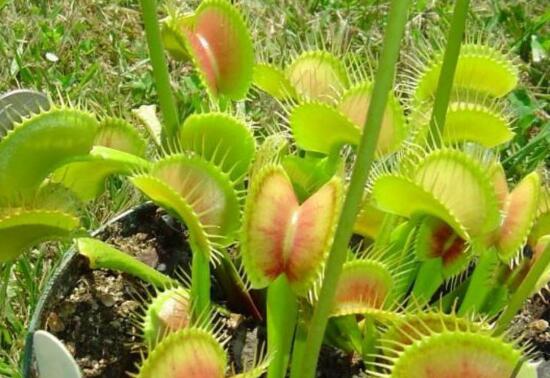
Keeping Venus flytraps indoors is not the same as in the wild; we have to create everything ourselves, and once they are not kept according to Venus flytrap cultivation methods, they will also get pests. So what should you do when Venus flytraps get pests? At this point, do not panic; instead, calmly identify the cause and then address it specifically. If you do not know what kind of pest it is, you can use the following method:
If you are a smoker, then it is very simple: once you find pests on your Venus flytrap, you can solve it with tobacco. Specific steps: put cigarette butts in water and soak for two to three days, then pour that water into the flowerpot, and after a few days the pests will be gone. Of course, this method works slowly; only after identifying the specific pest or disease can you address it specifically. For specific Venus flytrap pest and disease control, let us continue reading below.
2. Venus Flytrap Pests and Diseases
1. Nematodes
Although the Venus flytrap can catch insects, it is also very afraid of pests. According to the editor's research, the pests most often found in Venus flytrap soil by flower enthusiasts are nematodes, and the reason they are attracted is that the soil contains humus.
Symptoms and solutions: Nematodes are divided into ectoparasitic and endoparasitic types. Among them, ectoparasitic nematodes only eat decaying matter, so once found, just change the potting soil; endoparasitic nematodes, however, parasitize inside the Venus flytrap's body and cannot be eradicated.
2. Venus Flytrap Leaf Softening Dehydration Disease
If you want the Venus flytrap's traps to grow large, it needs plenty of sunlight. But many flower enthusiasts find that in summer, their Venus flytraps inexplicably develop soft, yellowing leaves. What is going on? Actually, this means the Venus flytrap is sick, and the disease is leaf softening dehydration disease.
What is Venus flytrap leaf softening dehydration disease? Simply put, the Venus flytrap is a plant that likes light and humid environments. In summer, because the weather is muggy and hot, the water supply cannot meet its requirements while the light is too strong, causing the Venus flytrap to develop leaf softening dehydration disease. In plain terms, you could also say the Venus flytrap has heatstroke.
Solutions for leaf softening dehydration disease: During cultivation, many flower enthusiasts will encounter Venus flytrap leaf softening dehydration disease. At this time, everyone must pay attention and best do the following two things:
① Because it is caused by a high-temperature, high-humidity environment, once you find the Venus flytrap has leaf softening dehydration disease, you should immediately stop exposing it to sunlight and stop watering. After 2-3 days, wait until the potting soil naturally dries before watering again, and control the water amount. Note: choose the cool evening or nighttime to water.
② The previous method is for cases where the disease is not severe. If the disease is severe, besides cutting off the diseased leaves, you also need to repot, pour out the substrate, and wait until the substrate naturally air-dries to a loose state before using it again.
3. Soft Rot
One of the Venus flytrap pests and diseases, it is the most serious disease harming Venus flytraps; after onset, the plant will gradually die.
Solution: For soft rot, mainly take preventive measures, spraying once a month with a 600-800 times dilution of 50% carbendazim, or a 1000 times dilution of thiophanate-methyl for control.
Although it is a bit odd for a plant that can catch insects to also fear pests, as long as it is a plant, it ultimately cannot escape pest damage. Thinking about it this way, one can let it go, since nature is just that amazing. Regarding pest and disease control for pitcher plants, the editor will introduce it here. I believe everyone will know what to do when encountering pests or illness in pitcher plants again!
Venus Flytrap Leaf Softening Dehydration Disease Prevention and Control
What Is Venus Flytrap Leaf Softening Dehydration Disease?
Although the Venus flytrap is a plant that likes light, it also greatly needs a humid growing environment. In summer, because the weather is muggy and hot, the water supply cannot meet its requirements while the light is too strong, causing the Venus flytrap to develop leaf softening dehydration disease. In plain terms, you could also say it has heatstroke.
Solutions for Leaf Softening Dehydration Disease
① Stop exposing it to sunlight and stop watering. After 2-3 days, wait until the substrate naturally dries before watering again, and control the water amount. Choose the cool evening or nighttime to water.
② Cut off the diseased leaves. If the condition is severe, you need to repot, pour out the substrate, and wait until the substrate naturally air-dries to a loose state before using it again.
③ Appropriately use some leaf fertilizer (best not to)
Observe for a few days and it can generally recover on its own. Beginners must remember not to assume that just because a plant's leaves become soft and yellow in summer, it is lacking water and blindly water it! Both too much and too little water for a plant will affect growth. This method applies to various plants.
As shown in the figure, you will find that both sides of the leaf begin to yellow and dry out, lacking chlorophyll, which is a sign of onset. The leaf is weak and limp, much like a collapsed leaf, but in summer, for a plant that should have upright leaves, this is abnormal. Many people wonder why it was upright at first and then suddenly went soft...
Venus Flytrap
Other Names for Venus Flytrap
The Venus flytrap is also called Venus's flytrap, insect-eating grass, insect-catching grass, fly's hell, ground pearl, etc.
Growth Habits
A perennial herbaceous plant native to North America. It belongs to the insect-eating tribe, Droseraceae family, genus Dionaea.
The Venus flytrap prefers to survive in environments with ample water and acidity.
After the Venus flytrap germinates from seed, it can mature, bloom, and fruit after 4~5 years. If cared for well, the Venus flytrap can live at least 20~30 years.
In summer, the lower part of the Venus flytrap's leaves is slender and extends into the air, while in other seasons the lower part of the leaves is short and wide and lies close to the ground. When light is ample, the inner side of the traps takes on a pale red color; after autumn begins, the traps turn red; during winter dormancy, the leaves basically wither.
Variety Classification of Venus Flytrap
To date, there are more than 600 horticultural varieties of Venus flytrap, most of which are mutant varieties or hybrid varieties produced through tissue culture. Well-known mutant varieties include:
Baron Venus flytrap, toothed Venus flytrap, B52 Venus flytrap, flower market Venus flytrap, alien Venus flytrap, shell Venus flytrap, etc.